
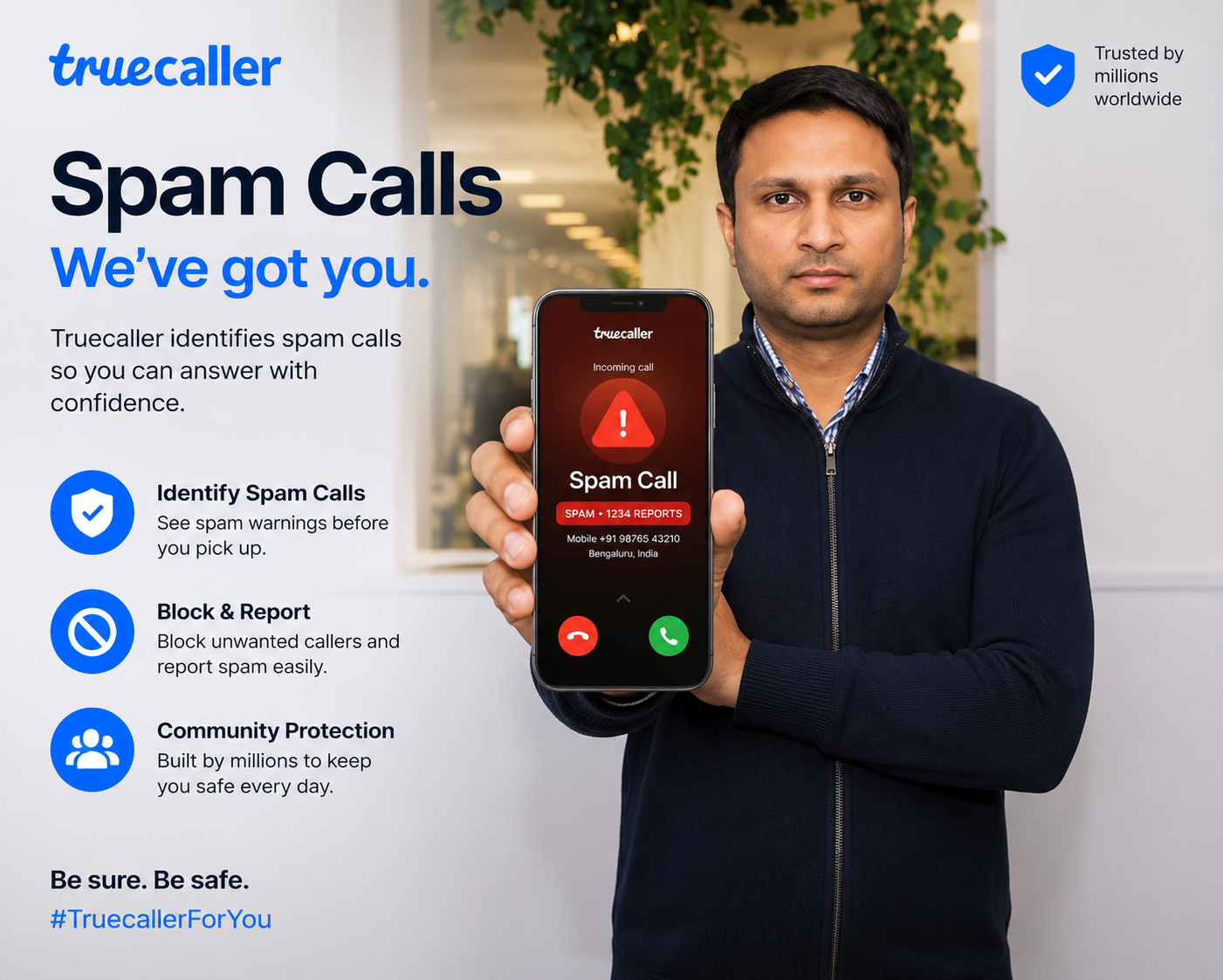
If your smartphone has been ringing incessantly with unknown numbers over the past few weeks, you are definitely not alone. Millions of mobile subscribers across India are currently experiencing an unprecedented deluge of telemarketing pitches and automated robocalls. While many hoped that recent regulatory overhauls would finally bring peace to their digital lives, the reality on the ground is starkly different.
The Truecaller spam calls breakout has turned into a massive regulatory showdown, and according to the company’s chief executive officer, the worst is yet to come.
In a surprisingly candid and detailed public disclosure, Truecaller CEO Rishit Jhunjhunwala took to social media platform X to issue a stark warning to the public. He explained that the very rules designed by the Telecom Regulatory Authority of India (TRAI) to protect consumers have inadvertently backfired, triggering a massive surge in unanswered calls, community distrust, and manual number blocking across the country.
The Root of the Problem: Understanding the 140 and 1600 Mandate
To understand why your phone will not stop ringing, we have to look back at a major policy introduced by the Indian telecom regulator. In an effort to clean up the commercial communication ecosystem, TRAI established a dedicated numbering framework. Under this system, specific number prefixes were assigned to businesses to help consumers distinguish between promotional noise and essential services:
The 140 Series: Reserved strictly for promotional telemarketing and advertising campaigns.
The 1600 Series: Earmarked for the Banking, Financial Services, and Insurance (BFSI) sector to deliver transaction-related alerts, OTPs, and critical service updates.
On paper, this sounds like a flawless strategy. If a consumer sees a number starting with 1600, they know it is likely their bank reaching out about an account balance or a credit card transaction. If they see 140, they can safely ignore it as a sales pitch.
However, the execution of this framework has hit a massive roadblock due to an accompanying directive that disabled standard safety filters.
1. Censoring the Wisdom of the Crowd
The primary reason the Truecaller spam calls problem is spiraling out of control is that TRAI simultaneously mandated that caller ID applications must not display community-reported spam flags on any numbers belonging to these official series.
For over a decade, crowdsourced data has been the backbone of modern call-screening apps. When thousands of users manually flag a specific telemarketer, the system updates in real time to protect the rest of the community. By forcing Truecaller to whitelist the entire 140 and 1600 series, the regulator effectively blinded the application’s core feature.

“This happened right in front of our eyes, and we are mandated not to tell our users that those calls are spam,” Jhunjhunwala expressed in his public statement.
Because the app is legally restricted from showing red spam alerts for these ranges, spammers operating within these series are hidden behind a shield of official legitimacy.
2. Aggressive Misuse by Major Corporate Entities
The second shocking reason for this crisis is the widespread abuse of the system by businesses themselves. The 1600 series was explicitly created for transaction-specific, critical service updates. It was supposed to be a safe channel for fraud alerts, account updates, and loan disbursement confirmations.
Instead, banks, non-banking financial companies (NBFCs), mutual fund houses, and insurers have begun using these “trusted” channels to push cold-call marketing agendas. Regular consumers are repeatedly bombarded with calls from 1600-prefix numbers offering unwanted personal loans, pre-approved credit cards, and insurance policy renewals.
Because these lines are whitelisted by regulatory decree, corporate entities know they can bypass the community filter completely, exploiting the lack of a spam tag to force their way onto user screens.
3. A Massive Collapse of Consumer Trust
When a consumer answers a 1600 number expecting an urgent banking update, only to find an automated voice pitching a pre-approved loan, trust evaporates instantly. This regular frustration has caused a massive drop in answer rates across the country.
According to internal statistics shared by Truecaller, a staggering 51 million calls originating from the 140 and 1600 series go completely unanswered every single day in India. Over the last eight months, users have actively ignored 81 percent of all calls from the 140 promotional series and 79 percent of all calls from the 1600 banking series.
This creates what Jhunjhunwala describes as a classic “lose-lose situation”. Legitimate businesses trying to convey crucial information are left stranded because consumers refuse to pick up their phones, while the consumers remain trapped in a state of constant annoyance.
4. The Explosion of Manual Blocking Actions
Faced with a lack of automated spam alerts, Indian consumers have taken matters into their own hands through mass manual blocking. The scale of this user-led resistance highlights the severity of the current situation.
| Metric | Recorded Inbound Data |
| Total Manual Blocks (Past 8 Months) | 7.4 Crore (74 Million) blocks |
| Daily 140-Series Manual Blocks | ~4,00,000 blocks per day |
| Daily 1600-Series Manual Blocks | ~1,25,000 blocks per day |
| 1600-Series Blocking Growth Rate | Triple (+208%) since October 2025 |
The fact that manual blocking of the supposedly safe 1600 series has more than tripled in less than a year proves that the current regulatory architecture is fundamentally disconnected from the actual consumer experience.
5. Escalating Tension Between Platforms and Regulators
The final and perhaps most worrying aspect of this ongoing saga is the looming regulatory battle between third-party applications and government watchdogs. To offer users some measure of protection without violating the direct whitelisting mandate, Truecaller developed an alternative workaround: the “Frequently Blocked” badge.
If a specific number from the 1600 or 140 series is blocked by a massive percentage of users, Truecaller displays a neutral warning badge on the incoming call screen. It does not label the call with a red spam indicator, but it quietly alerts the subscriber that the number is highly unpopular.
However, even this middle-ground compromise has drawn the ire of the regulator. Reports indicate that TRAI is currently seeking broader powers under India’s Information Technology Act to legally penalize caller ID platforms like Truecaller, Hiya, and Whoscall for displaying any crowdsourced intelligence on these dedicated series.
What Lies Ahead for Indian Mobile Subscribers?
If caller ID platforms are entirely restricted from providing context on these numbers, the protective barrier for hundreds of millions of users will disappear. Jhunjhunwala strongly emphasized that wiping out community data is an unacceptable move that will only benefit bad actors.
“We are the good actors who are helping hundreds of millions of Indians every day, including the vulnerable elderly, to have a trusted communication experience,” Jhunjhunwala noted. “Instead, they want to enable bad actors and give them an open playground to spam and scam us by censoring community information.”
Truecaller plans to formally present its comprehensive data logs to the Ministry of Electronics and Information Technology (MeitY) in the coming weeks. The platform argues that any modern regulatory framework must remain firmly evidence-based. The emphasis of the authorities should ideally pivot toward heavily penalizing the specific corporate entities misusing the lines, rather than muzzling the digital tools designed to expose them.
Until a functional balance is achieved between regulatory oversight and crowdsourced data, Indian smartphone users should prepare for a very noisy future. Be cautious with incoming commercial calls, double-check your security settings, and make frequent use of manual block tools to protect your personal digital space.