
The India ethanol expansion strategy is moving through a massive shift that goes way beyond ordinary automobile fuel tanks. For more than ten years, the country’s biofuel policy had a straightforward roadmap: mix ethanol into petrol, cut down expensive foreign crude oil bills, and back local farmers.
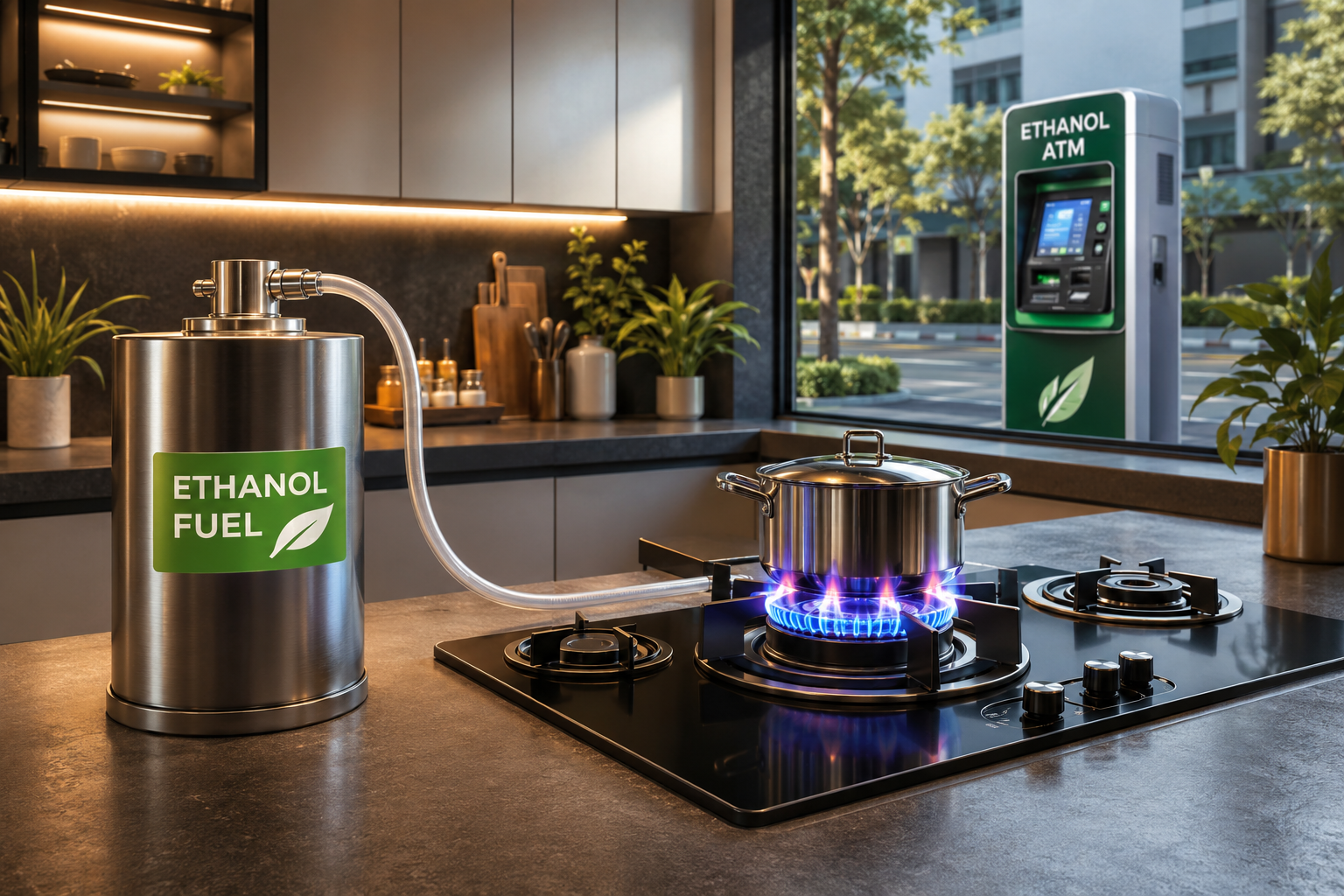
But with the national E20 blending target cleared way ahead of schedule, government planners are setting up a much broader playbook. Recent updates reveal that the central administration is building a solid framework to introduce ethanol directly into household kitchens. Under this retail setup, families could soon purchase ethanol canisters right from neighborhood “ethanol ATMs” to power their cooking stoves. Far from just a futuristic concept, this project marks a highly calculated move to clean up and utilize an incoming local ethanol production surplus.
1. Navigating the Challenge of Production Surplus
The national ethanol blending initiative has easily been one of the most successful energy moves executed in recent memory. Total blending levels skyrocketed from a tiny 1.5% a decade ago to a solid 20% today. This rapid growth saved the national treasury over ₹1.4 lakh crore in foreign reserves while channeling massive cash flows to regional distilleries and rural farming hubs.
However, this policy clarity sparked a massive rush of private funding. Sugar crushing mills quickly built out their processing lines, while grain-based ethanol distillers set up large-scale units across states like Uttar Pradesh, Bihar, and Maharashtra.
Today, India’s total ethanol production capacity is touching 20 billion (2,000 crore) litres annually. On the flip side, oil marketing companies (OMCs) only need around 1,100 crore litres per year to run the 20% petrol blending rule. This leaves an extra supply cushion of nearly 900 crore litres, pushing the government to unlock new domestic uses—turning a massive supply glut into a major economic win.
2. Massive Rice Allocation for the 2026-27 Supply Year
To ensure a continuous supply flow for this massive refinery setup, the central Food Ministry has heavily scaled up its grain distributions. For the upcoming Ethanol Supply Year (ESY) 2026-27, which kicks off in November 2026 and wraps up in October 2027, officials have securely locked in 72 lakh tonnes of rice from Food Corporation of India (FCI) granaries specifically for these distilleries.
This is a noticeable jump from the 52 lakh tonnes set aside during the 2025-26 run. By locking down these specific grain volumes at a set rate of ₹2,390 per quintal, the administration is giving distillers a predictable baseline, shielding the entire green energy sector from sudden crop price spikes.
┌────────────────────────────────────────────────────────┐
│          ETHANOL SUPPLY YEAR RICE ALLOCATION           │
├────────────────────────────────────────────────────────┤
│ Previous Cycle (2025-26)   : 52 Lakh Tonnes            │
│ Upcoming Cycle (2026-27)   : 72 Lakh Tonnes            │
│ Broken Rice Open Pool      : 55 Lakh Tonnes            │
└────────────────────────────────────────────────────────┘
3. The Broken Rice Incentive: Boosting Distillery Economics
Alongside the standard FCI reserves, the ministry is putting an extra 55 lakh tonnes of 100% broken rice on the table, sourced via the Rice Milling Transformation (RMT) program. This specific stock will be sold off through open electronic auctions with a starting floor price of ₹2,000 per quintal, which a specialized committee will review every quarter.
For biofuel makers, this creates an incredibly profitable opening. State oil firms buy ethanol made from regular FCI rice at ₹58.50 per litre, but that buying price climbs to ₹64 per litre if the ethanol is processed from broken rice grains. Since these e-auctioned broken stocks don’t carry tight end-use restrictions, distilleries can aggressively tap into this cheaper raw material to maximize their operating margins.
4. Climate Proofing the Energy Supply Chain
Banking entirely on crops like sugarcane or maize to fuel the nation brings high environmental risks, especially when monsoon patterns turn erratic. A poor rainy season can instantly dent crop harvests, creating a massive roadblock for the country’s clean energy goals.
By shifting a major portion of the raw material base to central rice pools and broken grain surpluses, the government is insulating its green energy targets from weather shocks. This safety net allows oil companies to run blending operations smoothly even if primary sugarcane fields take a hit from drought or unseasonal rains.
5. From Vehicles to Kitchens: The Dawn of Ethanol ATMs
The most revolutionary part of this new blueprint is taking ethanol directly into Indian homes. Government bodies are collaborating with energy experts and design teams to create an setup where ethanol acts as a direct substitute for traditional LPG cylinders and piped cooking gas.
The planned distribution system features automated “ethanol ATMs”. Consumers will be able to top up and buy secure, standardized canisters containing fuel tailored for specialized home stoves. This move does two massive things at once: it provides a giant domestic market to absorb the incoming manufacturing surplus and lifts a massive subsidy weight off the government’s cooking gas ledger.
6. A Multi-Pronged Strategy for Future Growth
The shift toward household cooking fuel is simply one piece of a much larger puzzle. The government is already running field tests to push blending targets past the 20% mark for passenger vehicles, setting the stage for a major rollout of flex-fuel engines across Indian roads.
At the same time, the local aviation sector is actively studying Sustainable Aviation Fuel (SAF), where ethanol serves as a core baseline ingredient. Once local demand settles into a rhythm, India will be perfectly positioned to operate as a major global exporter of green biofuels, catering to western nations racing to hit net-zero carbon rules.
7. Balancing Food Security and Open Market Mechanics
While backing the green energy push, the food ministry has carefully divided its remaining rice reserves to keep local food markets stable and prevent inflation. The stock has been divided among clear commercial and social channels:
Public Kitchens & States: Granted 16 lakh tonnes at ₹2,320 per quintal for the July-October window, and 32 lakh tonnes at ₹2,390 per quintal from November 2026 through June 2027.
Open Commercial Tenders: 25 lakh tonnes are set aside for private merchants and large co-operatives via electronic bidding, with price tags shifting between ₹2,660 and ₹2,970 per quintal depending on the season.
Retailers & Small Traders: Given dedicated access within the open market pool at ₹2,890 to ₹2,970 per quintal to ensure smaller enterprises aren’t priced out.
Premium Broken Stocks: 20 lakh tonnes of rice featuring a 10% broken ratio will be auctioned separately at a higher base range of ₹3,090 to ₹3,180 per quintal.
Meanwhile, direct grain supplies to central co-operatives like Nafed, NCCF, and Kendriya Bhandar for discounted retail under the ‘Bharat’ label have been temporarily put on hold, with final quantities to be updated down the line.
The Bottom Line
India’s biofuel push has outgrown the basic goal of just cutting down oil imports. By combining a massive domestic production network, huge grain buffers, and highly creative consumer uses like kitchen fuel, the country is actively shielding its economy from global energy market shocks. As these programs roll out over the next few months, the kitchen stove will stand right next to the modern car in powering India’s green transition.