
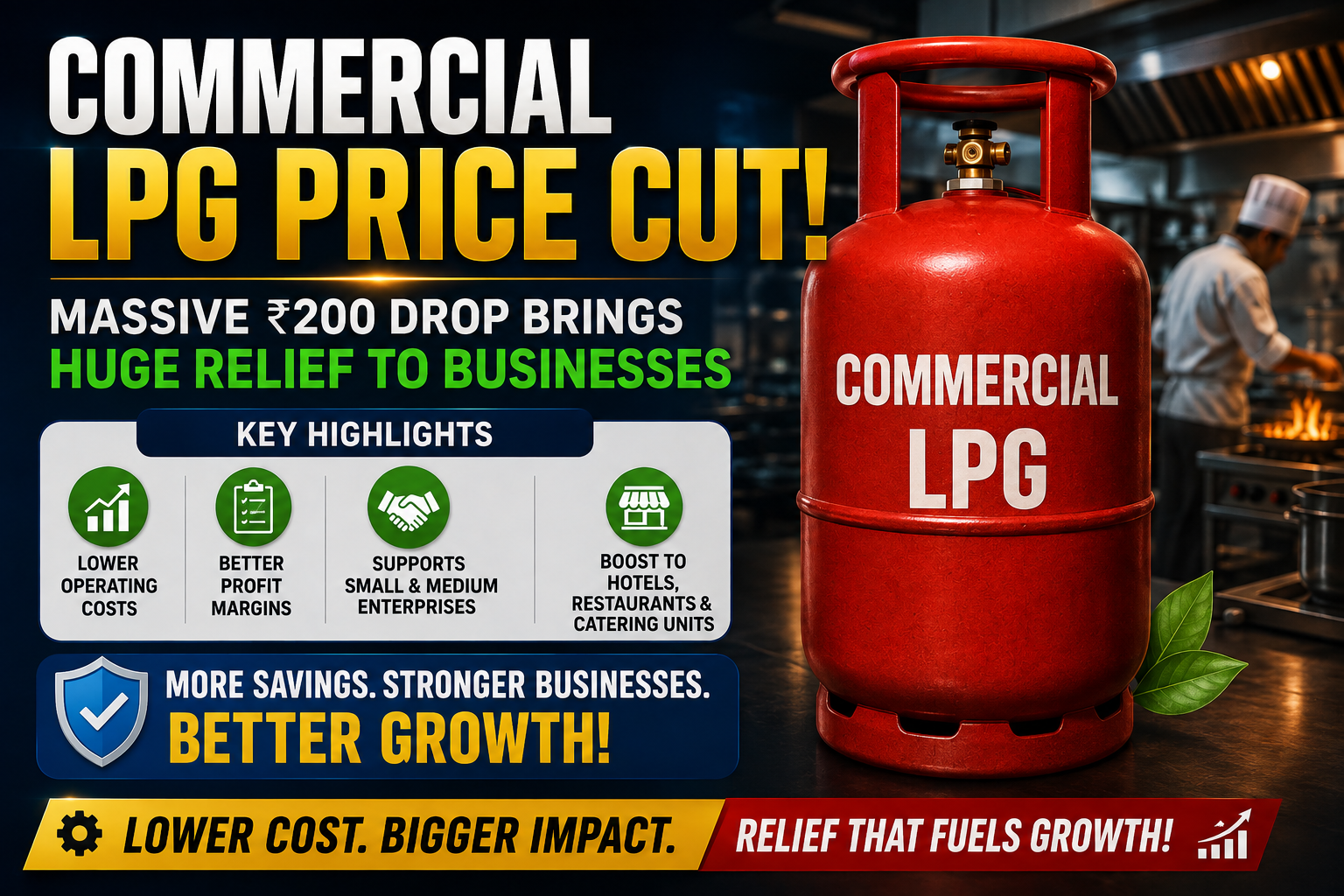
The Commercial LPG Price Cut and this is very good news for small business owners and people who run restaurants. On Saturday August 1 2026 the companies that sell oil in India said they would charge less for cylinders of LPG that hold 19 kilograms. The price of these cylinders is now lower by than ₹200 in big cities like Delhi and Kolkata. This is a change from what we saw before when the price was going up and up because of problems in the world energy market.
This makes a lot of people especially the people who run restaurants and small businesses.. The people who work with airplanes are not so happy. When the price of LPG went down the price of Jet fuel, which is also called Aviation Turbine Fuel or ATF went up a bit. It now costs ₹5 more per liter. With this mixed news the food and hospitality industries are relieved because they do not have to spend as much money on cooking gas. These industries have been having a time because their costs were very high and they were not making as much money as they wanted to. The price cut for LPG is a big help, to them.
Breakdown of Revised Fuel Rates Across India
The latest price adjustment reflects a sharp downward trend for commercial users, while domestic household rates remain entirely untouched. Below is the city-wise breakdown of the newly implemented rates taking effect immediately.
Commercial 19-kg LPG Cylinder Prices
Delhi: Price slashed by ₹202, bringing the revised cost down to ₹2,728 per 19-kg cylinder.
Kolkata: Price reduced by ₹209, bringing the new price to ₹2,872.50 per cylinder.
5-kg FTL Cylinders: Free Trade LPG (FTL) 5-kg cylinders have also become cheaper by ₹46, benefiting smaller roadside eateries and mobile vendors.
Domestic LPG and Aviation Fuel Status
14.2-kg Domestic Cylinders: Prices for household cooking gas cylinders remain strictly unchanged, ensuring rate stability for everyday consumers.
Aviation Turbine Fuel (ATF): Jet fuel prices saw an upward revision of ₹5 per litre, which could subtly impact airline operational expenses over the coming weeks.
Why Are Commercial Gas Prices Falling?
To understand the reason behind this significant price break, one must look at global energy supply chains. Over the past few months, the ongoing conflict in West Asia and geopolitical tensions involving Iran disrupted Middle Eastern supply routes. This uncertainty led to a series of aggressive price hikes in domestic and commercial fuels worldwide.
However, recent reports suggest a gradual easing of shipping bottlenecks and supply constraints in West Asia. This stabilization in global crude and gas markets allowed Indian oil marketing companies to pass on the benefits directly to commercial buyers. This decision marks the second consecutive monthly reduction in commercial LPG rates, following a similar downward adjustment in July.
Government Preparedness and High-Level Energy Reviews
The price announcement follows intense government scrutiny regarding national fuel reserves. Prime Minister Narendra Modi chaired an extensive, two-hour high-level review meeting in Parliament to assess India’s economic and energy readiness amid global instability.
The meeting brought together key cabinet figures and top security leadership, including:
Home Minister Amit Shah
Defence Minister Rajnath Singh
External Affairs Minister S. Jaishankar
Finance Minister Nirmala Sitharaman
Petroleum Minister Hardeep Singh Puri
Commerce Minister Piyush Goyal
Shipping Minister Sarbananda Sonowal
National Security Advisor Ajit Doval
During the meeting, officials evaluated India’s fuel reserves, import logistics, and maritime security. The government reaffirmed that despite ongoing geopolitical friction, there is no shortage of LPG, petrol, or diesel anywhere in the country.
Strategic Shift: India Diversifies LPG Imports Beyond Middle East
A major takeaway from recent energy management developments is India’s proactive strategy to secure long-term energy security by diversifying its supplier network.
According to global trade data, India is actively scaling up spot purchases and long-term contracts with non-Middle Eastern nations. Most notably, India plans to source up to 25% of its total LPG imports from the United States by 2027.
Key Highlights of India’s Import Diversification Strategy:
Record US Imports: In June alone, India’s US LPG imports surpassed the 1 million tonne mark for the first time in history.
Surpassing Annual Targets: Total US imports are projected to easily exceed the initial 2026 contract benchmark of 2.2 million tonnes.
Risk Mitigation: By relying less on vulnerable transit bottlenecks like the Strait of Hormuz, India is safeguarding its domestic market against abrupt price spikes and supply disruptions.
Economic Impact on Hospitality and Small Enterprises
The food service industry is undoubtedly the biggest beneficiary of this latest price slash. For months, owners of restaurants, hotels, bakeries, and local dhabas were forced to absorb high fuel costs or risk alienating customers by raising menu prices.
“Running a commercial kitchen during peak inflation tested our limits,” shared a Delhi-based restaurant owner. “A drop of over ₹200 per cylinder directly reduces our monthly overhead. It gives us room to keep menu rates stable for our customers without sacrificing quality.”
For small-scale street food vendors who rely heavily on 5-kg free trade cylinders, the ₹46 price drop brings immediate day-to-day liquidity, helping micro-businesses maintain steady profit margins.
What Lies Ahead for Consumers and Businesses?
While the commercial sector enjoys immediate relief, market analysts advise cautious optimism. Because global energy markets remain sensitive to international political developments, domestic fuel prices will continue to depend on import costs and foreign exchange fluctuations.
For now, the government’s dual approach—securing alternative energy corridors with allies like the US while passing international cost reductions directly to commercial users—offers a stable path forward. Businesses can breathe easier this month, knowing that fuel expenses have finally taken a turn for the better.