
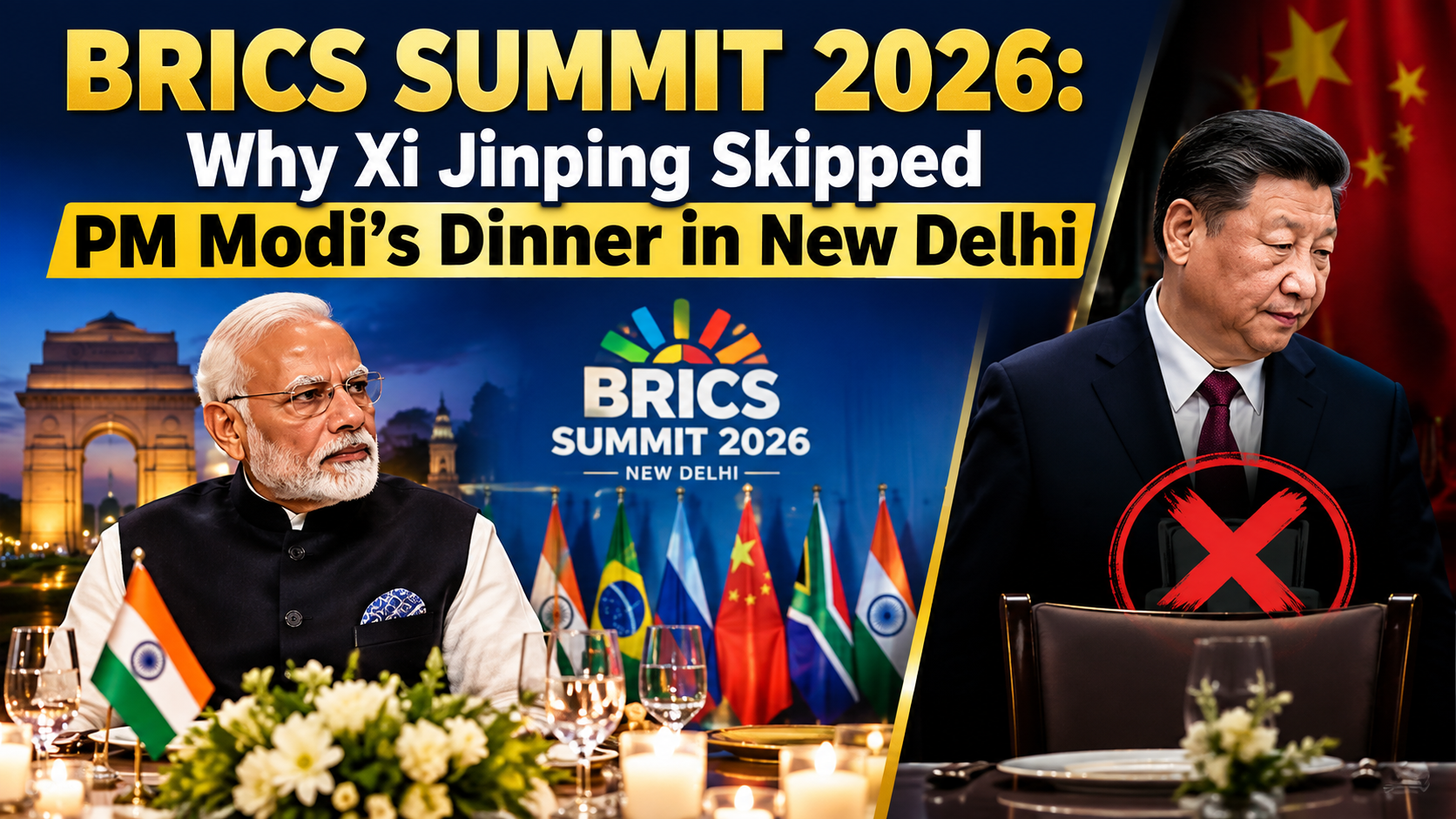
The big BRICS Summit 2026 hosted by India in New Delhi brought together leaders from growing countries but one thing stood out on the first day of the event. The official dinner at the opening was attended by many. Chinese President Xi Jinping did not show up. The dinner was held at Delhi’s Bharat Mandapam and hosted by Prime Minister Narendra Modi.
The choice to skip the dinner made a lot of people in the field of policy and international relations wonder why. This happened after a major meeting, between the two leaders that took place during the summit.
5 Quick Key Takeaways from the 18th BRICS Summit
Dinner Absence Explained: Chinese President Xi Jinping missed PM Narendra Modi’s welcome dinner due to physical exhaustion and time-zone fatigue following a long flight into New Delhi.
Border Protocol Priority: Both leaders agreed that maintaining peace along the Line of Actual Control (LAC) remains essential for long-term strategic relations.
Economic Strategy: High-level discussions targeted structural trade imbalances, supply chain disruptions, and predictable market access between India and China.
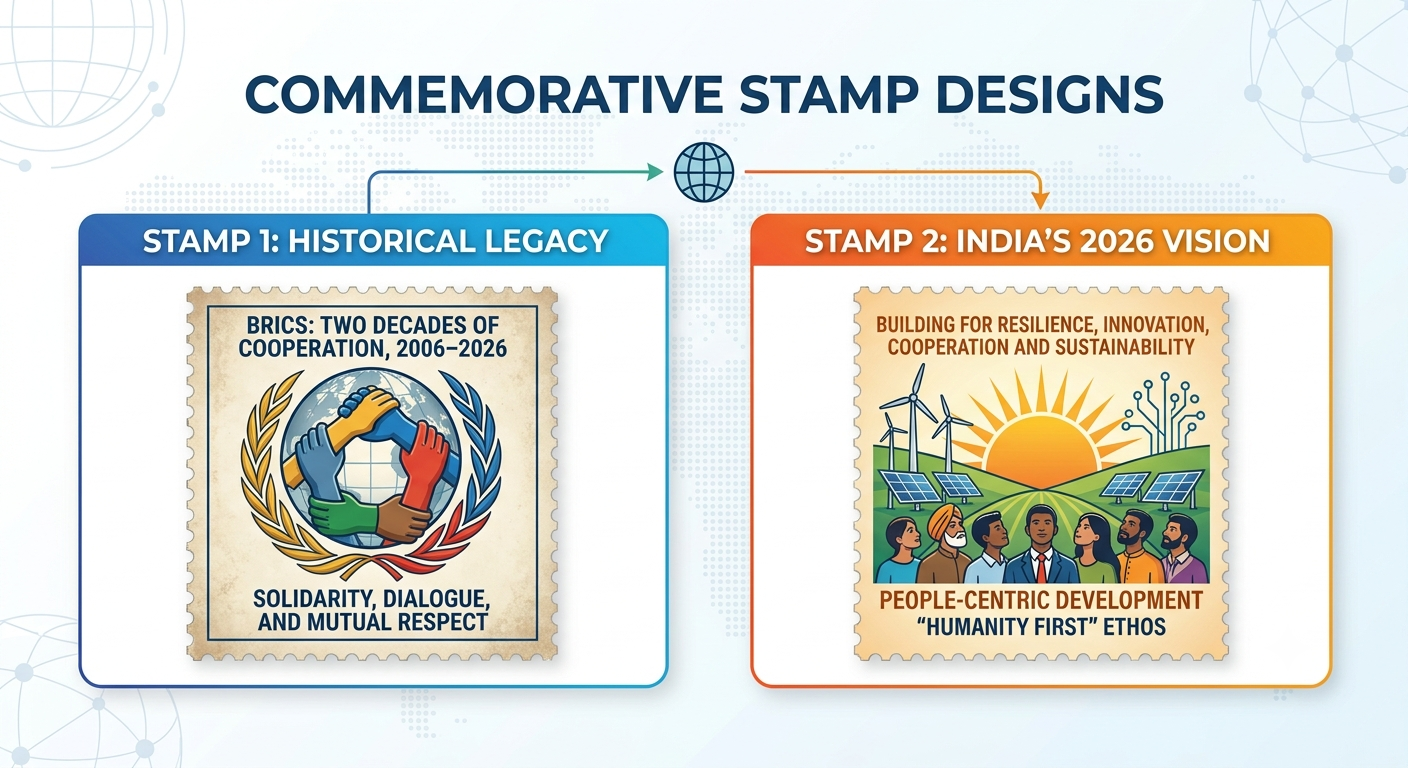
Commemorative Launch: India unveiled two postal stamps marking 20 years of BRICS cooperation (2006–2026) under the theme “Building for Resilience, Innovation, Cooperation and Sustainability.”
Global South Framework: Academic and industry experts highlighted China’s Global Governance and Civilization Initiatives as pivotal drivers for BRICS expansion.
The first day of the BRICS Summit 2026 in New Delhi had a lot of important diplomatic talks major agreements between countries and a lot of attention from the world. One of the discussed moments during the day was that Chinese President Xi Jinping did not attend the official dinner that Indian Prime Minister Narendra Modi hosted at Bharat Mandapam.
Some people wondered why he was not there.. Official people said that President Xi missed the dinner because he was tired from traveling and had jet lag. He arrived in New Delhi in the afternoon on Saturday and then had many meetings with other leaders, including a very important meeting with Prime Minister Modi.
While President Xi went to rest early Russian President Vladimir Putin was at the event, with top Indian government officials. These officials included Union Home Minister Amit Shah, Finance Minister Nirmala Sitharaman, External Affairs Minister S. Jaishankar and several state Chief Ministers.
                    18th BRICS SUMMIT 2026 SUMMARY
───────────────────────────────────────────────────────────────────────

  [Xi Jinping's Absence] ──► Travel Fatigue & Time-Zone Exhaustion

  [PM Modi Bilateral]    ──► "Differences Should Not Become Disputes"
                             Focus: Border Peace & Trade Imbalance

  [Commemorative Launch] ──► Two Postage Stamps Released                                           Celebrating 20 Years of BRICS (2006-2026) │

───────────────────────────────────────────────────────────────────────
Inside the Modi-Xi Bilateral Meeting: “Differences Should Not Become Disputes”
The first day focused firmly on the talks between PM Narendra Modi and President Xi Jinping. This meeting built on the progress that started at their last meeting in Tianjin in August 2025.
During the dialogue PM Modi described a three‑pillar plan to shape future India‑China relations:
- Mutual Respect for national sovereignty and developmental aspirations.
- Mutual Sensitivity regarding concerns and domestic priorities.
- Mutual Interest in keeping regional stability intact.
Both PM Modi and President Xi reaffirmed that neighbour disputes must be handled strategically so that short‑term differences do not turn into lasting conflicts.
Border Tranquility as the Core Foundation
A key point of the discussion was the focus on managing the border. PM Modi said that complete peace along the frontier is a must, for normalising areas.
“Peace and tranquility in the border areas remain an essential basis for the continued development of bilateral relations. Both sides must strictly observe existing agreements and work toward a fair, reasonable, and mutually acceptable boundary solution.” — Official Statement, Ministry of External Affairs (MEA)
Addressing Economic Realities and Trade Imbalances
Beyond security concerns, economic cooperation took center stage. India raised long-standing structural issues affecting bilateral trade, including the widening trade deficit and regulatory hurdles faced by Indian companies seeking market entry in China.
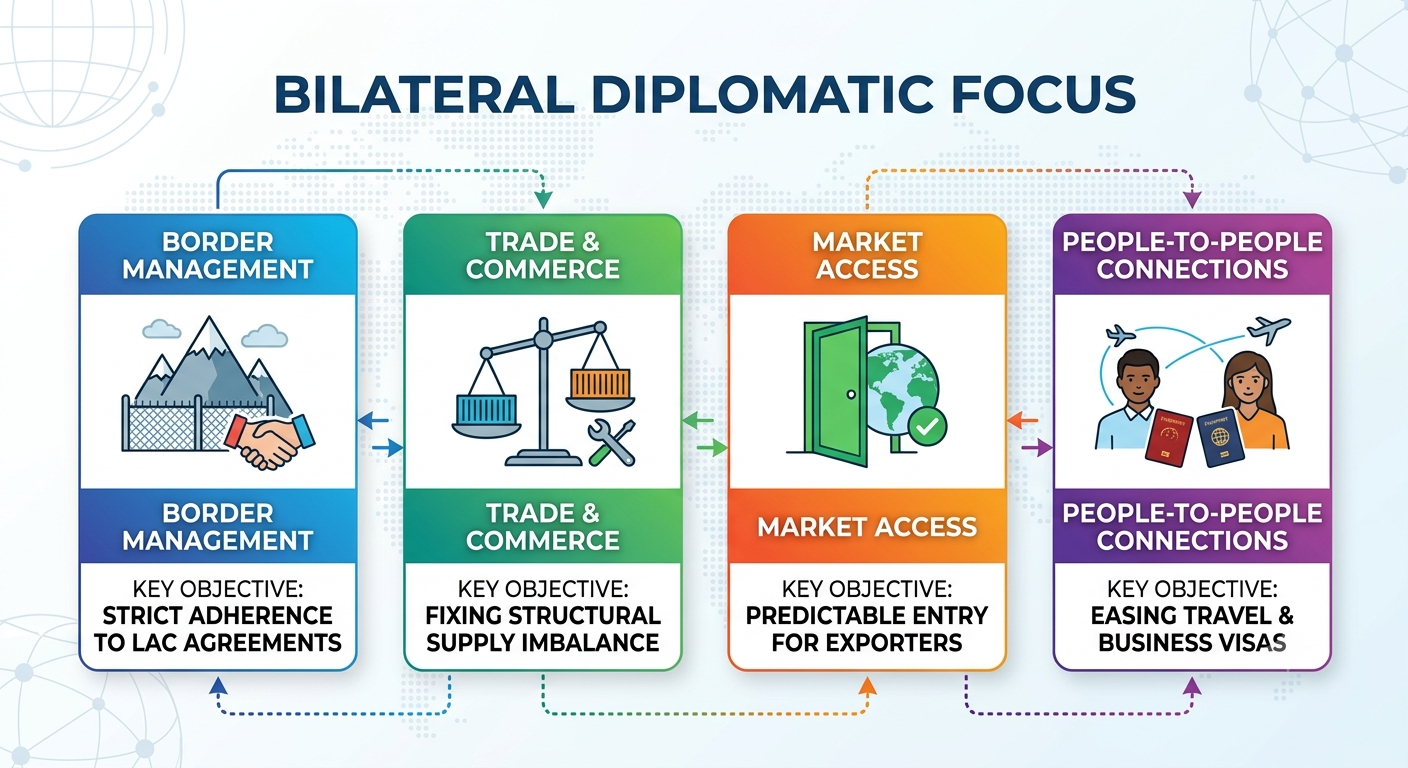
The leaders agreed on creating predictable market access and building resilient supply chains that protect both economies against external global shocks. Furthermore, plans to streamline business mobility, academic exchange programs, and tourism were fast-tracked to rebuild grassroots connections.
Celebrating Two Decades of BRICS: Commemorative Postage Stamps
To mark the milestone 20-year journey of the alliance (2006–2026), PM Modi released two commemorative postage stamps at Bharat Mandapam during the summit
Expert Perspectives: China’s Role in the Evolving BRICS Framework
Analytic voices across industry and academia shared insights on how the New Delhi Summit shapes the future of Global South representation.
Expanding the Scope of Cooperation
Sameep Shastri, Chairman of the BRICS Chamber of Commerce and Industry (India), noted China’s role in pushing the grouping toward broader humanitarian and developmental goals:
Pillars of Growth: China’s five proposed focus areas—Peace, Innovation, Green Development, Justice, and People-to-People Exchange—broaden the conversation beyond standard trade metrics.
Strategic Unity: These initiatives help sync developmental priorities across both core members and newly inducted BRICS+ partner nations.
Strengthening Global Governance
Prof. B.R. Deepak from the Centre for Chinese Studies at Jawaharlal Nehru University highlighted China’s manufacturing strength and global policy contributions:
Manufacturing Backbone: With China accounting for nearly one-third of global manufacturing output, its industrial stability directly benefits emerging markets.
Civilizational Respect: Global initiatives led by emerging economies promote mutual respect regardless of a nation’s size, economic scale, or political system.
Frequently Asked Questions (FAQs)
Why did Xi Jinping miss the BRICS dinner hosted by PM Modi?
President Xi Jinping skipped the dinner due to extreme travel fatigue and time-zone adjustments following his flight into New Delhi on Saturday afternoon.
What are the “Three Mutuals” mentioned during the Modi-Xi bilateral meeting?
The “Three Mutuals” outlined by PM Narendra Modi are Mutual Respect, Mutual Sensitivity, and Mutual Interest. They serve as foundational principles for stabilizing India-China relations.
Where is the 18th BRICS Summit being held?
The 18th BRICS Summit (2026) is hosted in New Delhi, India, with main events taking place at the Bharat Mandapam convention complex.
What was the theme of India’s BRICS Chairship in 2026?
The official theme for India’s 2026 chairship is “Building for Resilience, Innovation, Cooperation and Sustainability.”
The Path Ahead for BRICS
As the summit concludes, New Delhi’s hosting of this 20th-anniversary milestone demonstrates the bloc’s growing role in steering global economic policies. The positive tone of the Modi-Xi bilateral meeting, combined with concrete steps toward addressing trade and border issues, signals a pragmatic chapter for regional stability.