
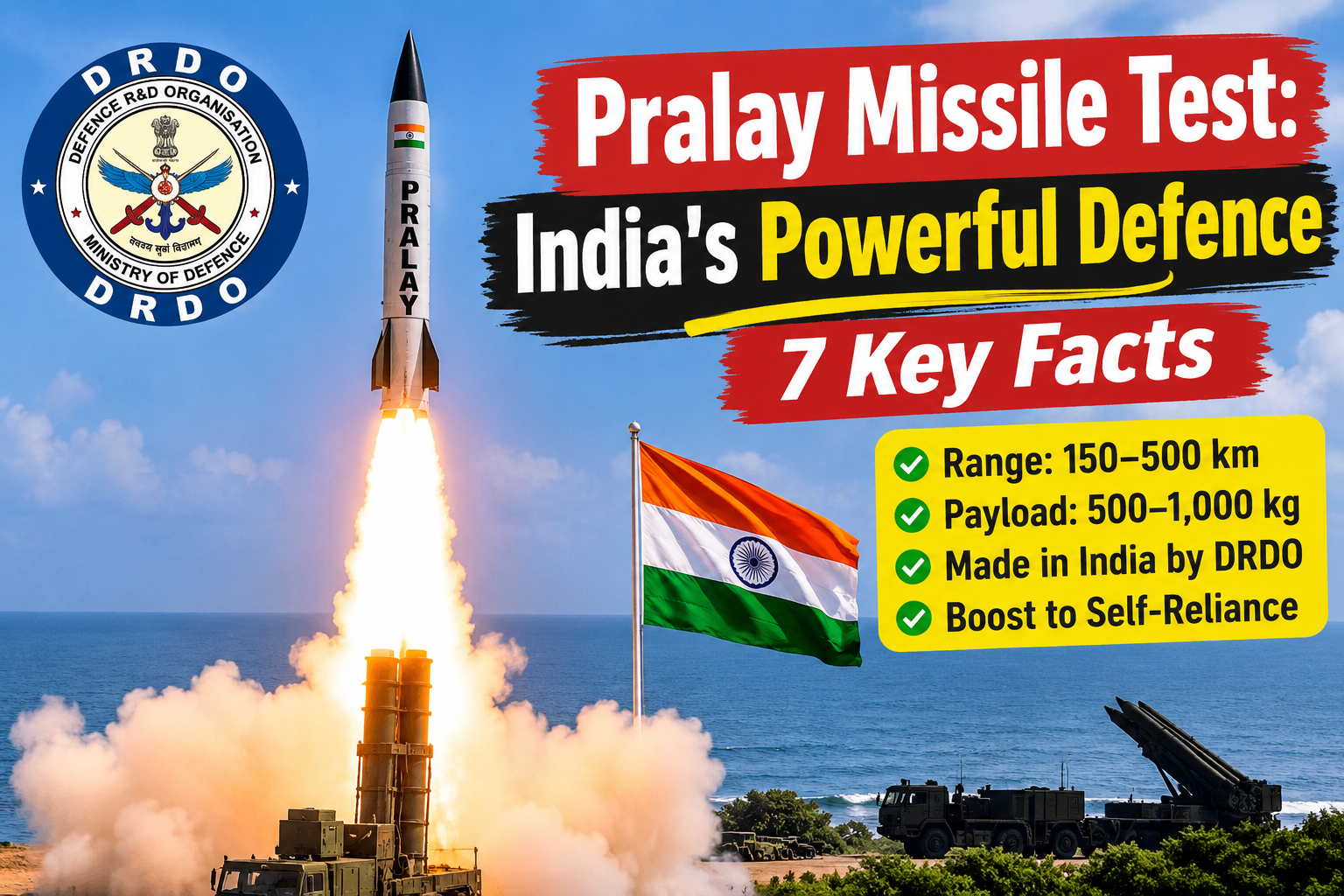
Pralay Missile Test marks another important achievement in India’s efforts to strengthen its indigenous defence capabilities. The successful flight trial of the domestically developed quasi-ballistic missile off the Odisha coast has brought the country’s growing missile development programme into focus.
India has successfully test-fired its indigenously developed Pralay missile from Dr APJ Abdul Kalam Island off the Odisha coast. The Defence Research and Development Organisation (DRDO) conducted the flight test on Thursday at 11:10 am as part of the missile’s user evaluation trials.
According to the Ministry of Defence, the missile successfully achieved all the objectives set for the trial. Data collected through various tracking and monitoring instruments confirmed that the test met the required performance parameters.
The development is significant because Pralay is not simply another addition to India’s missile inventory. It represents the country’s growing ability to design, develop and manufacture advanced conventional missile systems using domestic technology and industrial capabilities.
With a reported operational range of 150 to 500 kilometres and the ability to carry conventional warheads weighing between 500 kg and 1,000 kg, Pralay is being developed to provide the Indian armed forces with an additional tactical strike capability.
The Defence Ministry has also indicated that the successful trial brings the missile system closer to induction into the armed forces.
Pralay Missile Test: What Happened During the Latest Trial?
The latest flight test was conducted from Dr APJ Abdul Kalam Island, an important missile testing facility located off the coast of Odisha.
The trial formed part of the user evaluation process, during which the missile’s performance is assessed against the requirements of its intended military users.
The Ministry of Defence confirmed that all stipulated objectives were successfully achieved. Instruments deployed by the Integrated Test Range (ITR), Chandipur, collected the necessary flight data to evaluate the missile’s performance.
Defence Minister Rajnath Singh also confirmed the successful test and congratulated the DRDO, the armed forces and the industry partners involved in the programme.
The successful evaluation is an important step towards the next stage of the missile’s development. However, completing a flight test does not automatically mean that the system has entered operational service. Further procedural and induction-related requirements may still need to be completed.
The Defence Ministry’s statement that induction has become imminent indicates that the programme has reached an important stage.
What Is India’s Pralay Missile?
Pralay is an indigenously developed, solid-fuel-powered, quasi-ballistic surface-to-surface missile designed to carry conventional warheads.
Unlike traditional ballistic missiles, which generally follow a more predictable trajectory after their powered flight phase, quasi-ballistic systems are designed to offer greater flexibility in their flight profiles.
This characteristic can make interception more challenging for certain missile defence systems, although actual effectiveness depends on several factors, including flight behaviour, target location and the capabilities of opposing defence systems.
Pralay has been developed to provide a tactical strike option against selected military targets.
Its reported range of 150 to 500 kilometres gives it a role between shorter-range battlefield weapons and longer-range strategic missile systems.
The missile can carry different types of conventional warheads, allowing it to be configured for different operational requirements.
Its solid-propellant propulsion system is another important feature. Solid-fuel missiles are generally easier to store and prepare for launch compared with liquid-fuel systems that require more complicated fuelling procedures.
This can provide practical advantages in military operations, particularly when rapid deployment and operational readiness are important.
Pralay Missile: Important Specifications
The following are the key publicly reported specifications of the missile.
- Missile Name: Pralay
- Developer: Defence Research and Development Organisation (DRDO)
- Category: Quasi-ballistic surface-to-surface missile
- Propulsion: Solid propellant
- Reported Range: 150–500 kilometres
- Payload Capacity: 500–1,000 kg
- Warhead Type: Conventional
- Launch Location: Dr APJ Abdul Kalam Island, Odisha
- Testing Organisation: DRDO
- Development-cum-production partner: Bharat Dynamics Limited
These specifications highlight the missile’s intended tactical role. Its range and payload capacity provide flexibility for different conventional strike requirements.
It is important to note that operational performance can depend on the missile configuration, payload, mission profile and other technical factors.
Advanced Guidance and Navigation: The Technology Behind Pralay
One of the important parts of the Pralay programme is its guidance and navigation technology.
A missiles success is not about how far it can go or how much it can carry. It is also about how it can reach the target with a lot of accuracy.
According to the Defence Ministry Pralay uses homegrown guidance and navigation systems that are meant to make sure it is very precise.
These systems help the missile stay on the path and change as needed for the mission.
Using guidance systems is very important for regular weapons because the accuracy can directly affect how well the mission works.
A missile that can hit the target accurately might mean fewer attacks are needed and accidental damage but real results depend on where the target is and how the operation goes.
Another key part is the missiles -ballistic flight pattern. This way of flying is different from ballistic missile systems.
For todays forces being able to use different flight paths can give more options when planning operations.
The Defence Ministry has not shared all the technical details about how the missiles guidance works or how it flies. So any specific claims, about its accuracy how it moves or how well it can avoid air defence systems should be looked at carefully unless they are officially confirmed.
Why Is the Pralay Missile Important for the Indian Armed Forces?
The successful test is important for India’s plans to modernise its military.
Modern warfare increasingly relies on the ability to spot and attack targets quickly. Precision‑guided weapons have become a part of this changing battlefield environment.
Pralay is intended to give the forces another option for conventional precision strikes. Its medium‑range tactical role could help meet needs that are different from those served by shorter‑range battlefield weapons or longer‑range strategic missile systems.
There are reasons why the missile programme matters.
1. Strengthening India’s Conventional Strike Capability
Pralay is designed to carry warheads making it relevant to military operations where precision strikes against selected targets may be required.
Pralay’s reported payload capacity of 500 to 1,000 kg gives the forces flexibility in choosing suitable conventional warhead configurations.
This capability could become an addition to India’s existing missile inventory.
2. Greater Operational Flexibility
Pralay’s 150–500 km range provides a strike option across a considerable distance.
Different military situations require weapon systems.
Having missile categories allows defence planners to choose capabilities according to the mission and operational environment.
Pralay could help fill a requirement in this area.
3. Advanced Indigenous Technology
Pralay has been developed through India’s defence research and development ecosystem.
This is important because the ability to develop weapons at home reduces dependence on foreign suppliers for certain defence technologies.
It also allows Indian research organisations and manufacturers to build expertise through long‑term development programmes.
4. Supporting Military Modernisation
The Indian armed forces are continuously working to improve their equipment, technology and operational preparedness.
The development of missile systems is one part of this wider modernisation process.
Pralay’s successful evaluation trial represents progress toward adding another developed capability, to the country’s defence infrastructure.
DRDO and Bharat Dynamics Limited: The Organisations Behind Pralay
The Pralay missile programme shows collaboration between government research bodies and India’s defence manufacturing sector.
The Defence Research and Development Organisation has been at the heart of this effort leading the development of the missile.
Research Centre Imarat in Hyderabad along with DRDO labs has played a key role in making the missile a reality through indigenous innovation.
Bharat Dynamics Limited or BDL is also a part of the project. It is. A development and production partner and has built the missile system.
This partnership matters because creating a missile is not just about designing it and running tests.
A successful defence programme needs research, precise engineering, component development, reliable manufacturing, strict quality control and the ability to produce systems in large numbers.
When domestic companies join projects it bridges the gap between research and real-world production.
For India’s defence industry programmes, like this doors to building specialised manufacturing skills and strengthening the national supply chain.
Rajnath Singh Praises DRDO After Successful Missile Trial
After the flight test ended successfully Defence Minister Rajnath Singh sent his congratulations to DRDO, the defence forces and the industry partners who worked on the programme. I felt very proud to see the results.
Defence Minister Rajnath Singh called this success a milestone that helps strengthen India’s own defence abilities.
Defence Minister Rajnath Singh also pointed out how important the advanced technologies built into the missile were.
The Defence Ministry said the trial proved that the system met all the goals set for it during the user evaluation.
Seeing DRDO officials, defence force leaders and industry participants at the test showed how much the organisations that build and test the missile rely on teamwork.
Defence Secretary and DRDO Chairman Rajesh Kumar Singh also offered his congratulations to the teams that made the flight test a success.
The praise, from defence leaders underlines how much value India places on this programme as it keeps growing its own defence technology foundation.
How Pralay Fits Into India’s Growing Indigenous Missile Programme
India has been investing in the development of different categories of missile systems to address its defence requirements.
The country’s missile development ecosystem includes systems designed for air defence, anti-tank operations, anti-ship missions, strategic deterrence and conventional ground strikes.
Pralay belongs to the tactical surface-to-surface missile category.
Its development reflects an effort to build a wider range of indigenous capabilities rather than depending on a limited number of weapon platforms.
For a country with complex security requirements, maintaining a diverse defence inventory can provide important operational advantages.
Different missile systems serve different purposes. Some are designed to intercept incoming threats, while others are developed to engage targets on land or at sea.
Pralay’s intended role is to provide a conventional strike capability against selected ground targets.
Its successful testing also demonstrates the importance of continued investment in research, testing infrastructure and domestic manufacturing.
India’s ability to develop these systems independently is becoming an increasingly important part of its long-term defence planning.
What Does the Successful Trial Mean for India’s Defence Industry?
The Pralay programme is not only a military development story. It also has wider implications for India’s domestic defence manufacturing sector.
India has been trying to increase the contribution of domestic companies to defence production and reduce reliance on imported equipment.
Indigenous missile development supports this objective by encouraging collaboration between research institutions, manufacturing companies and the armed forces.
Bharat Dynamics Limited’s participation as a development-cum-production partner is an example of how domestic industrial organisations can contribute to advanced defence programmes.
Such partnerships can help strengthen the country’s manufacturing ecosystem in several ways.
First, they support the development of specialised technical knowledge within Indian companies.
Second, they create opportunities for domestic suppliers involved in components, materials and manufacturing processes.
Third, they help build production experience that may be useful in future defence projects.
However, developing a successful prototype and establishing a reliable production programme are two different challenges.
The long-term success of the programme will depend on production quality, supply-chain readiness, maintenance arrangements and the ability to meet the armed forces’ requirements.
The successful trial is therefore an encouraging development, but sustained manufacturing and operational performance will be equally important.
Pralay Missile and India’s Strategic Preparedness
India’s geographical location and security environment require a defence system capable of responding to different types of challenges.
The armed forces need equipment that can support conventional military operations while remaining adaptable to changing battlefield conditions.
Pralay could contribute to this requirement by adding another option for precision conventional strikes.
Its reported range gives it a different operational role from shorter-range weapons.
The quasi-ballistic design also represents an effort to develop missile technologies suited to modern military requirements.
However, it would be premature to assume that one missile system can independently change the overall military balance.
Defence preparedness depends on several interconnected factors, including intelligence, surveillance, command systems, logistics, training, air defence and the availability of different weapon platforms.
A missile’s actual contribution depends on how effectively it is integrated into the broader military structure.
From this perspective, Pralay should be seen as one component of India’s wider effort to modernise its conventional military capabilities.
What Happens Next After the Successful Pralay Trial?
The latest successful test is an important development in the missile’s evaluation process.
The Defence Ministry has indicated that induction of the system has become imminent.
The next stage will involve the necessary procedural steps associated with bringing the missile into service.
These may include completing the required evaluation documentation, finalising user requirements, production planning and other induction-related activities.
The exact timeline for operational deployment has not been publicly established in the information released about this trial.
It is also important to distinguish between a successful test and full operational induction.
A flight test demonstrates the performance of a missile under specified test conditions. Operational deployment requires additional preparation, including manufacturing readiness, trained personnel, logistics and maintenance support.
If the remaining requirements are completed successfully, Pralay could become another important addition to India’s indigenous conventional missile inventory.
Analysis: Is Pralay a Major Step Forward for India’s Defence Capabilities?
The successful Pralay missile trial deserves attention for three main reasons: indigenous technology, operational flexibility and the development of India’s domestic defence manufacturing capabilities.
The first important factor is technological independence.
Advanced missile systems require sophisticated engineering and a strong research ecosystem. Developing such technology domestically allows India to build expertise that can support future defence projects.
The second factor is operational flexibility.
Pralay’s reported range of 150 to 500 kilometres and its conventional payload capacity make it relevant to a specific category of military requirements.
Its quasi-ballistic flight profile and advanced guidance and navigation systems are also important features of its design.
The third factor is industrial development.
The involvement of DRDO laboratories and Bharat Dynamics Limited shows how public-sector research and domestic manufacturing can work together to develop advanced defence equipment.
However, the true value of Pralay will ultimately be determined by its performance beyond testing.
Reliable production, operational integration, maintenance and the ability to meet the armed forces’ requirements will be essential.
There is also an important strategic consideration. Modern military preparedness is not built around a single weapon system. It requires a combination of technologies, trained personnel, effective planning and dependable logistics.
Therefore, Pralay’s successful trial should be viewed as a meaningful addition to India’s broader defence modernisation efforts rather than a standalone change in the country’s military position.
A Strong Achievement for India’s Indigenous Defence Programme
The successful Pralay missile test near the Odisha coast is a sign for Indias homegrown defence research and manufacturing setup.
Built by DRDO with help from Research Centre Imarat and other labs the missile uses fuel, modern guidance and navigation systems and can carry a regular warhead.
It is said to have a range between 150 and 500 kilometers making it a tactical weapon in Indias expanding missile collection.
The involvement of Bharat Dynamics Limited also shows how important it is to work with manufacturers to turn research and development into actual defence products.
Importantly the successful trial done by the users brings the project nearer to being officially accepted as stated by the Defence Ministry.
For India this success is not about firing a missile. It shows progress in creating advanced defence technologies inside the country.
As the project moves forward how ready it is, for production how reliable it is when used and how well it works with the military will decide how much it helps the countrys defence in the future.
India’s Pralay missile programme is another important step towards building a stronger, more technologically capable and self-reliant defence sector.