
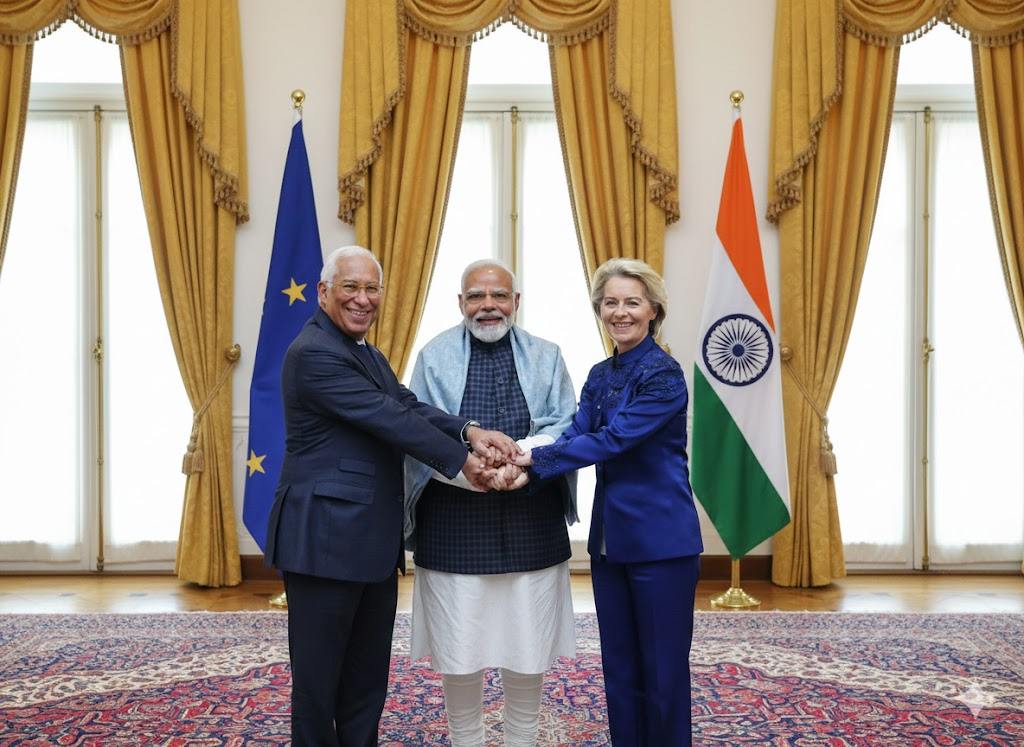
‘Mother of All Deals’: India-EU FTA to Reshape Global Trade and Boost ‘Make in India’. In a historic move being hailed as the Prime Minister Narendra Modi and European leaders today announced the successful conclusion of the India-European Union Free Trade Agreement (FTA). The landmark accord, nearly two decades in the making, is set to create a massive economic corridor connecting 1.9 billion people and representing approximately 25% of global GDP.
Speaking at the 16th India-EU Summit in Delhi, PM Modi emphasized that the deal is more than just a commercial pact; it is a “new blueprint for shared prosperity.” The agreement is expected to provide a decisive boost to India’s manufacturing and services sectors while offering a strategic counterweight to the shifting sands of global trade policy.
A Strategic Pivot in an Unpredictable World
The conclusion of the FTA comes at a critical juncture. With the Trump administration doubling down on a tariff-heavy approach—including 50% duties on certain Indian imports—and the EU facing similar pressures from Washington, both New Delhi and Brussels have looked inward to strengthen their partnership.
The deal also addresses the shared challenge of China’s dominance in critical technologies. By integrating India more deeply into European supply chains, the FTA aims to de-risk economies and provide a reliable alternative for manufacturing in sectors like solar energy, semiconductors, and green technology.
“People around the world are discussing it as the ‘Mother of All Deals’. This agreement represents approximately 25% of global GDP and about one-third of global trade. It has become a wonderful example of synergy between two of the world’s major economies.” — Prime Minister Narendra Modi
Key Winners: Labour-Intensive Sectors
For India, the most immediate impact will be felt in its labour-intensive industries. Currently, Indian exporters in sectors like textiles and leather face significant tariff disadvantages compared to countries like Bangladesh or Vietnam. This FTA levels the playing field.
Major Beneficiaries of Zero-Duty Access:
- Textiles and Apparel: Immediate duty elimination on exports worth billions.
- Marine Products: Tariffs currently as high as 26% will be removed.
- Gems and Jewellery: Expected to see a surge in exports to the EU’s luxury markets.
- Footwear and Leather: High tariffs of up to 17% will be slashed to zero.
What Becomes Cheaper for Indian Consumers?
The deal isn’t just a win for exporters; it’s a boon for the Indian consumer. The agreement outlines a phased reduction of duties on iconic European goods, making luxury and high-quality products significantly more accessible.
| Product Category | Current Tariff | Future Tariff (Phased) |
| Luxury Cars | 110% | 10% (within quota) |
| Premium Wines | 150% | 20% |
| Spirits | 150% | 40% |
| Processed Foods (Chocolates/Pasta) | 50% | 0% |
| Olive Oil | 45% | 0% |
Note: India has carefully ring-fenced sensitive agricultural sectors like dairy and wheat to protect domestic farmers.
Beyond Goods: Services and Digital Trade
The “Mother of All Deals” also includes a comprehensive framework for services and mobility. This is particularly vital for India’s IT and professional sectors.
- Managed Mobility: Facilitating easier visas for Indian professionals, including ICTs (Intra-Corporate Transferees).
- Digital Trade: A dedicated chapter ensures secure and predictable online commerce.
- Investment Confidence: The EU has already invested over $117 billion in India; this pact is expected to triple the presence of EU firms over the next five years.
‘Mother of All Deals’India-EU FTA the Road Ahead :
While the negotiations have concluded, the agreement will now undergo “legal scrubbing”—a process expected to take 4 to 5 months. The formal signing is scheduled for later this year, with the FTA likely coming into full effect by early 2027 after ratification by the European Parliament.
As European Commission President Ursula von der Leyen noted, “When India succeeds, the world is more secure.” This deal ensures that both giants remain central to the global economic order for decades to come.
This deal affects a specific sector, such as the Automotive or Pharmaceutical industry?
The India-EU FTA is a sophisticated “balancing act” designed to modernize India’s industrial landscape while protecting its domestic giants. Below is a detailed look at how the two most contentious and high-impact sectors—Automotive and Pharmaceuticals—will be transformed.
1.The Automotive Sector: A Premium Opening
For decades, India’s auto market has been a “fortress,” with import duties as high as 110%. The FTA cracks this door open, but with strategic caveats to ensure that domestic players like Tata Motors and Mahindra are not overwhelmed.
Key Changes:
- The “Luxury Quota”: India has agreed to a quota of 250,000 vehicles per year from the EU. For cars within this quota priced above €15,000 (approx. ₹16.3 lakh), tariffs will drop from 110% to 10% over five years.
- Electric Vehicles (EVs): To protect India’s nascent EV ecosystem, duty concessions on European EVs will only kick in from the 5th year of the agreement, gradually reaching 10% by the 10th year.
- Auto Components: This is where India wins big. Duties on car parts will be eliminated over 5–10 years. Since India is already a major exporter of components to Europe ($3.73 billion in H1 FY26), this will integrate Indian suppliers directly into the global value chains of brands like Volkswagen and Renault.
The “Middle-Class” Reality Check:
While brands like BMW, Mercedes, and Audi will become more competitive, the sub-₹25 lakh segment remains largely protected. The goal is to encourage European makers to use India as an export hub for smaller cars while importing their high-tech flagship models at lower rates.
2.Pharmaceuticals: The “Pharmacy of the World” vs. R&D
The negotiations for the pharma sector were the most delicate, pivoting on the balance between India’s affordable generic drugs and Europe’s high-value patents.
Impact on Indian Generics:
- Market Access: Indian generic manufacturers (like Cipla, Sun Pharma, and Aurobindo) gain smoother, duty-free access to the EU’s $250 billion+ market.
- IP Protection: India successfully resisted the EU’s initial demands for “data exclusivity,” which could have delayed the launch of cheap generics. India will maintain its current patent laws, ensuring it remains the “Pharmacy of the World.”
Impact on Indian Patients & Hospitals:
- Lifesaving Drugs: Tariffs of 11% on many life-saving medicines (cancer therapies, biologics, and rare disease drugs) will be eliminated. This is expected to lower the “landed cost” of specialized medicines imported from Europe.
- Medical Devices: India is a massive importer of high-end diagnostic equipment (MRIs, robotic surgery tools). The FTA will zero out duties on 90% of medical and surgical equipment, significantly reducing capital costs for Indian hospitals.
Sectoral “Quick-View” Summary
| Sector | Primary Benefit for India | Primary Benefit for EU |
| Automotive | Tech transfer and becoming an export hub for parts. | Access to India’s wealthy 1% and luxury EV market. |
| Pharma | Massive export volume increase for generic drugs. | Easier sales of high-value patented biologics and oncology drugs. |
| Textiles | Parity with Vietnam/Bangladesh (0% duty). | High-quality sustainable fabrics for EU fashion brands. |
| Med-Tech | Cheaper diagnostic tech for Indian healthcare. | Dominance in India’s booming private hospital sector. |
Strategic Significance: The “China-Plus-One” Factor
By signing this deal, India becomes only the third Asian nation (after Japan and South Korea) to have a comprehensive FTA with the EU. In a world wary of over-dependence on China, this deal positions India as the primary manufacturing and services partner for the 27-nation bloc.
1️⃣ Sector-Wise Impact of the India–EU Trade Deal
| Sector | What Was Finalised | Impact on India | Impact on EU |
| Automobiles & Auto Components | Gradual reduction of high import duties on EU cars; elimination of duties on auto parts | Protects domestic manufacturers through phased cuts; boosts component exports | Major gain for European carmakers (BMW, Mercedes, VW); improved access to Indian market |
| Textiles & Apparel | Near-zero duty access to EU markets | Big boost for Indian textile, garment, and MSME exporters | EU retailers get cheaper sourcing from India |
| Leather & Footwear | Tariffs reduced/eliminated | Benefits labour-intensive sectors and job creation | Lower import costs for EU buyers |
| Gems & Jewellery | Preferential tariff access | Strengthens India’s export competitiveness | EU gets stable supply at reduced cost |
| Chemicals & Petrochemicals | Duties sharply reduced | Enhances India’s chemical exports | EU chemical companies gain market access |
| Pharmaceuticals | Tariff elimination with regulatory cooperation | Supports India’s generic drug exports | EU healthcare sector gains cost-effective medicines |
| Machinery & Industrial Goods | Import duties removed or cut | Cheaper high-end machinery for Indian industry | Strong win for EU exporters |
| Agri-Food & Processed Food | Tariff cuts on non-sensitive products (olive oil, wine, processed foods) | Sensitive sectors (dairy, small farmers) protected | EU agri-exports gain partial access |
| Alcohol & Spirits | Duties on wines and spirits reduced in phases | Gradual opening avoids domestic shock | Significant win for European wine & spirits industry |
| Services (IT, Finance, Maritime) | Enhanced market access | Indian IT & professional services gain mobility | EU financial and maritime firms enter India |
| Mobility & Skilled Labour | Framework for professionals and students | Easier access for Indian skilled workers | EU gains talent pipeline |
| Sustainability & Climate | Green cooperation and funding commitments | Financial & technical support for energy transition | Helps EU push climate standards globally |
2️⃣ Tariff Reduction & Implementation Timeline
| Timeline | What Happens | Key Sectors Affected |
| Immediate (Year 0–1) | Tariffs eliminated on most textiles, leather, gems, jewellery, select industrial goods | Textiles, apparel, leather, gems & jewellery |
| Short Term (3–5 Years) | Gradual reduction of duties on machinery, chemicals, pharmaceuticals | Machinery, chemicals, pharma |
| Medium Term (5–7 Years) | Auto components duties eliminated; partial cut in spirits & wine tariffs | Auto parts, alcohol, processed foods |
| Long Term (7–10 Years) | Steep reduction in passenger vehicle import duties | Luxury & premium automobiles |
| Excluded / Protected | No major liberalisation | Dairy, sensitive agriculture, small cars |
Disclaimer: This information is based on various inputs from news agency.