
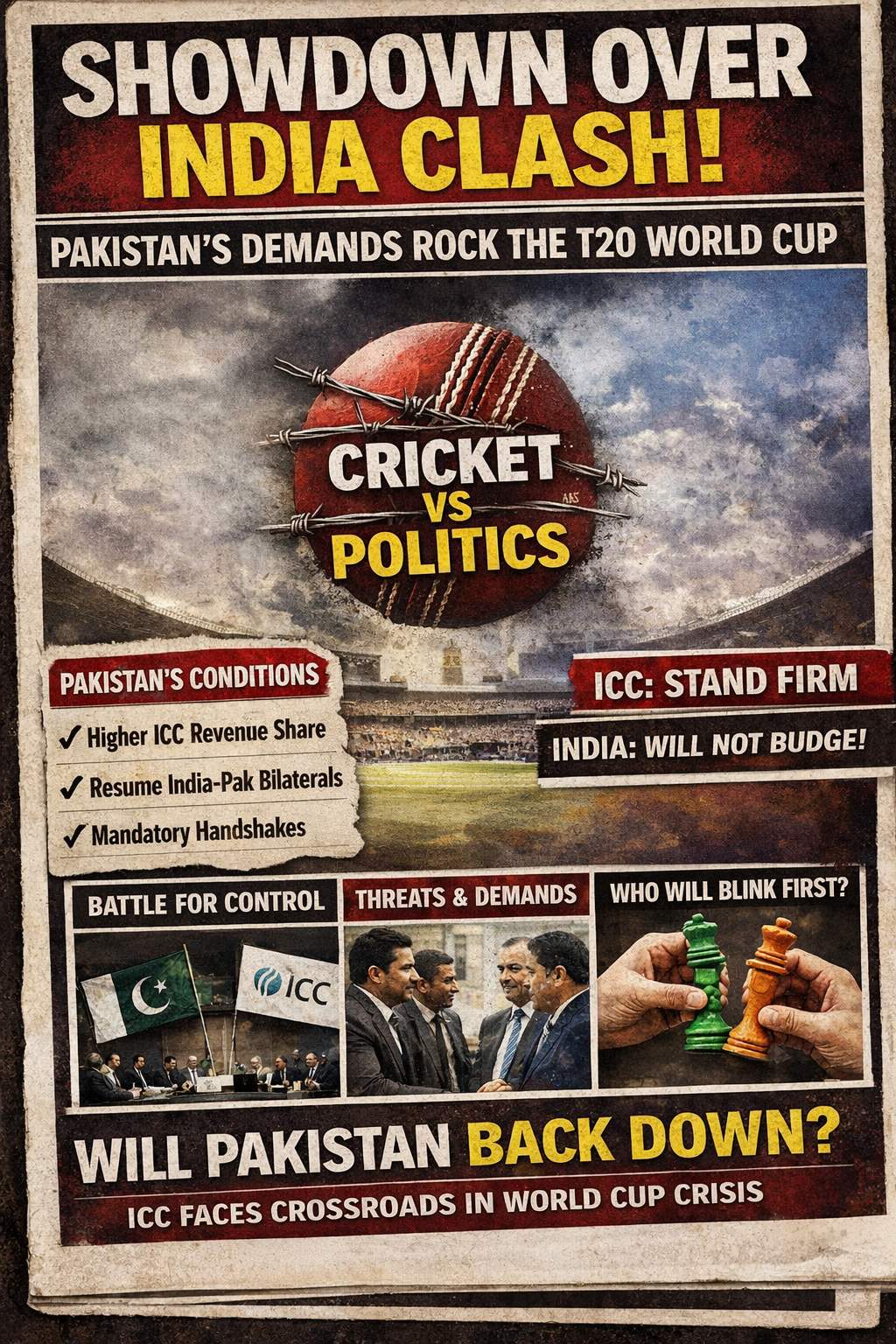
COLOMBO, February 9, 2026 —India VS Pakistan Political Gamesmanship in the World Cup: As the T20 Cricket World Cup 2026 unfolds across Sri Lanka and India, the actual cricket on the field is being overshadowed by a high-stakes geopolitical drama. What began as a grand gesture of regional solidarity has morphed into a complex web of financial and diplomatic demands. Pakistan’s decision to boycott their marquee clash against India has dominated front-page news globally, but recent developments suggest the “real intent” behind the standoff has finally surfaced.
India VS Pakistan Political Gamesmanship in the World Cup:the “Solidarity”Facade Bangladesh and the Boycott.
The controversy ignited weeks ago when the Pakistan government—not the PCB—announced a selective participation in the World Cup. The directive was clear: Pakistan would play every team except India. At the time, Islamabad framed this as a stand of solidarity with Bangladesh, following the BCB’s removal from the tournament over a venue dispute.
Pakistan position itself as the champion of its neighbor, showing dissent even as the tournament drew near. However, following an emergency high-level meeting in Lahore this past weekend between the ICC, PCB, and BCB, the narrative has shifted. The meeting revealed that while the boycott was marketed as a moral stand, it is being used as a powerful lever for institutional gain.
India VS Pakistan Political Gamesmanship in the World Cup the Three Demands: Leverage Over Loyalty.
The talks in Lahore, attended by PCB Chairman Mohsin Naqvi and ICC Deputy Chairman Imran Khwaja, saw Pakistan put forth three specific conditions to end the boycott. These demands have fundamentally changed the public’s perception of the standoff:
- Increased Revenue Share: Pakistan currently receives a 5.75% to 6% share of the ICC’s annual revenue. They are demanding a significant hike in this figure, arguing for a revised financial model that benefits them more equitably.
- Renewal of India-Pakistan Bilaterals: The PCB is pushing for the resumption of bilateral series with India—a move that hasn’t happened in years due to political tensions and security concerns.
- Mandatory Handshake Protocols: In a symbolic demand, Pakistan is seeking the enforcement of post-match handshakes, a point of contention following India’s reported refusal to engage in the gesture during recent tournaments citing cross-border issues.
These demands make it abundantly clear: the boycott was never truly about Bangladesh. It was about gaining leverage. By threatening the broadcast-gold “India vs. Pakistan” fixture, Pakistan is attempting to strong-arm the ICC into concessions that purely benefit their own board.
The Logistics of Conflict: Can the ICC Play God?
The ICC finds itself in a precarious position. As a governing body, its mandate is to handle cricketing matters, not to arbitrate decades of geopolitical friction.
| Feature | Pakistan’s Demand | Current Reality |
| ICC Revenue Share | Seek > 6% | Fixed at ~5.75% based on existing model |
| Bilateral Ties | Full Restoration | Governed by State diplomacy, not the ICC |
| India Match Status | Boycott (Forfeit) | Scheduled for Feb 15 in Colombo |
| Qualification | “Do-or-Die” | Forfeit leads to 0 points; NRR hit |
The ICC has already issued a subtle warning, noting that selective participation violates the Members Participation Agreement (MPA). If Pakistan forfeits the match on February 15, India will be awarded two points automatically, and Pakistan’s road to the Super 8s will become a statistical nightmare.
A House Divided: Reactions from the Pitch
The drama hasn’t just stayed in the boardroom. Pakistani players have expressed a sense of helplessness, stating they must follow their government’s orders regardless of their sporting desires. Indian players, meanwhile, have maintained a stoic stance, confirming they will “hold up their end of the deal” and show up at the R. Premadasa Stadium in Colombo.
The irony is not lost on fans that this drama comes at a time when Pakistan is already struggling on the field. After a shaky opener against the Netherlands where they nearly lost the plot, the team is now demanding a larger share of the global revenue while their current performance remains inconsistent.
Conclusion: Who Will Blink First?
As we move into the second week of the tournament, the question remains: who will be gracious enough to step back? The ICC cannot be seen to succumb to a single nation’s demands, especially when those demands involve political corridors outside its jurisdiction.
Pakistan has made its real intentions clear—this is a fight for money, bilateral play, and optics. If they proceed with the boycott, the sport loses its biggest spectacle, but Pakistan loses its credibility and potentially its place in the tournament. One party will have to take a step back for the spirit of the game to proceed.