
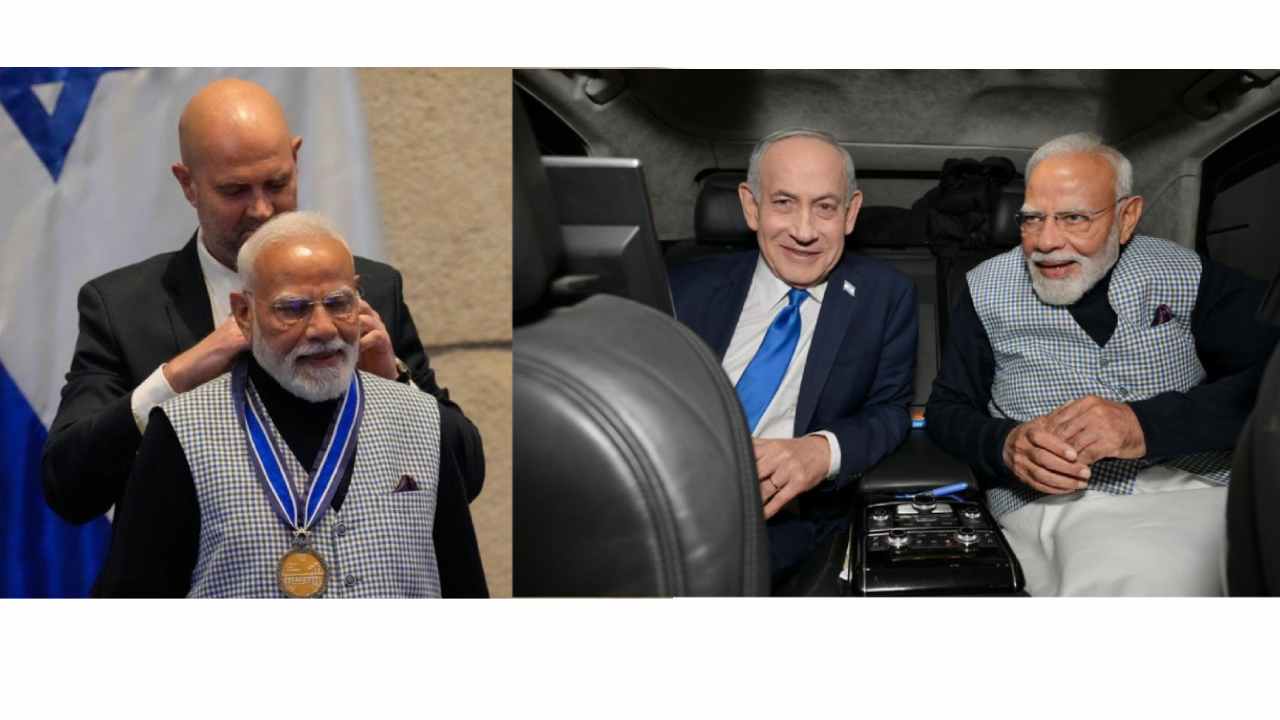
A Defining Chapter in Diplomacy: The geopolitical landscape of West Asia witnessed a seismic shift on Wednesday, February 25, 2026, as Indian Prime Minister Narendra Modi landed in Tel Aviv for a landmark two-day state visit. Marking his second trip to the Jewish state in nine years, the visit is not merely a diplomatic formality but a high-stakes mission aimed at balancing India’s strategic interests, reaffirming a “zero-tolerance” policy against terrorism, and advocating for a durable peace in a region long fractured by conflict.
From receiving the highest parliamentary honor to addressing the Knesset with a stirring call for global unity against terror, PM Modi’s visit underscores India’s rising role as a “Vishwa Bandhu” (friend of the world)—a mediator capable of maintaining deep ties with both Israel and Palestine.
A Defining Chapter in Diplomacy: Red Carpet Rolled Out for PM Modi in Tel Aviv
The visit began with a display of profound personal chemistry between Prime Minister Modi and Israeli Prime Minister Benjamin Netanyahu. Accompanied by his wife, Sara Netanyahu, the Israeli Premier broke protocol to receive Mr. Modi at the Ben Gurion International Airport. Amidst the fluttering flags of both democracies and the echoes of a guard of honor, the atmosphere was one of “wondrous friendship,” a term Netanyahu used to describe the bilateral bond.
Immediately following the arrival, the two leaders held a private restricted meeting. Taking to ‘X’ (formerly Twitter), PM Modi expressed his delight:
“Had an excellent meeting with Prime Minister Netanyahu. Expressed gratitude to him for the warm welcome… It is a delight to be back in Israel after 9 years. We discussed a wide range of subjects aimed at boosting bilateral ties.”
The agenda for this visit is exhaustive, spanning technology, water management, agriculture, and a burgeoning “talent partnership” designed to bridge India’s human capital with Israel’s technological prowess.
The Knesset Address: ‘Terrorism Anywhere Threatens Peace Everywhere’
The centerpiece of the first day was PM Modi’s address to the Knesset, the Israeli Parliament. This rare honor, reserved for the closest of allies, provided a global stage for India to articulate its stance on the October 7, 2023, Hamas attacks and the subsequent humanitarian crisis in Gaza.
1. Condemning the “Barbaric” Acts
With somber conviction, PM Modi condemned the October 7 attacks as “barbaric,” stating, “We feel your pain, we share your grief.” He drew a direct parallel between the trauma of the 26/11 Mumbai attacks and the violence faced by Israel, reminding the world that India has long been on the front lines of the fight against extremism.
2. The Doctrine of Zero Tolerance
The Prime Minister’s rhetoric was uncompromising. He asserted that India maintains a “consistent and uncompromising policy of zero tolerance for terrorism with no double standards.” By stating that “terrorism anywhere threatens peace everywhere,” Modi positioned India as a moral anchor, arguing that terror is not just a regional issue but a global destabilizer that erodes development and trust.
3. Backing the Gaza Peace Plan
In a significant diplomatic move, while standing firmly with Israel, PM Modi also threw New Delhi’s weight behind the Gaza peace initiative endorsed by the UN Security Council. He described the initiative as a “pathway” to a “just and durable peace.” This nuanced stance highlights India’s transition from a passive observer to an active stakeholder in Middle Eastern stability, advocating for dialogue over perpetual warfare.
A Rare Diplomatic Feat: The Knesset Medal
In a moment of historic proportions, PM Modi was conferred the Speaker of the Knesset Medal—the highest honor of the Israeli Parliament—by Speaker Amir Ohana. This award recognizes his “exceptional contribution” to strengthening the India-Israel strategic partnership.
What makes this achievement truly remarkable is the “Double Crown” of West Asian diplomacy. With this medal, Modi becomes the first world leader to hold the highest honors from both Israel and Palestine.
2018: Awarded the Grand Collar of the State of Palestine by President Mahmoud Abbas.
2026: Awarded the Speaker of the Knesset Medal by Israel.
This duality silences critics who argue that India’s “de-hyphenation” policy (treating relations with Israel and Palestine independently) is a zero-sum game. Instead, it proves that India’s “Middle Way” is respected by both sides of the divide.
Domestic Dissent and Geopolitical Headwinds
Despite the international accolades, the visit has not been without its share of domestic friction. In India, the political divide was sharp:
The Left Perspective: The CPI(M) strongly opposed the visit, labeling it a “betrayal of the Palestinian cause.”
The Congress Party: The opposition launched a scathing attack, accusing the PM of “moral cowardice” for failing to publicly criticize Netanyahu’s military actions in Gaza while the rest of the world remains vocal.
Furthermore, the visit takes place against a backdrop of deteriorating ties between the U.S. and Iran, and ongoing volatility in the Red Sea. Analysts suggest that Modi’s presence in Jerusalem is a strategic masterstroke intended to ensure that India remains a central player in the proposed IMEC (India-Middle East-Europe Economic Corridor), which relies heavily on Israeli infrastructure.
Beyond Defense: A Multi-Dimensional Partnership
While the security and defense sectors remain the bedrock of the relationship—with India being a major buyer of Israeli defense technology—the 2026 visit is pushing the envelope into “Future Tech.”
| Sector | Focus Areas |
| Technology & AI | Collaborative research in Generative AI and semiconductor supply chains. |
| Water Management | Scaling up desalination and drip irrigation projects across arid Indian states. |
| Agriculture | Establishing more Centers of Excellence to boost crop yields for Indian farmers. |
| Talent Partnership | Streamlining visas for Indian professionals and students to work in Israel’s tech ecosystem. |
Tomorrow, the leaders are expected to visit Yad Vashem (the World Holocaust Remembrance Center) and sign a series of bilateral agreements that will codify these ambitions into policy.
The Pulse of the People: Cultural Diplomacy
The visit wasn’t just about high-level meetings; it was also a celebration of the Indian Diaspora. Upon his arrival at the Hotel King David in Jerusalem, PM Modi was greeted by a vibrant assembly of Indian-origin Jews, students, and workers.
The cultural exchange was a tapestry of both nations:
The rhythmic Thiruvathira dance from Kerala.
The spirited Israeli folk dance Hava Nagila.
The traditional Rajasthani Ghoomer.
These performances, including those by specially-abled singers, served as a reminder that the India-Israel bond is built on people-to-people connections that predate modern diplomatic treaties.
Conclusion: The Architect of a New Balance
Prime Minister Modi’s 2026 visit to Israel is a testament to India’s maturing foreign policy. By condemning terror in the strongest terms while simultaneously advocating for a peace plan in Gaza, India is navigating the “geopolitical headwinds” with a steady hand.
As the world watches, the “wondrous friendship” between Modi and Netanyahu is setting a new template for how middle powers can collaborate to solve 21st-century challenges—ranging from food security to global counter-terrorism.
Disclaimer: This information is based on various inputs from news agency.