
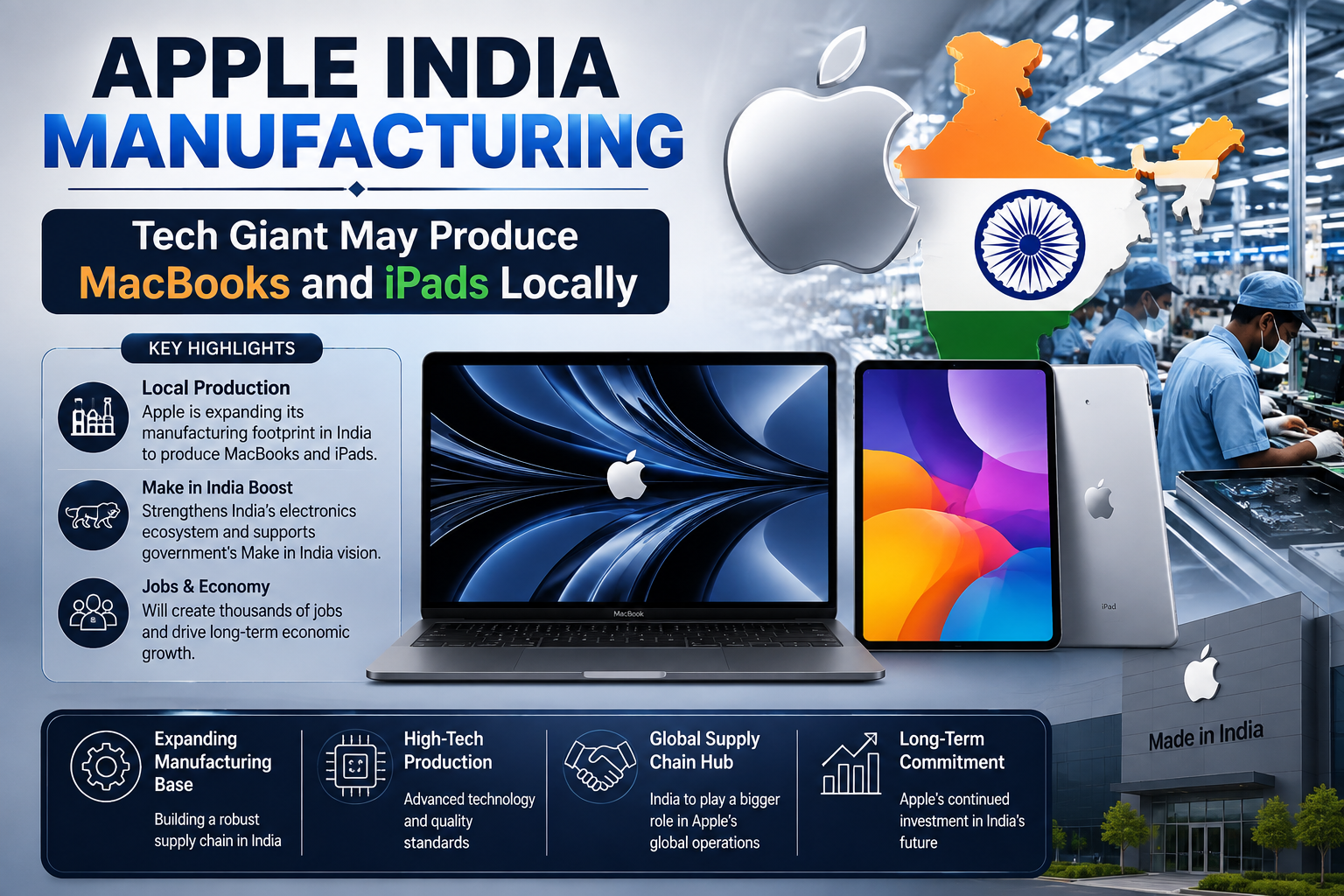
Apple India Manufacturing is entering a phase that could change how people think about technology production around the world. For ten years India has mainly been a place where Apple phones are assembled.. New statements from top government leaders show that the Silicon Valley company is planning to make laptops, tablets and other advanced consumer devices right inside India.

At the launch of the large Rs 62,500-crore Mobile Phone Manufacturing Scheme (MPMS) Union Electronics and IT Minister Ashwini Vaishnaw said that Apple India Manufacturing might soon add flagship items such as MacBooks and iPads to its assembly line. When asked directly if Indian factories would start building these higher‑tier items with phones the minister answered with a firm, confident “yes.”
This change is a turning point. India is no longer content with simple assembly tasks. The government wants to create an industrial system that covers deep research designing components in-house and making all parts locally. As big global brands look to reduce reliance on one country for supply Apple India Manufacturing is becoming the tech manufacturing hub, for the world.
The New Rs 62,500-Crore Mobile Phone Manufacturing Scheme (MPMS)
The foundation of this upcoming manufacturing expansion rests on the government’s newly rolled out MPMS framework. Running for five years from FY2026-27 to FY2030-31, this financial policy succeeds previous production-linked packages, setting its sights far beyond basic volume targets.
While earlier initiatives successfully proved that India could assemble smartphones at a global standard, MPMS focuses on building true domestic intellectual property and self-sustaining supply chains.
Key Highlights of the MPMS Policy
Enormous Financial Ambition: The government aims to generate nearly Rs 39 lakh crore in cumulative mobile production over the five-year policy period.
Aggressive Export Targets: Officials project around Rs 15 lakh crore in direct hardware exports to foreign markets.
Direct Job Creation: The policy expects to generate at least 60,000 direct, high-skilled industrial jobs across manufacturing assembly, testing, and component logistics.
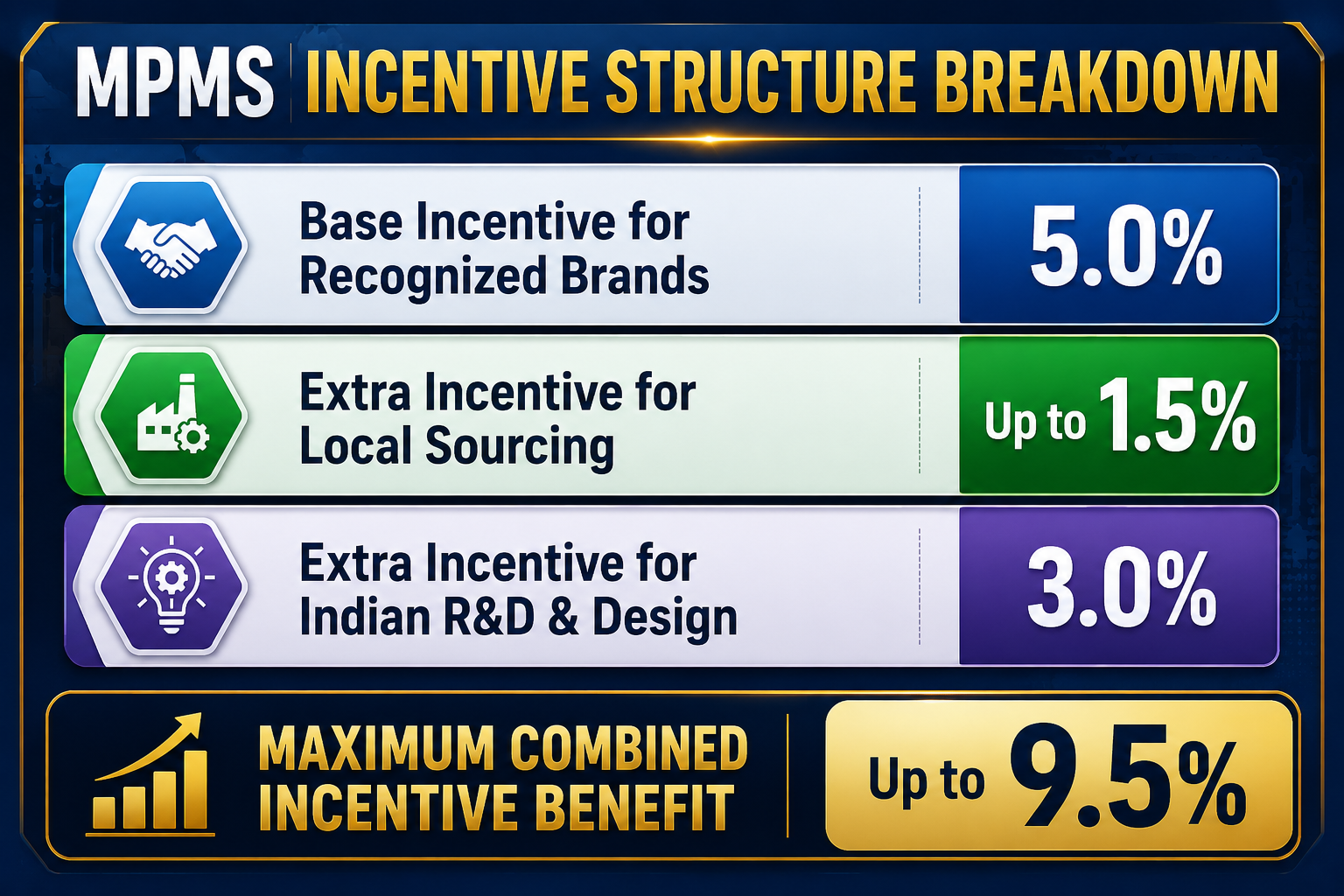
Multi-Tier Incentives: Companies can stack a base incentive of 5 percent with an additional 1.5 percent for sourcing local physical parts, plus a dedicated 3 percent bonus for conducting genuine domestic design work.
To qualify as a genuine domestic brand under this framework, firms must maintain strict control standards. A brand must hold its legal entity, trademarks, and core intellectual property inside India. Furthermore, Indian citizens must hold over 51 percent of equity shares and maintain executive control, supported by active in-house engineering and laboratory teams.
Helping Local Sourcing and In-House Supply Chains.
One of the things we learned from old manufacturing rules is that if you only rely on parts from other countries your economy will not grow much. Under MPMS the government gives rewards to factories that buy their important raw parts from local suppliers.
The policy gives a cash bonus of up to 1.5 percent when factories buy parts from local sources. To get this money a manufacturer must buy parts locally for at least 25 percent of all units made during that financial year.
Key Components Targeted for Indian Sourcing:
- High-Resolution Display Modules: Moving from buying imported panels to doing bonding and integration.
- Advanced Camera Modules: Putting together lens systems and sensor units right here in India.
- Precision Enclosures & Chassis: Making aluminum and composite shells inside Indian plants.
- Battery Packs & Power Units: Buying cells and custom protection circuits from battery suppliers.
- High-Speed USB Cables & Connectors: Making wiring, braided cables and internal ports locally.
By making suppliers set up component lines, near assembly plants India makes the supply chain stronger. This also helps speed up manufacturing. Makes freight costs much lower.
From Basic Assembly to True Research and Intellectual Property.
The key point of India’s plan is that India is putting a strong emphasis on research, product design and patents.
Ministry officials say that just copying someone ’s plans will not make India a big industrial nation.
MeitY Secretary S Krishnan explained that companies must reach countable research goals before they can enjoy top-level money rewards.
The special 3 percent cash reward for home-made design work is a strong push for companies to set up engineering centers right here.
Besides encouraging names like Apple the government is also actively supporting homegrown device makers.
Union Minister Ashwini Vaishnaw said that three possible Indian smartphone brands have already been spotted in the 10 to 14 months.
These candidate companies are now tweaking product designs, for various price levels.
The ministry will check their prototypes, software fit and build quality before giving out big money help.
India’s Rapid Journey to a Global Tech Powerhouse
India’s sudden rise as an industrial electronics hub is one of the most remarkable manufacturing stories of the past decade. Looking back at historical benchmarks from FY2014-15 shows just how dramatically the landscape has shifted.
| Metric | Historical Level (FY2014-15) | Present Operational Scale | Total Growth Multiple |
| Total Electronics Production | Baseline Scale | 7x Increase | 7-Fold Growth |
| Electronics Hardware Exports | Baseline Scale | 11x Increase | 11-Fold Growth |
| Mobile Phone Production | Baseline Scale | 33x Increase | 33-Fold Growth |
| Mobile Phone Exports | Baseline Scale | 166x Increase | 166-Fold Growth |
| Domestic Usage Localisation | Low Import Reliance | 99.2% Domestic | Near Total Self-Reliance |
Today, an incredible 99.2 percent of all mobile devices sold and used across India are assembled inside the country. Furthermore, the previous PLI 1.0 program shattered every expectation set by financial planners:
Target Investment vs. Actual: Against an initial goal of Rs 7,000 crore, private factory investments surged to Rs 20,587 crore.
Target Output vs. Actual: Total production value reached Rs 11.62 lakh crore, representing an impressive 142 percent achievement rate over original projections.
Export Delivery: Outbound shipments hit Rs 6.43 lakh crore, easily beating expectations at 132 percent of target volumes.
The numbers behind this expansion speak for themselves:
Massive Export Revenues: Union Minister Vaishnaw noted that Apple shipped roughly $50 billion worth of mobile devices out of India in 2025 alone.
Volume Output: Reports indicate Apple assembled approximately 55 million iPhones within Indian facilities last year, representing nearly a quarter of its global device output.
Global Share Projections: Market intelligence firm Counterpoint Research estimates India will manufacture around 26 percent of all global iPhones in 2026.
2017: Entry Phase ──────► Initial assembly of legacy iPhone models in small batches.
2023: Scale Phase ──────► Assembly expands to current-generation flagship iPhones.
2025: Mass Export ──────► Shipped $50 Billion worth of iPhones; assembled ~55 Million units.
2026: Expansion ──────► Target 26% of global iPhone output; expanding into MacBooks & iPads.
A massive share of the devices produced at Foxconn’s and Tata’s expansive Indian facilities are now regularly exported to competitive international markets, including Western Europe and the United States. Expanding these production lines to accommodate MacBooks and iPads is a natural next step for Apple as it works to shield its global business from regional supply disruptions.
Furthermore, this momentum is spilling over to other tech giants. As companies look to diversify operations beyond traditional hubs, India expects to capture a significant portion of Google’s shifted hardware manufacturing capacity for overseas markets as well.
What This Expansion Means for Consumers and the Economy
The idea of MacBook and iPad production lines moving to India is a deal. This change will affect tech buyers, local supply chains and the whole economy in ways:
1. Competitive Pricing and Local Availability
The cost of high-end tech usually depends on how much parts cost around the world. However making MacBooks and iPads inside India can help cut down on import taxes and shipping costs. If MacBooks and iPads are made locally the prices in stores might stay more steady. It will also make it much easier for people to buy these devices.
2. Upskilling the Local Workforce
Making motherboards metal cases and screens takes a lot of skill. As big brands grow in India local workers will learn a lot. Technicians, engineers and quality checkers will get to learn how to work with world-class tools and methods.
3. Boosting the Domestic Component Network
When big hardware companies move in the people who make the parts move in too. We will likely see more local money going into making parts, custom boxes, glass and even recycling systems.
Looking Ahead: The Future of Hardware Manufacturing
Moving from making phones to making fast laptops and tablets shows that India is getting much better at industry. With help from the Rs 62,500-crore MPMS program and support from names like Apple India is becoming a very important place, for tech.
As the new production lines get ready India is showing the world that India can build things design smart tech and help the economy grow.