
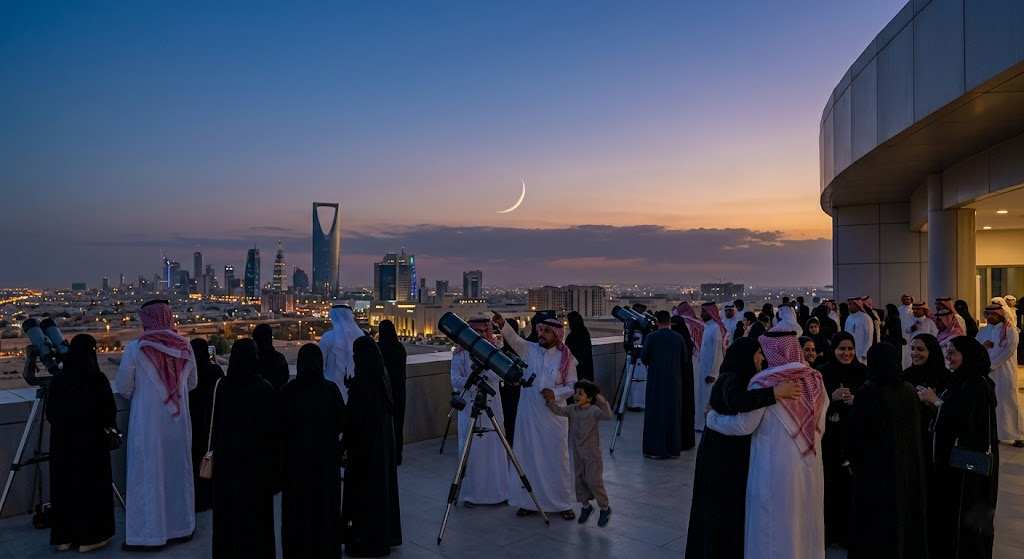
Eid ul-Fitr 2026 :As the sun begins its descent over the golden sands of the Arabian Peninsula this Wednesday, March 18, 2026, millions of eyes are turning toward the western horizon. The holy month of Ramadan, a period of intense prayer, self-reflection, and fasting, is drawing to a close. The global Muslim community now stands on the precipice of Eid ul-Fitr, the “Festival of Breaking the Fast,” awaiting the definitive signal from the skies: the sighting of the Shawwal crescent moon.
In Saudi Arabia, the heart of the Islamic world, the Supreme Court has issued an official call for citizens and residents to participate in the moon-sighting process. This tradition, spanning over 1,400 years, remains the final authority on when one of Islam’s most significant holidays begins.
Eid ul-Fitr 2026 Sighting the Shawwal Moon: Timings and Procedures
The Great Crescent Watch: Saudi Arabia Set for Eid ul-Fitr 2026 Moon Sighting:
The religious authorities in the Kingdom of Saudi Arabia have specified that the search for the thin sliver of the new moon—the hilal—will begin immediately after sunset , Wednesday, March 18.
The Visibility Window
Astronomical data suggests that the sun will set in Riyadh at approximately 6:03 PM. This marks the beginning of a critical 20-to-40-minute window. During this brief period, professional observers at state-of-the-art observatories, as well as thousands of private citizens using binoculars or the naked eye, will scan the twilight sky.
If the moon is spotted and the sighting is verified by the Saudi Supreme Court, the announcement will ripple across the globe. Thursday, March 19, 2026, would then be declared the first day of Eid ul-Fitr.
What if the Moon is Not Seen?
The Great Crescent Watch: Saudi Arabia Set for Eid ul-Fitr 2026 Moon Sighting Today: The Islamic calendar is strictly lunar, meaning a month can only be 29 or 30 days long. If the moon remains hidden—whether due to its astronomical position, heavy cloud cover, or dust storms—Ramadan will automatically complete a 30th day. In this scenario, Eid ul-Fitr would be observed on Friday, March 20, 2026.
Eid ul-Fitr 2026 Global Impact: From Riyadh to New Delhi
The announcement from Saudi Arabia serves as a primary guide for many Gulf nations, including the UAE, Qatar, and Kuwait. However, for the massive Muslim populations in South Asia, the timeline typically follows a different rhythm.
The South Asian Context
In countries like India, Pakistan, and Bangladesh, the moon-sighting committees generally look for the crescent a day after Saudi Arabia.
- If Saudi Arabia celebrates on March 19: It is highly likely that India and its neighbors will observe the final day of Ramadan on Thursday and celebrate Eid on Friday, March 20.
- The “Two Eids” Phenomenon: Due to geographical differences and the curvature of the earth, it is common for the festival to be celebrated on two different days across the globe. This reflects the atmospheric diversity of the planet rather than a religious schism.
Eid 2026: A Celebration Amidst Global Tensions
While Eid is traditionally a time of unbridled joy, the 2026 celebrations arrive at a somber moment in international affairs. From Cairo to Chicago, the festive spirit is being tempered by the weight of global events.
Middle Eastern Context
In the Middle East, the festive preparations are shadowed by ongoing geopolitical conflicts and the “Iran war,” which continues to impact regional stability. For many families in Egypt, Jordan, and Lebanon, the holiday is a bittersweet moment—a time to pray for peace while attempting to provide a sense of normalcy for children through traditional sweets and new clothes.
The Muslim Experience in the United States
Across the Atlantic, American Muslims are preparing for Eid under a complex domestic atmosphere. Communities have reported navigating a landscape of heightened anti-Muslim rhetoric and concerns regarding immigration policies. Despite these challenges, US mosques are preparing for large-scale congregational prayers and community festivals featuring face painting, balloon twisting, and diverse culinary offerings that reflect the racial and ethnic melting pot of the American Muslim minority.
Traditions of the “Meethi Eid” (Sweet Eid)
Eid ul-Fitr is often called “Meethi Eid” in South Asia because of the focus on desserts, but the traditions vary beautifully across the globe.
| Country | Key Tradition | Signature Dish/Activity |
| Indonesia | Mudik (Homecoming) | Massive exodus from cities to rural villages to seek family forgiveness. |
| Malaysia | Open House | Friends and family of all faiths are invited to enjoy traditional delicacies. |
| Egypt | Eidiya | Children receive cash gifts from elders; families eat powdered sugar cookies. |
| United States | Diversity Festivals | Multicultural gatherings featuring diverse foods and activities for children. |
The “Green Packet” and “Eidiya”
A universal theme of Eid is the spirit of giving. In Malaysia and Singapore, elders give children money in “green packets”—a tradition inspired by the Chinese “red envelope.” In the Middle East and South Asia, this cash gift is known as Eidi or Eidiya. It serves as a reward for children who have participated in the fasting or the spiritual atmosphere of the month.
How to Greet Your Neighbors
If you wish to wish someone well during this time, the most common greeting is “Eid Mubarak,” which translates to “Blessed Eid.” You can also simply say “Happy Eid.”
As the world waits for the official word from Saudi Arabia, the essence of the holiday remains the same: a celebration of perseverance, a return to “fitra” (the natural state of goodness), and a commitment to charity. Whether the moon appears tonight or tomorrow, the spirit of Eid 2026 is already beginning to take hold in homes around the world.