
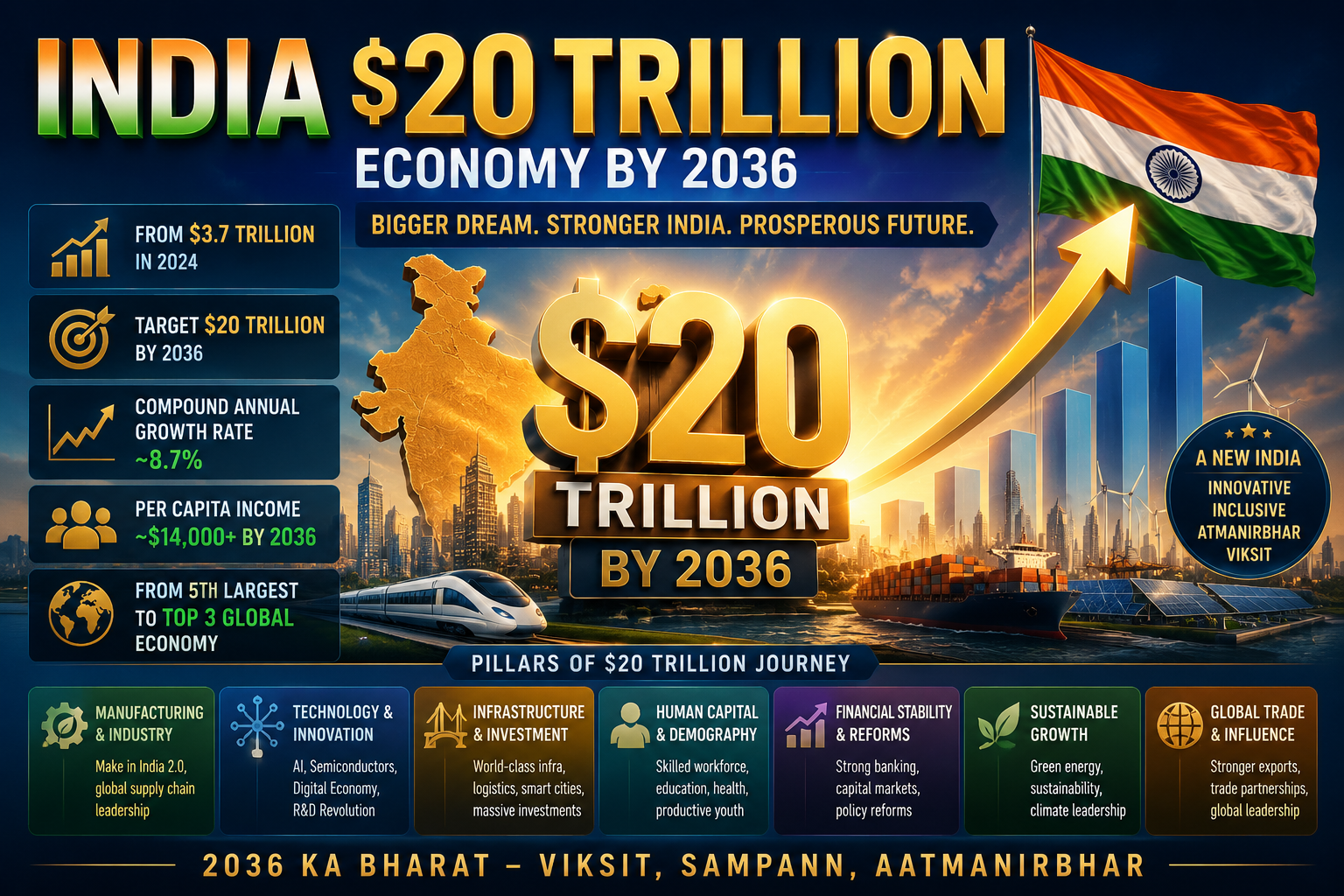
India $20 trillion economy by 2036 is no longer just a distant aspiration—it is an achievable economic milestone if the country executes a comprehensive structural overhaul across its real economy, financial framework, and human assets. According to an exhaustive research report released by domestic brokerage firm Equirus, achieving this monumental goal will require domestic rupee output to grow at an underlying rate of 14.2% annually, coupled with a steady annual currency appreciation of approximately 3% to 3.6%. While this path requires sharp deviation from historical trends, a strategic 20-step reform agenda could unlock the necessary momentum to make it a reality.
Over the past few decades, India has demonstrated remarkable economic resilience and agility. It took nearly 67 years after independence in 1947 for the country to build its initial $2 trillion Gross Domestic Product (GDP). However, the subsequent decade saw a rapid doubling of economic output, bringing the present GDP base to roughly $3.7 trillion. To leap from this baseline to a staggering $20 trillion over the next twelve years demands expanding the total size of the economy by nearly 5.5 times. In dollar terms, this necessitates maintaining a compound nominal growth rate of roughly 18% per year—a significant step up from the historical 10% to 11% trajectory observed over previous market cycles, according to news agency ANI.
Key Macroeconomic Target Snapshot
| Macro Metric | Historical Trend | 2036 Target Scenario |
| Gross Domestic Product (GDP) | $3.7 Trillion (Current) | $20 Trillion |
| Nominal Dollar Growth Pace | 10% – 11% annually | 18% per year |
| Underlying Rupee Growth | ~10% – 12% | 14.2% annually |
| Currency Trajectory | Slow depreciation trend | 3.0% – 3.6% annual appreciation |
| Services Share of GDP | 54% (~$2 Trillion) | >65% (>$11 Trillion) |
| Net Direct Economic Gain | Baseline | Rs 4.5 Trillion net surplus per year |
1. The Services Pivot: Shifting the Core Engine of Expansion
The composition of economic expansion will be just as crucial as the speed of growth itself. The Equirus report highlights that the traditional manufacturing-led development playbook may face headwind constraints in today’s increasingly protectionist global backdrop. Supply chain regionalization and trade barriers mean India must rely heavily on services as its primary development motor.
Currently, services contribute approximately 54% to India’s total economic output, translating to roughly $2 trillion. To meet the 2036 horizon goals, this proportion must cross 65%, soaring to an absolute valuation of over $11 trillion. Meanwhile, the relative GDP contribution from agriculture is expected to naturally taper as urban migration and industrial modernizations gain traction.
Global Capability Centres (GCCs) as Growth Catalyst
A flagship recommendation in the report calls for establishing a dedicated National GCC Policy. India is already home to more than 1,800 Global Capability Centres, serving as technological and operational backbones for worldwide enterprises. Scaling this footprint to over 5,000 facilities could generate an economic impulse ranging between $470 billion and $600 billion, while simultaneously creating 20 to 25 million high-value jobs for young professionals.
Unlocking International Tourism Potential
Beyond digital services, physical service export mechanisms require an overhaul. Strategic promotion of domestic tourism, infrastructure modernizations, and streamlined visa protocols could yield an additional $21 billion in annual foreign exchange inflows. This step directly stabilizes the current account balance while supporting grassroots employment in hospitality and local commerce.
2. Working Capital Reform: Liquidity Relief via Tax Rationalization
One of the most actionable facets of the Equirus study revolves around eliminating tax-induced friction that currently traps immense capital within corporate balance sheets. Inefficient tax collection systems choke cash flows, constraining reinvestments in capital expenditure and hiring.
| Tax / Liquidity Reform Area | Current Friction Point | Proposed Structural Fix | Estimated Capital Unlocked |
| Advance Tax System | Quarterly estimated tax payments freeze liquid funds ahead of final assessments. | Abolish or overhaul advance tax frameworks for compliant corporate entities. | Rs 10 Trillion in working capital |
| Tax Deducted at Source (TDS) | Multiple complex rate slabs create administrative overhead and cash blockages. | Implement a streamlined, uniform flat 5% TDS rate across categories. | Rs 13.4 Trillion in liquidity release |
| Fuel Inclusion in GST | Exclusion of petroleum products leads to cascading input tax losses. | Bring motor fuels and energy feedstocks under unified GST coverage. | Substantial reduction in logistics costs |
By implementing these tax rationalization measures, Indian businesses could see an immediate release of nearly Rs 23.4 trillion in operational working capital. This capital liquidity surge would reduce reliance on short-term bank borrowing, lower financing costs, and accelerate private capital investment cycles nationwide.
3. The 20-Step Reform Blueprint across Core Sectors
To reach the goal of the India $20 trillion economy by 2036 we need to do a lot of things at the time. The research report talks twenty important steps that we need to take. These steps are divided into five areas:
* Real Economy & Energy Infrastructure: We should include petroleum and energy products in the Goods and Services Tax framework. This will help remove costs and lower the cost of transporting things.
* State Fiscal Discipline: We need to make sure state governments spend money on things that will be useful in the run. This means they should not use money to fund things that people will only use for a short time.
* Public Asset Monetization: We should sell shares of state-owned companies like Indian Railways. This will help us find the value of these companies and make them work better.
* Sovereign Wealth Management: We should create an Indian Sovereign Wealth Fund. This fund will invest our countrys money in things like minerals, new technologies and infrastructure projects.
* Capital Markets Expansion: We need to make it easier for companies to raise money. We can do this by improving the corporate bond market helping more people buy bonds and making it simpler for companies to issue shares.
* Human Capital Development: We should make it easier for private colleges and universities to grow. We should also remove rules that make it hard for new companies to start.. We should help private companies do more research and development by giving them tax breaks and grants.
* Urban Governance & Land Markets: We need to improve the way cities are run. We should make it easier to access land records.. We should help cities issue bonds to build better infrastructure. This will help us create cities that are ready for the future. The India $20 trillion economy by 2036 is a goal. We need to work on all these areas to achieve it. The India $20 trillion economy, by 2036 requires a lot of effort.
4. Cost-Benefit Balance: Direct Gains vs Implementation Expenses
The country will have to pay some costs when it makes reforms.. The numbers, from Equirus show that the country will get a lot of money back.
The country will get a lot of money every year. This is because people will pay their taxes things will get made efficiently and the value of things will go up. The country will get around Rs 7.9 trillion from these things.
It will cost the country some money to make these changes. The country will have to spend around Rs 3.4 trillion to make these changes happen. This money will go to things like changing the budget paying people to do things and building things.
So the country will still get a lot of money. The country will get around Rs 4.5 trillion more every year. This shows that making these changes is an idea. The changes will not just be ideas. They will actually. Make the country more money. The changes will pay for themselves. Make the economy move faster. The economic reforms will really help the countrys balance sheet. The economic reforms will make the countrys financial situation better.
5. Currency Mechanics & Global Macro Requirements
A critical pillar of the Equirus model is the role of currency dynamics. Traditionally, emerging market currencies experience slow, steady depreciation against the US Dollar due to inflation differentials. However, for India to hit $20 trillion in nominal dollar terms within twelve years, this pattern must shift toward sustained nominal rupee growth paired with mild currency appreciation of 3.0% to 3.6% annually.
This shift requires maintaining lower domestic inflation, securing strong, continuous foreign direct investment (FDI) inflows, and building significant current account strength through high-value service exports. If inflation stays contained and export competitiveness remains robust, the rupee can maintain a strong valuation baseline without hurting domestic manufacturing competitiveness.
6. Execution Over Policy: The Road Ahead to 2036
To get to a twenty trillion dollar economy India will not be able to do it with one plan or one big idea. It is going to take a lot of people working together including state governments and the central government as well, as businesses.
If India makes it easier for companies to get the money they need by making taxes simpler and if it builds service centers that can work with other countries and if it makes its cities work better and if it helps people get the skills they need then India can really change its economy. The plan that Equirus made shows that if India works hard and stays focused it can reach a twenty trillion dollar economy by the year 2036 and that would make India an important part of the global economy. The twenty trillion dollar economy is what India is working towards and the twenty trillion dollar economy is what will make India strong.