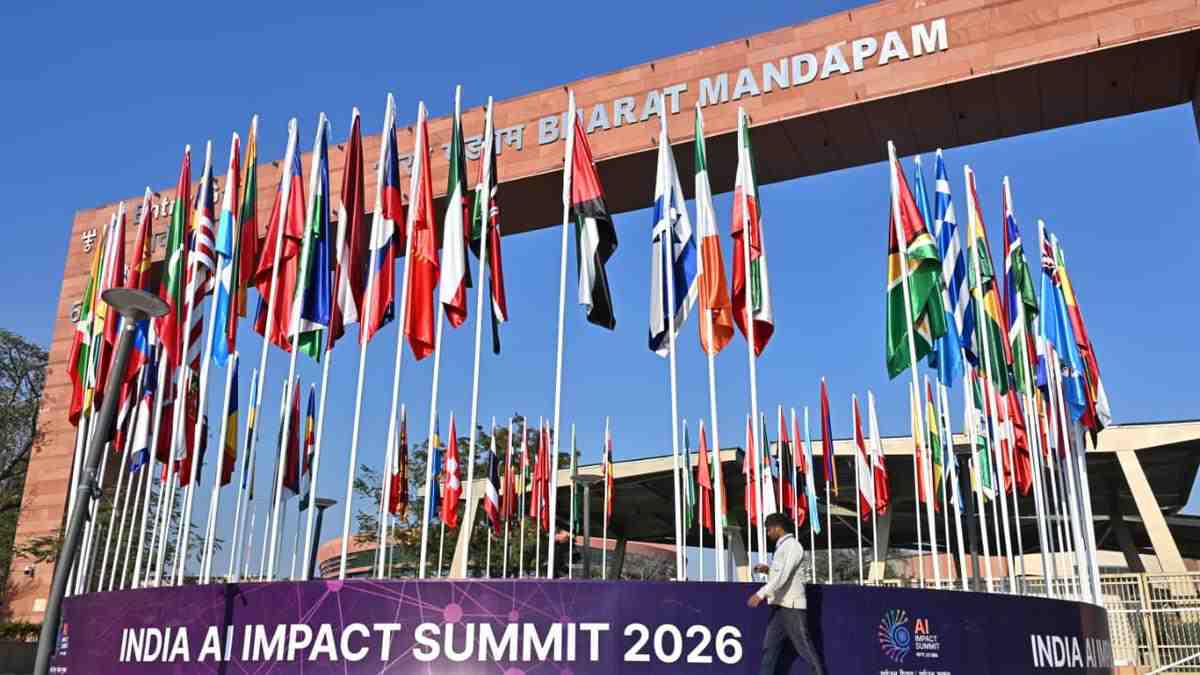
NEW DELHI, February 16, 2026 –India AI Summit 2026: The eyes of the global technology community turned toward New Delhi today as Prime Minister Narendra Modi inaugurated the India AI Impact Summit 2026. Transforming the iconic Bharat Mandapam—the site of the historic 2023 G20 Summit—into a futuristic hub of innovation, the five-day event marks a watershed moment for the Global South.
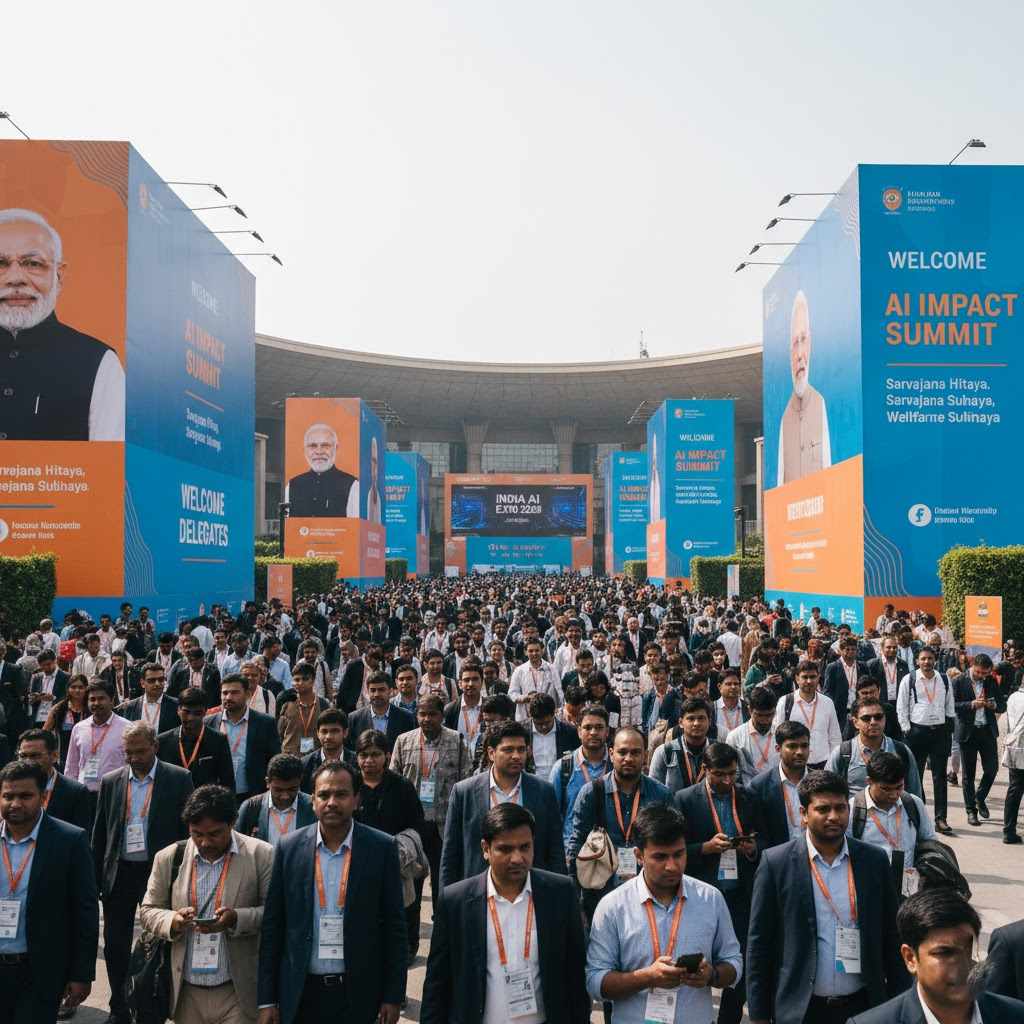
With a theme of “Sarvajana Hitaya, Sarvajana Sukhaya” (Welfare for all, Happiness for all), the summit aims to bridge the digital divide and establish a democratic, inclusive framework for the most transformative technology of the 21st century.
India AI Summit 2026 :A Global Stage for Innovation
Prime Minister Modi kicked off the event by exploring the India AI Impact Expo 2026, a massive exhibition featuring pavilions from 13 countries and hundreds of Indian startups. Engaging directly with researchers and tech leaders, the PM emphasized that India’s AI strides reflect both “ambition and responsibility.”
“Bringing the world together to discuss AI! Starting today, India hosts the AI Impact Summit at Bharat Mandapam in Delhi,” PM Modi posted on X. “India stands at the forefront of the artificial intelligence transformation.”
The scale of the event is unprecedented, with 2.5 lakh visitors expected to attend. From February 16 to 20, the summit will feature over 3,250 speakers and more than 500 sessions. While tech titans like Sundar Pichai (Alphabet) and Sam Altman (OpenAI) are scheduled to take the stage later this week, the opening day belonged to the spirit of “Sovereign AI.”
AMD vs. Nvidia: The Battle for India’s Data Centers
One of the day’s most significant business announcements came from Advanced Micro Devices (AMD). In a decisive move to challenge Nvidia’s dominance in the subcontinent, AMD announced an expanded partnership with Tata Consultancy Services (TCS).
The duo will co-develop rack-scale AI infrastructure based on AMD’s “Helios” platform. This infrastructure is specifically designed for large enterprises and to meet India’s growing demand for Sovereign AI—the ability for a nation to produce and control its own AI capabilities using local data and infrastructure.
Cultural Sensitivity and Global Governance
Union Minister Ashwini Vaishnaw addressed the satellite event, ‘Rewarding Our Creative Future in the Age of AI,’ stressing that global platforms must respect local cultural contexts.
“What is normal in one society may not be normal in another,” Vaishnaw remarked, urging OTT and digital platforms to adhere to national legal frameworks. He also revealed that India is in active discussions with over 30 countries to find technical and legal solutions for the burgeoning crisis of deepfakes and AI-generated misinformation.
The Sectoral Impact: Healthcare, Mobility, and Cinema
The summit highlighted that AI is no longer a “pilot project” but a “mission-critical” tool across Indian industry:
- Healthcare: Ankit Modi, Founding Member of Qure.ai, shared that AI-driven medical imaging has already reduced diagnosis time by 50% in disease areas like TB and cardiology, impacting 40 million people globally.
- Mobility: Priya Kapur of Sona Comstar discussed how the automotive sector is integrating AI and robotics for automated inspection and predictive analytics, moving decisively toward next-generation mobility.
- Cinema: Actor Rana Daggubati noted that AI is “rewriting the grammar of cinema,” allowing creators to visualize and choreograph complex worlds before a single frame is even shot.
AI as a Force Multiplier, Not a Job Killer
Addressing the perennial fear of automation, industry leaders offered a nuanced perspective. Puneet Chandok, President of Microsoft India, argued that AI would “unbundle” jobs rather than eliminate them.
“Your job is a bundle of tasks. What AI will do is it will unbundle it,” Chandok explained, emphasizing that the technology represents the ability to “manufacture intelligence” at scale. Similarly, Neeraj Aggarwal of BCG described AI as a “huge multiplier” for sectors like healthcare and education where India faces a talent deficit.
Safety and Ethics: “Safe by Default”
The summit also heard from international voices. Canada’s Victor Fedeli and UNICEF India Representative Cynthia McCaffrey both hammered home the necessity of safety. McCaffrey insisted that AI must be “safe by default” for children, while Principal Scientific Adviser Ajay Kumar Sood warned that the long-term effects of AI-driven feeds on child development are still largely unknown.
The Infrastructure of Tomorrow: Renewable Energy and UPI
The convergence of AI and sustainable energy was a key talking point. Officials noted that India’s 520 GW renewable capacity will be the backbone of AI growth. The true success of this convergence, they argued, will be when industrial competitiveness rises and the cost of power for consumers falls.
In a nod to India’s Digital Public Infrastructure (DPI) prowess, the NPCI launched the “UPI One World” wallet service for foreign delegates. This allows visitors from 40+ countries to experience India’s real-time payment revolution without needing a local bank account.
Looking Ahead
As the first two days focus on innovation and industry, the summit will conclude on February 19 and 20 with a high-level diplomatic segment. More than 20 heads of state, including France’s Emmanuel Macron and Brazil’s Lula da Silva, will join PM Modi to sign a potential “Global AI Commons” agreement—a move to ensure AI access is not restricted to a handful of nations.
With long queues at Bharat Mandapam and a palpable sense of excitement, the 2026 Summit has already succeeded in its first goal: proving that the future of AI is not just being written in Silicon Valley, but in the heart of New Delhi.