
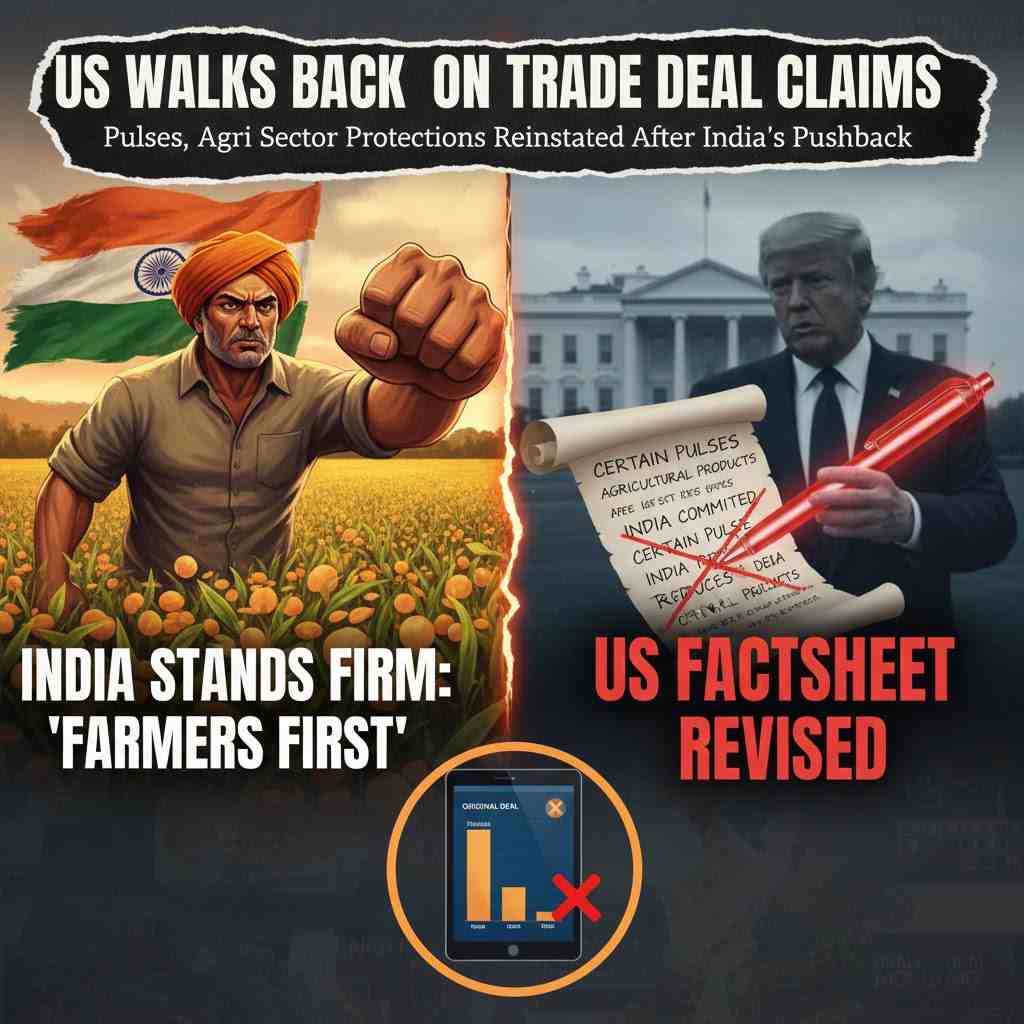
New Delhi | February 11, 2026 —India and US Trade Deal Strategic: In a move that signals intense behind-the-scenes diplomatic maneuvering, the Donald Trump administration has issued a significant revision to its official factsheet regarding the “historic” interim trade deal with India. Just days after the framework was announced, the White House has scrubbed mentions of tariff reductions on pulses and softened language regarding a headline-grabbing $500 billion purchase “commitment.”
The revisions come at a critical time for the Indian government, which has been facing a firestorm of criticism from the opposition and farmer groups who fear the deal could leave India’s massive agricultural sector vulnerable to a flood of cheap American imports.
The India and US Trade Deal Strategic Pulse of the Matter: Agriculture Concessions Removed
Perhaps the most glaring change in the updated factsheet is the total disappearance of the word “pulses.”
In the original document released on Monday, February 9, the White House explicitly stated that India would “eliminate or reduce tariffs on… certain pulses.” This was a major red flag for New Delhi. India is the world’s largest producer and consumer of pulses—including lentils, chickpeas, and dry beans—and the sector is a lifeline for millions of small-scale farmers.
The revised version, issued late Tuesday, now lists a range of products—including dried distillers’ grains (DDGs), red sorghum, tree nuts, and soybean oil—but notably excludes any mention of pulses. This pivot suggests that Indian negotiators successfully argued that any concession on pulses was a “red line” that could not be crossed without devastating domestic political consequences.
“Our farmers, artisans, and handloom industry will not suffer any harm,” Union Commerce Minister Piyush Goyal stated during a recent briefing. “Sectors where India is self-sufficient have been kept outside the deal.”
From “Committed” to “Intends”: Softening the $500 Billion Claim
The Trump administration also walked back its characterization of India’s purchasing plans. President Trump had initially touted a “commitment” from India to buy over $500 billion of U.S. goods in sectors ranging from energy and ICT to coal and agriculture.
| Feature | Original Factsheet (Feb 9) | Revised Factsheet (Feb 10) |
| Purchasing Language | India “committed” to buy… | India “intends” to buy… |
| Agricultural Products | Included in purchase list | Removed from purchase list |
| Target Amount | Over $500 Billion | Over $500 Billion |
The shift from “committed” to “intends” is more than just semantics; it reflects a move away from a binding obligation toward a statement of commercial intent. Furthermore, the removal of “agricultural products” from this $500 billion bucket underscores India’s refusal to link its macro-purchasing goals (like energy and aircraft) to the sensitive farm sector.
Digital Sovereignty and the “Google Tax”
The walk-back extended beyond the farm. The original factsheet asserted that “India will remove its digital services taxes.” This refers to the equalization levy—often called the “Google Tax”—which India has used to ensure foreign digital giants pay their fair share of taxes on revenue generated within the country.
The revised text now merely says India has “committed to negotiate a robust set of bilateral digital trade rules.” This suggests that while India is willing to talk about the future of digital trade, it has not yet agreed to unilaterally surrender its right to tax the digital economy.
Political Firestorm: A “PR-Wrapped Betrayal”?
The timing of the U.S. revisions follows a blistering attack by Congress President Mallikarjun Kharge. In a viral post on X (formerly Twitter), Kharge labeled the deal a “PR-wrapped betrayal” and a “trapped surrender.”
Kharge raised four primary objections:
- Sovereignty: He alleged that the deal requires India to stop purchasing Russian oil in exchange for the removal of a 25% U.S. tariff.
- Agriculture: He claimed pulses and genetically modified (GM) feed were “silently added” to the deal behind closed doors.
- Dairy Crisis: He warned that the inclusion of animal feed products like DDGs could harm 20 million Indian dairy farmers.
- Textile Disadvantage: He argued that while India celebrated an 18% tariff, neighboring Bangladesh secured zero-duty access to the U.S. market, putting Indian hubs like Surat and Tirupur at a disadvantage.
The Road to a Final Agreement
Despite the revisions and the political noise, the Ministry of Commerce maintains that the interim deal is a strategic win. Minister Goyal has dismissed the opposition’s claims as “absolute nonsense,” arguing that the deal provides Indian exporters a competitive edge over China (which faces 35% tariffs) and aligns with the “Viksit Bharat 2047” vision.
However, the rapid editing of the White House factsheet proves one thing: the road to a final, comprehensive India-US trade agreement is paved with sensitivities that neither Washington nor New Delhi can afford to ignore.
Disclaimer: This information is based on various inputs from news agency