
India’s AI Revolution for years, the global artificial intelligence race has been a tug-of-war between Silicon Valley and Beijing. India, despite being a global hub for IT services and talent, was often viewed primarily as a consumer rather than a creator of foundational AI models. However, the tides are shifting. Sarvam AI, a Bengaluru-based startup founded in July 2023, has just unveiled a suite of homegrown AI tools that aren’t just “built in India” but are outperforming global giants like Google’s Gemini and OpenAI’s ChatGPT on critical, India-centric tasks.
This push is part of a broader “Sovereign AI” mission—a strategy aimed at ensuring India’s digital future is not dependent on foreign platforms. As Union IT Minister Ashwini Vaishnaw recently noted, “Our sovereign model strategy is delivering results.”
India’s AI Revolution :Bridging the Linguistic and Data Gap
Most global AI systems, such as Claude, Gemini, and ChatGPT, are trained on vast amounts of Western, English-centric data. While they are impressively versatile, they often stumble when faced with India’s unique challenges: a messy landscape of scanned paper records and a linguistic diversity of 22 official languages and hundreds of dialects.
Sarvam AI’s strategy is simple: Build AI for Bharat. By focusing on “document intelligence” and “natural voice,” they are filling the gaps that global labs have largely ignored. Founded by Dr. Vivek Raghavan and Dr. Pratyush Kumar (who also co-founded AI4Bharat at IIT Madras), the company prioritizes compact, efficient models designed for smartphones and telephony rather than just massive cloud-based supercomputers.
India’s AI Revolution Sarvam Vision: Document Intelligence at Scale
India’s administrative backbone still relies heavily on physical paperwork—forms, certificates, and historic archives. Sarvam Vision is a 3-billion-parameter multimodal vision-language model specifically designed to solve this problem. It uses advanced Optical Character Recognition (OCR) to read and interpret complex layouts, technical tables, and even mathematical formulas in Indian scripts.
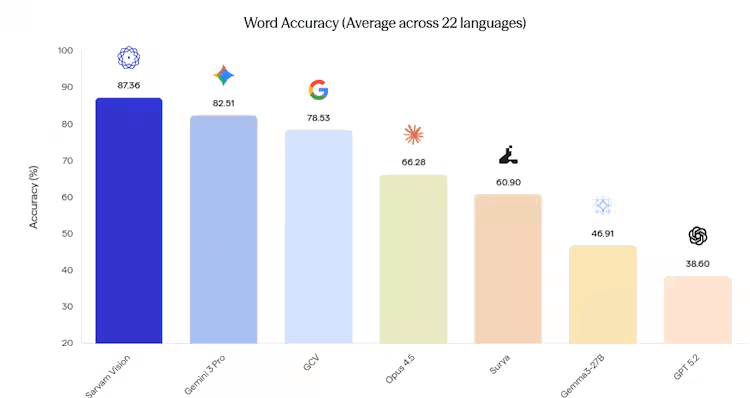
The Benchmarks
In evaluations conducted in early February 2026, Sarvam Vision proved that smaller, specialized models can beat the world’s most powerful general-purpose systems on targeted tasks.
| Benchmark | Sarvam Vision Accuracy | Google Gemini 3 Pro | OpenAI ChatGPT (GPT-4o) |
| olmOCR-Bench | 84.3% | 80.2% | 69.8% |
| OmniDocBench v1.5 | 93.28% | ~ | ~ |
These scores indicate that while Sarvam Vision may not be a “general intelligence” replacement for ChatGPT in creative writing or coding, it is significantly more reliable for digitizing the vast, often poorly formatted paper records found in Indian banks, government offices, and courts.
Bulbul V3: Giving AI an Indian Voice
The second pillar of Sarvam’s recent launch is Bulbul V3, a state-of-the-art text-to-speech (TTS) platform released on February 5, 2026. For AI to be inclusive in a country where literacy rates vary and regional accents are diverse, it must be able to speak naturally.
Key Features of Bulbul V3:
- Linguistic Depth: Currently supports 35+ expressive voices across 11 Indian languages (including Hindi, Tamil, Telugu, and Bengali), with a roadmap to cover all 22 official languages.
- Code-Mixing Mastery: Unlike foreign models that struggle with “Hinglish” or other mixed-language patterns common in Indian speech, Bulbul V3 is trained specifically to handle these nuances.
- Telephony Optimization: In blind A/B human listening studies, Bulbul V3 outperformed rivals like Cartesia Sonic-3 and Azure TTS, particularly in low-bandwidth, 8 kHz telephony environments—ideal for Indian call centers and rural helplines.
The Sovereign AI Strategy: Why it Matters
The emergence of Sarvam AI comes at a time when the Indian government is investing ₹10,300 crore into the IndiaAI Mission. This mission marks a defining step toward strategic autonomy, ensuring India has the ability to build and control its own AI infrastructure. The “Full-Stack Sovereign AI Stack” involves:
- Sovereign Compute: Building massive AI-optimized data centers. India has already onboarded over 38,000 GPUs available at subsidized rates for startups.
- Domestic Learning Loops: Keeping Indian data within national boundaries to train models locally rather than “exporting data and importing tokens.”
- Digital Public Infrastructure: Embedding AI into governance to make services accessible in every taluka and district.
India’s AI Revolution:The Future of Indian AI
Sarvam is not alone. The Indian ecosystem is flourishing with players like Hugging Face India Labs, Niramai (healthcare), and Cycible (cybersecurity) contributing to this indigenous tech stack.
While global giants will likely continue to dominate the “general-purpose” chatbot market, Sarvam AI has demonstrated that for a country like India, specificity is the new superpower. By mastering the way Indians speak, read, and document their lives, homegrown startups are ensuring that India is no longer just a passenger in the AI revolution—it is one of the drivers.