
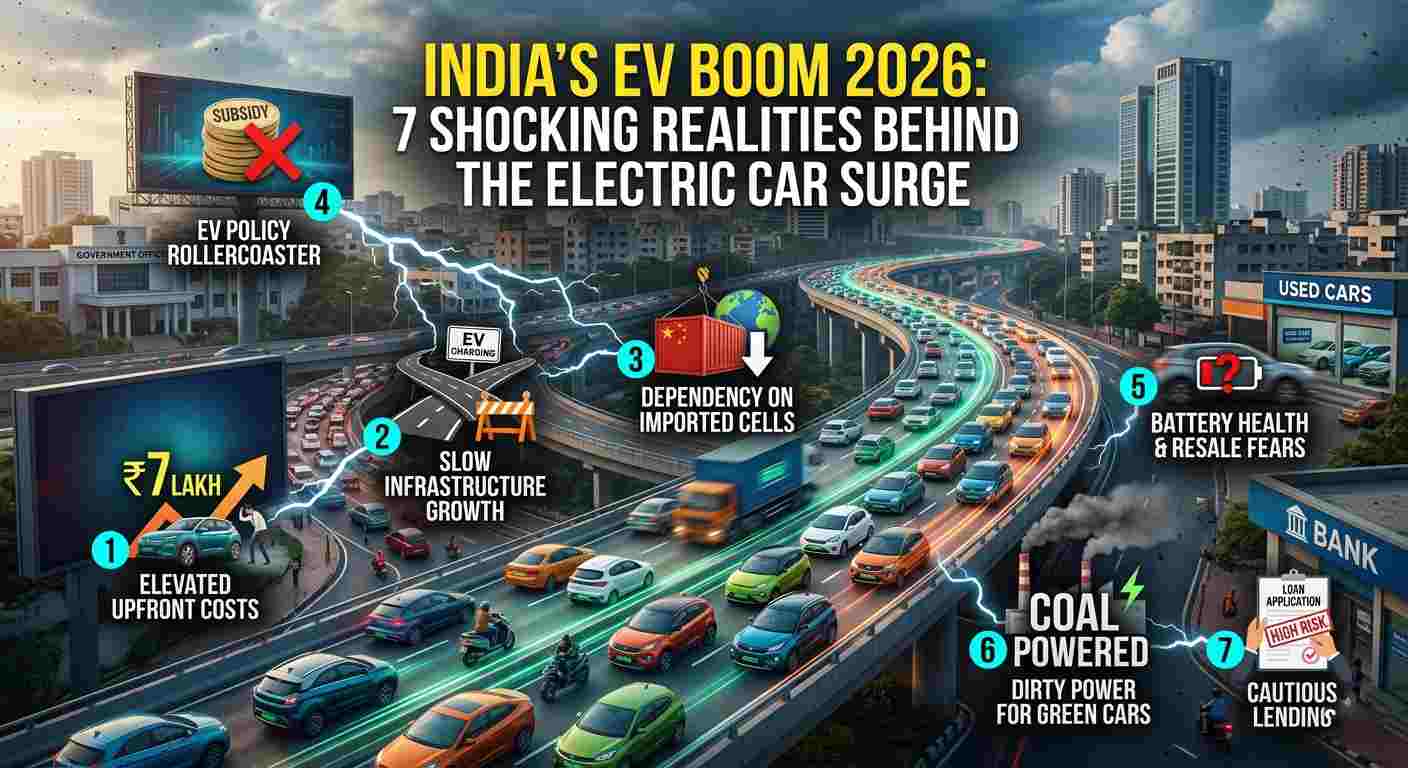
India’s EV Boom 2026 is witnessing a fascinating paradox. On one hand, the streets of Delhi, Mumbai, and Bengaluru are increasingly humming with the silent whine of electric motors. On the other hand, the industry is hitting a “reality wall” where infrastructure gaps and pricing dilemmas are forcing a massive recalibration.
According to the latest data from the Federation of Automobile Dealers Association (FADA), electric vehicle sales in India surged by approximately 25% year-on-year in FY26, reaching a staggering 24.5 lakh units. While the momentum looks unstoppable on paper, the transition from early adopters to the mass market is proving to be a bumpy ride.
The Rs 7 Lakh Barrier:Why the “Common Man” is Still Hesitant
Despite the hype surrounding India’s EV Boom 2026 the biggest hurdle remains the “upfront cost” dilemma. For the average Indian family looking for a primary vehicle, the magic number is often below Rs 7-8 lakh. Currently, most capable electric SUVs and sedans sit well above the Rs 12-15 lakh bracket.
Srikumar Krishnamurthy, Senior Vice President at ICRA Limited, notes that while the journey is moving in line with government targets, several inherent challenges persist:
Elevated Upfront Costs: EVs remain significantly more expensive than their Internal Combustion Engine (ICE) counterparts.
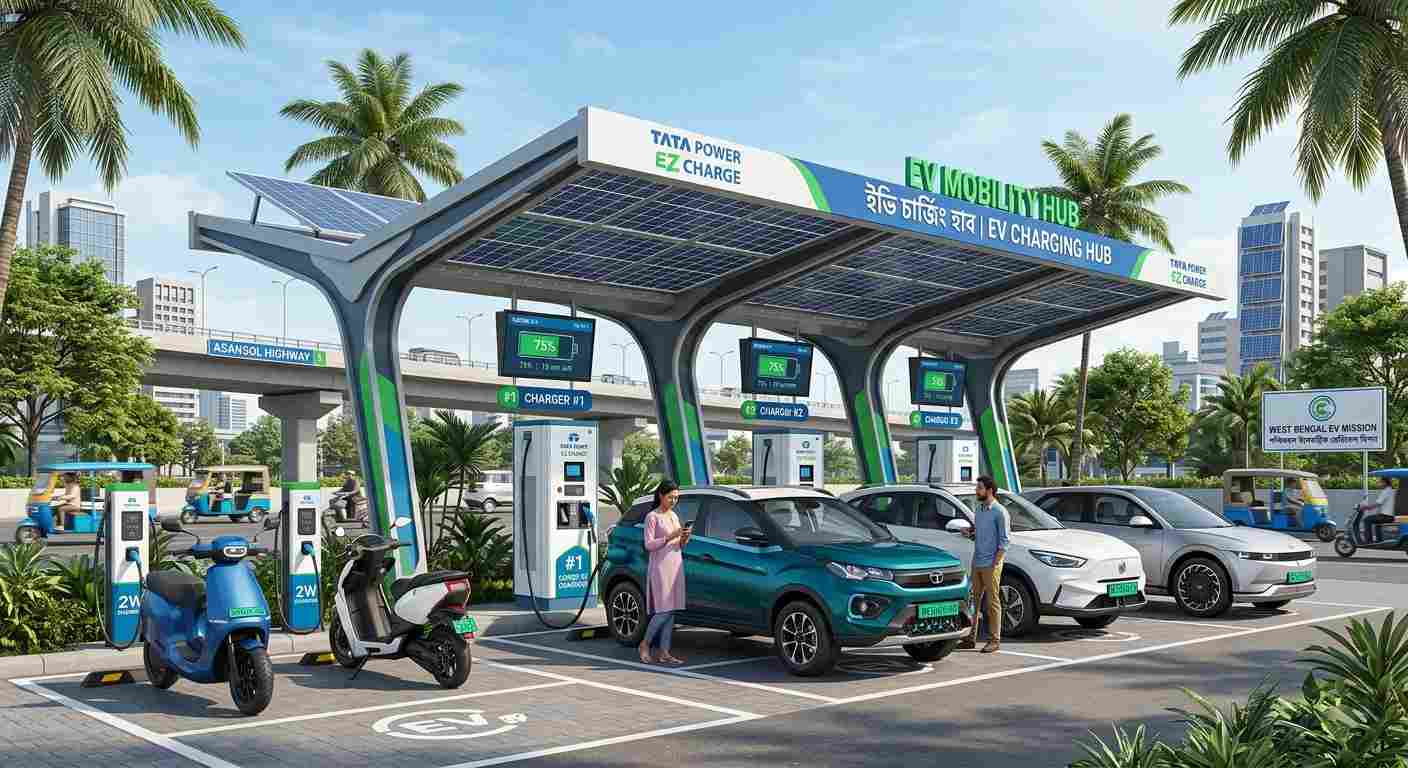
Slower Ecosystem Growth: Charging stations are still a rare sight in Tier-2 and Tier-3 cities.
Cautious Lending: Banks remain hesitant to offer aggressive financing due to uncertainty over the resale value of EV batteries.
Global Recalibration: Why 2030 Goals are Being Lowered
It’s not just an Indian phenomenon. The global automotive landscape is undergoing a “shuffling phase.” Counterpoint Research recently revised its global EV sales forecast downward. While they previously predicted a 44% market share by 2030, that figure has been adjusted to 36%.
Why the sudden cooling of heels? Major global players like Ford, General Motors, and Mercedes-Benz have collectively incurred over $70 billion in EV-related losses. This has led to a strategic shift where manufacturers are:
Scaling back production plans to match slower-than-expected adoption.
Investing back into Hybrid and ICE technology to maintain profitability.
Extending deadlines for 100% Zero-Emission Vehicle (ZEV) targets.
The Geopolitical Silver Lining: Oil vs. Electrons
While the market faces “short-term setbacks,” the geopolitical climate is ironically acting as a long-term catalyst. The ongoing tensions involving the US, Israel, and Iran have disrupted Middle Eastern oil supplies, leading to extreme fuel price volatility.
For a country like India, which imports the vast majority of its crude oil, the shift to electric isn’t just about the environment—it’s about national energy security. As countries look to reduce reliance on imported fuel, the case for EVs becomes a strategic necessity rather than just a lifestyle choice.
India’s EV Boom 2026 : 5 Game-Changing Factors for the Future of Indian EVs
| Factor | Impact on Market | Estimated Timeline |
| Battery Price Drop | Expected to hit below $70/kWh, making EVs as cheap as petrol cars. | By 2030 |
| Indigenous Cell Mfg | Reducing dependency on Chinese imports. | 2027-2028 |
| Charging Corridors | Massive expansion of fast chargers on National Highways. | Ongoing |
| Second-Hand Market | Emergence of a structured used-EV market. | 2028 |
| Regulatory Shifts | Possible rollback or restructuring of FAME-III subsidies. | 2027 |
The Path Forward: Measured Acceleration
As we look toward 2030, the “Electric Dream” is far from dead—it is simply becoming more realistic. The industry is moving away from aggressive, idealistic targets and toward a “measured electrification strategy.”
Partnerships like Stellantis’s Leapmotor JV and Volkswagen’s collaboration with Rivian show that the future lies in shared platforms and technological synergy. For the Indian consumer, the “Boom” will truly arrive when the cost of a battery no longer accounts for 40% of the vehicle’s price, and a charging plug is as easy to find as a tea stall.
“The global automotive industry stands at a crossroads, balancing near-term strategy adjustments with growing energy uncertainty.” — Greg Basich, Associate Director, Counterpoint Research.
In conclusion, India’s EV Boom 2026 is a story of grit and growing pains. The race is definitely on, but the winners won’t just be the ones with the fastest cars—they’ll be the ones who solve the infrastructure and pricing puzzles for the 1.4 billion people waiting to make the switch.