
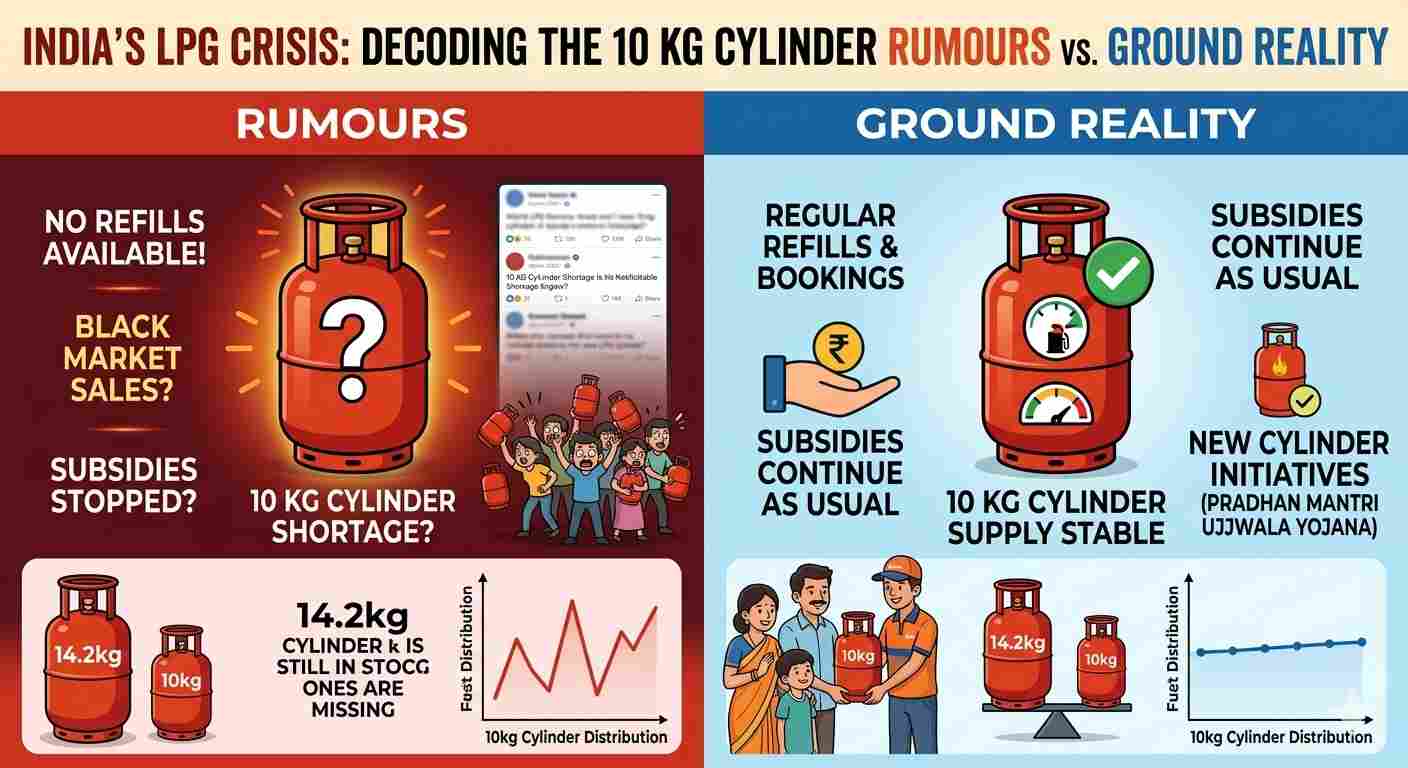
India’s LPG Crisis: The Indian energy landscape is currently navigating one of its most challenging periods in recent memory. As geopolitical tensions in the Middle East—specifically around the critical Strait of Hormuz—impact global supply chains, the ripple effects are being felt in kitchens across India.
Recent reports suggesting that the standard 14.2 kg LPG cylinder might be replaced by a 10 kg variant have sparked widespread concern among households. Here is an in-depth analysis of the current situation, the government’s official stance, and what consumers can actually expect.
India’s LPG Crisis: The “10 Kg Cylinder” Proposal: Fact or Fiction?
India’s LPG Crisis: Decoding the 10 Kg Cylinder Rumours vs. Ground Reality
Reports recently surfaced, primarily via The Economic Times, suggesting that state-run Oil Marketing Companies (OMCs) like IOC, HPCL, and BPCL were considering a temporary shift. The idea was to supply only 10 kg of LPG within the existing 14.2 kg cylinders.
The Logic Behind the Speculation:
Stretching Stocks: By reducing the volume per cylinder, the same amount of gas could be distributed among a larger number of households.
Managing Shortfalls: With nearly 60% of India’s LPG imported (and 90% of those imports passing through the Strait of Hormuz), any disruption in the Gulf directly pinches domestic inventory.
Preventing Dry-outs: Industry insiders suggested this could prevent a situation where some families have full cylinders while others have none.
India’s LPG Crisis : The Government’s Official Rebuttal:
On Monday, March 23, 2026, the Ministry of Petroleum and Natural Gas issued a stern clarification. Sujata Sharma, Joint Secretary in the Ministry, dismissed these reports as “highly speculative.”
“Reports of 14.2 kg domestic LPG cylinders being converted to 10 kg LPG cylinders are purely speculative. We urge the public not to believe in such rumours. Our focus remains on stabilizing supply and curbing illegal trade,” Sharma stated during an inter-ministerial briefing.
India’s LPG Crisis : Why is Supply Under Pressure?
The current shortage isn’t a result of domestic policy but is a direct consequence of the “Strait of Hormuz” bottleneck. This 33-km-wide waterway is the exit point for most of the world’s LPG exports from Saudi Arabia, Qatar, and the UAE.
Shipping Disruptions: In March 2026 alone, several Indian-flagged tankers were stranded in the Persian Gulf. While vessels like MT Shivalik and MT Nanda Devi have successfully crossed the Strait, the flow remains inconsistent.
Import Dependency: India is the world’s second-largest consumer of LPG. With global energy routes partially blocked, the government has had to scramble for alternative sources, including increased imports from the United States.
Refinery Pivot: To compensate for the import dip, Indian refineries have been ordered to maximize LPG production by diverting streams that were previously used for petrochemicals.
New Guidelines for Households and Commercial Users
While the 14.2 kg cylinder remains the standard, the government has introduced several measures to manage the “somewhat difficult phase” of supply:
1. Extended Booking Cycles
To prevent hoarding and “panic booking,” the waiting period between two refills has been adjusted:
Urban Areas: Approximately 25 days.
Rural Areas: Up to 45 days.
This ensures that households do not stock up on more gas than they immediately need, allowing for equitable distribution.
2. Commercial LPG Allotment
In a significant update as of March 24, 2026, the Centre has increased the commercial LPG allocation to 50% of pre-crisis levels for States and UTs.
Priority Sectors: This 50% volume is earmarked for restaurants, dhabas, hotels, industrial canteens, and dairy units.
Migrant Support: A special 10% of this quota is focused on providing 5 kg “Free Trade LPG” (FTL) for migrant labourers and community kitchens.
3. The PNG Push
The government is aggressively pushing the transition to Piped Natural Gas (PNG). Over 3.5 lakh domestic and commercial PNG connections have been activated in the last three weeks alone.
Incentives: City Gas Distribution (CGD) companies are offering incentives (like ₹500 free gas) to those who switch from LPG to PNG.
Mandatory Transition: For some commercial establishments to qualify for the new 50% LPG quota, they must show they are “ready” to receive a PNG connection.
What This Means for the Average Household
For now, the 14.2 kg cylinder is not being replaced. However, the way you use it might have to change:
No “Dry-outs”: The government maintains that while supply is “worrisome,” there are no dry-outs at distributorships. Delivery is currently “normal.”
Panic Booking is the Enemy: Officials have noted that panic bookings create artificial shortages. If your cylinder has gas, wait until it is near empty to book the next one.
Strict Vigilance: Over 3,500 raids have been conducted across India to catch hoarders and black marketers selling domestic cylinders for commercial use.
Looking Ahead: The Energy Outlook for April 2026
The situation remains tied to the geopolitical climate in West Asia. While the 5-day pause in strikes announced by the US has cooled oil prices below $100, the energy supply chain is far from fully restored.
India’s strategy of diversifying to US-origin LPG and ramping up domestic refinery output (which is up nearly 28-40% recently) provides a cushion, but the “booking discipline” of the average citizen will be the deciding factor in avoiding a full-scale crisis.