
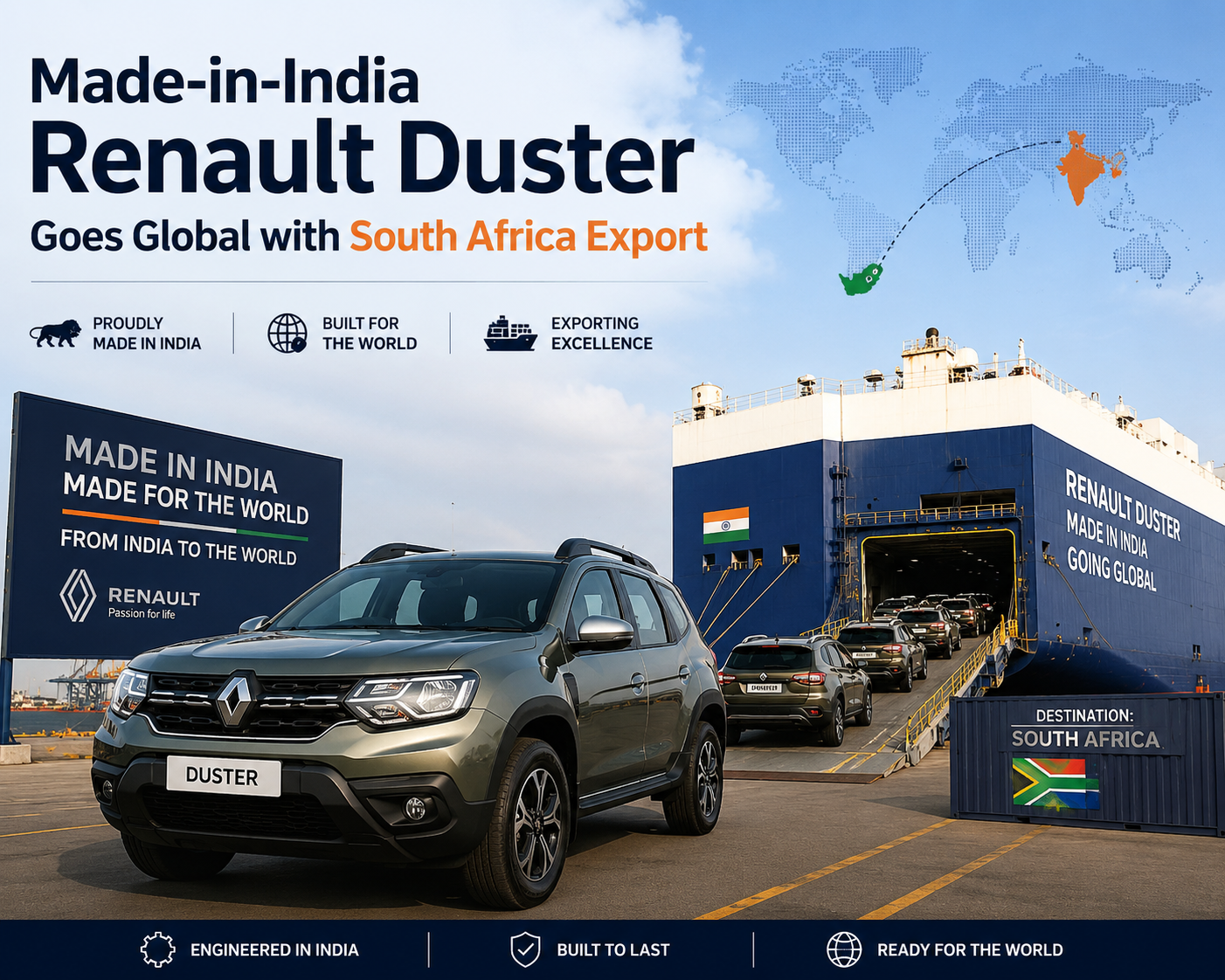
The Indian automotive manufacturing sector just locked in another massive win on the global stage. Renault India has officially kicked off its international export program for the highly anticipated, all-new Duster. In a major milestone for the French automaker’s Indian operations, the initial batch of 750 SUVs has officially set sail from the Chennai Port, bound straight for South Africa.
This strategic move does not just mark the return of an iconic nameplate to international waters; it firmly cements India’s position as a primary manufacturing and engineering hub within the Renault Group’s global industrial footprint. With plans to roll out the SUV to several other international markets in the coming months, the Made-in-India Renault Duster is geared up to spearhead Renault’s ambitious global growth strategy.
Renault’s Strategic Shift: India as a Global Export Hub
For years, global automakers viewed India primarily as a high-volume, cost-sensitive domestic market. However, a major structural shift has been underway. Thanks to a rapidly evolving logistics ecosystem, world-class manufacturing plants, and a massive pool of highly skilled engineering talent, India has transformed into an export powerhouse.
The commencement of the Made-in-India Renault Duster export program is a direct reflection of Renault Group’s broader ‘futuREady’ strategy. This initiative is explicitly designed to optimize local manufacturing efficiencies while leveraging India’s cost-competitive, high-quality production capabilities to cater to right-hand-drive (RHD) and left-hand-drive (LHD) markets across the world.
The €2 Billion Vision by 2030
Renault isn’t just testing the waters here; they are playing an incredibly high-stakes game with massive long-term commitments. Commenting on the historic departure of the first shipment from Chennai, Mr. Stephane Deblaise, CEO of Renault Group India, highlighted the country’s massive potential:
“The start of exports of the all-new Duster is an important moment for Renault India and a strong validation of the quality, capabilities, and competitiveness of our operations in Chennai. It reflects the progress we have made in building India into an integral part of Renault’s global industrial footprint.”
Deblaise further outlined a highly ambitious fiscal target for the brand’s Indian operations. Renault aims to generate a staggering €2 billion (approximately ₹18,000 crore) in annual exports from India by the year 2030. The all-new Duster, alongside a wave of upcoming next-generation vehicles, will serve as the primary catalyst to achieve this aggressive commercial objective.
Inside the Tech: The All-New RGMP Architecture
The vehicle heading to South African shores is a massive departure from the utilitarian Duster that Indian and global buyers grew fond of over the last decade. The new-generation SUV is the very first vehicle in India to be constructed on the cutting-edge Renault Group Modular Platform (RGMP).
A Flexible, Future-Proof Foundation
The RGMP architecture is a highly adaptable, modular platform engineered to accommodate a vast array of body styles, wheelbases, and, most importantly, advanced powertrain technologies.
[RGMP Modular Architecture]
       │
       ├──► Structural Rigidity & Enhanced Safety
       ├──► Multi-Powertrain Flexibility (ICE, Hybrid, EV)
       └──► Scalable Wheelbase (5-Seater & 7-Seater Layouts)
By shifting the Duster to this global platform, Renault has unlocked several critical advantages:
Enhanced Structural Rigidity: The extensive use of high-strength and ultra-high-strength steel ensures a much stiffer chassis, directly translating to superior highway handling, reduced body roll, and exceptional crash protection.
Alternative Powertrain Compatibility: As global emissions regulations tighten, the RGMP platform allows Renault to seamlessly integrate mild-hybrid, strong-hybrid, and even fully electric (EV) setups on the same assembly line without requiring completely new vehicle geometry.
Optimized Cabin Space: The clever packaging of the platform allows for shorter overhangs and a maximized wheelbase, giving passengers significantly more legroom and cargo capacity compared to older-generation crossovers.
Safety First: Securing the Coveted 5-Star Bharat NCAP Rating
In the modern automotive landscape, exceptional build quality is no longer just a luxury—it is an absolute prerequisite for entering highly regulated international markets. Renault has left no room for compromise here. The new Made-in-India Renault Duster has successfully secured a perfect 5-star safety rating from Bharat NCAP (BNCAP).
What makes this achievement particularly impressive is that the top-tier rating applies across all variants and powertrain options. Whether a customer chooses the entry-level trim or the fully loaded version, the core structural integrity and safety kit remain uncompromisingly excellent.
Why the BNCAP Milestone Matters for Global Exports
| Safety Feature | Impact on Domestic Market | Impact on Export Markets (e.g., South Africa) |
| 5-Star Crash Rating | Boosts consumer trust against local rivals. | Meets rigorous international safety benchmarks effortlessly. |
| Standard ESC & Six Airbags | Aligns with upcoming safety mandates. | Prepares the vehicle for strict global entry requirements. |
| Advanced Driver Assistance (ADAS) | Offers premium tech appeal to tech-savvy buyers. | Crucial for competing with established European and Asian brands. |
This robust safety profile heavily reinforces the vehicle’s readiness for global export destinations where consumer awareness and government safety mandates continue to grow increasingly stringent.
Driving the Renaissance of Renault IndiaTo understand why the launch and export of this mid-size SUV are so vital, one has to take a quick look back at Renault’s journey in the Indian market.
The original Duster, launched over a decade ago, single-handedly put Renault on the Indian automotive map. It created the monocoque mid-size SUV segment out of thin air, combining the ruggedness of a traditional ladder-frame off-roader with the driving dynamics of a comfortable hatchback. It was an overnight sensation, driving massive volumes for the brand.
However, after the original model was eventually discontinued due to aging architecture and shifting emissions standards, Renault India’s portfolio contracted significantly. The brand relied heavily on its mass-market trio:
Kwid: The quirky, entry-level micro-crossover.
Triber: The highly practical, sub-4-meter 7-seater MPV.
Kiger: The stylish, compact turbo-petrol SUV.
While these models maintained steady volume, Renault lacked a premium, aspirational flagship vehicle to pull buyers up the value chain. The return of the Duster brand name is the cornerstone of Renault India’s aggressive revival strategy.
The domestic reception has already proven the market’s hunger for the nameplate, with local sales recently crossing the 5,000-unit milestone in record time. With prices starting at a highly competitive Rs 10.5 lakh (ex-showroom), it strikes a phenomenal balance between affordability, premium features, and rugged capabilities.
Looking Ahead: The Future Product Pipeline (2026–2027)
The export of the 5-seater Duster to South Africa is merely the opening chapter of a much larger, multi-year product offensive. Renault has carefully aligned a series of major launches to capitalize on the momentum generated by the RGMP platform.
1. The Duster 7-Seater Version (Expected Late FY 2026)
Recognizing the massive global and domestic demand for three-row family SUVs, Renault is currently fast-tracking a longer, more premium 7-seater version of the Duster. Built on the exact same scalable RGMP platform, this upcoming model will target larger families looking for weekend adventure capabilities without sacrificing urban ride comfort. It will feature a distinct visual identity, upgraded cabin appointments, and potentially more powerful engine options to handle the extra weight.
2. The Sub-4-Meter ‘Bridger’ SUV (Diwali 2027 Launch)
Further down the line, Renault is developing an all-new sub-4-meter rugged SUV, internally referred to or codenamed as the ‘Bridger’. Scheduled for a high-profile launch around Diwali 2027, this vehicle will slot cleanly between the Kiger and the Duster. It aims to offer buyers the chunkier, commanding road presence of a true blue SUV while remaining perfectly sized and priced for congested metropolitan environments.
The Broader Impact on India's Economy and Supply ChainWhen a massive container ship loaded with 750 SUVs leaves the Chennai Port, it represents a massive win for the localized automotive ecosystem.
Building the Duster in India requires an extensive network of Tier-1 and Tier-2 component suppliers spanning across major industrial automotive clusters like Chennai, Pune, and Delhi-NCR. From localized high-tensile steel stamping to intricate electronic control modules and locally sourced seat fabrics, the high level of localization significantly boosts the domestic manufacturing ecosystem.
Furthermore, this export push perfectly aligns with the Indian government’s “Make in India” initiative. By scaling up production volumes for both domestic consumption and international markets like South Africa, Renault achieves massive economies of scale. This allows them to keep component costs low, maintain highly competitive pricing in showrooms, and reinvest profits directly into localized R&D for future mobility solutions.
Final Thoughts: A New Era for the Iconic Duster
The departure of those first 750 units to South Africa is definitive proof that Indian manufacturing has truly come of age. The Made-in-India Renault Duster is no longer just a vehicle built specifically to handle tough Indian roads; it is a meticulously engineered, internationally compliant product capable of taking on the best crossovers the world has to offer.
Boasting a flawless 5-star Bharat NCAP safety rating, a highly advanced modular RGMP platform, and an aggressive pricing structure, the Duster is perfectly poised to reclaim its legendary status. If this initial export batch is anything to go by, Renault Group India is well on its way to hitting that monumental €2 billion export target, making India a global automotive powerhouse to be reckoned with.