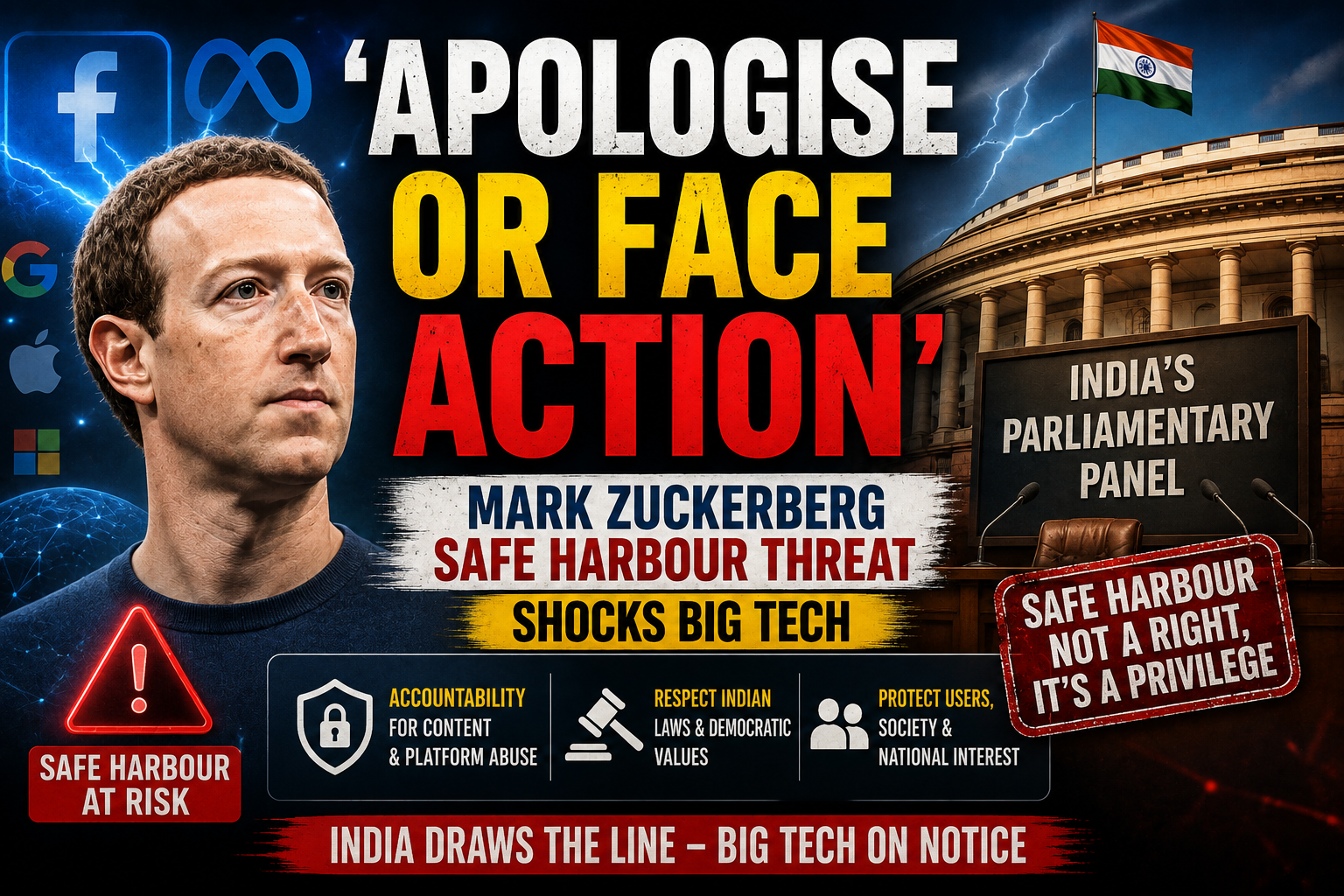
The Mark Zuckerberg Safe Harbour Threat is getting worse. It is now a fight between the biggest tech company in Silicon Valley and Indian lawmakers. A powerful group of lawmakers in New Delhi has given Metas Chief Executive Officer three days to say sorry and take action. This is because they removed a video message from Prime Minister Narendra Modi.
The group is led by Bharatiya Janata Party MP Nishikant Dubey. They are very upset about the video being removed. They do not think it was a mistake. They think it was a challenge to Indias authority and an attack on democracy. They are saying this because Prime Minister Narendra Modi represents a lot of people 1.4 billion citizens.
If Meta does not do what the lawmakers want within three days they will take away the protections that Facebook, Instagram and Meta have. This protection is called harbour protection. If they lose this protection the top people at Meta could be in trouble. They could even be arrested. The police in India could file reports against them which are called First Information Reports. The Mark Zuckerberg Safe Harbour Threat is a deal. Meta needs to be careful. The Indian government is serious, about the Mark Zuckerberg Safe Harbour Threat.
The Spark: A Brief Deletion with Massive Legal Fallout
The problem started on July 23 when Prime Minister Narendra Modi made a video and posted it on his media accounts. He wanted to talk to people like students, about what the government is going to do about exam paper leaks. He said the government is going to take action. This was happening when a lot of students were protesting and a group called the Cockroach Janta Party was organizing these protests.
The video went up on Instagram without any issues. When it was posted on Facebook it was blocked right away. For a hours people who tried to watch or share the video got error messages. Facebook eventually put the video up after a lot of people including government officials complained.. The fact that the video was blocked for a little while made a lot of people in the government very upset.
The government called people from Facebook to come and explain what happened. The people from Facebook said they were sorry and that it was a technical mistake.
* They said it was a mistake with their technology.
* The government did not think this was an enough explanation.
The Ministry of Electronics and Information Technology did not accept this explanation. They said a big company, like Facebook cannot say it was a mistake when it is dealing with the Prime Minister. The government wants Facebook to make sure this does not happen again so they are telling Facebook to fix its systems. The government thinks it is very important that Facebook doesn’t interfere with what the government’s doing. The Prime Minister and the government are very important. Facebook should make sure it can handle their communications without any problems.
Understanding Safe Harbour: What’s at Stake for Meta?
To grasp why the committee’s threat carries such profound weight, one must understand how modern digital platforms operate legally within India’s borders. Under current regulations, social media companies operate under “intermediary status.”
| Legal Status | Protection Level | Corporate Liability |
| Intermediary (Safe Harbour) | High | Protected from user-generated content lawsuits under IT Act Section 79. |
| Publisher Status | Low / None | Direct liability for every piece of content published or moderated. |
Intermediary status works like a shield that protects platforms from being held responsible for harmful content created by users. If tech companies follow government requests to remove content have someone to handle complaints and do their part to check for problems they are not legally responsible for what others post
Committee Chairman Nishikant Dubey said that Meta’s actions went beyond being a middleman. By choosing which political messages to allow or block platforms stop being neutral. When they make decisions, about what content to show they are no longer a passive helper.
“Deleting the Prime Minister’s video was not the responsibility of an intermediary but that of a publisher,” stated Dubey during a media briefing. “Therefore, Mark Zuckerberg must apologize within three days. If he fails to do so, we will revoke the safe harbour protection currently provided to social media platforms, a privilege that they have been misusing.”
If safe harbour shields are dismantled:
State and local law enforcement agencies can register criminal complaints directly against Mark Zuckerberg and local Meta executives.
Courts can hold platform leadership accountable for copyright infringement, defamation, and national security violations occurring on their sites.
Lawsuits could flood lower courts nationwide, forcing tech companies to continuously litigate moderation decisions.
The Broader Regulatory Storm: CSAM and Illegal Ads
The ultimatum surrounding the Prime Minister’s video does not exist in a vacuum. It represents the culmination of mounting frustration among Indian regulators regarding digital platform compliance across multiple fronts—most notably regarding Child Sexual Abuse Material (CSAM) and illicit advertising.
Parallel to the video row, the parliamentary panel issued a stern, simultaneous warning to all major social media platforms active in India, including:
Google and YouTube (Alphabet Inc.)
X (formerly Twitter)
Facebook, Instagram, and WhatsApp (Meta Platforms)
Snapchat (Snap Inc.)
All tech entities have been given the same three-day timeline to demonstrate strict compliance with child protection guidelines and purge objectionable, deepfake, or non-consensual graphic content targeting women.
Recent statistics published by the National Crime Records Bureau (NCRB) highlight the severity of the crisis. In 2024, Indian authorities registered 1,238 distinct cybercrime offenses specifically targeting children. Out of those cases, 1,099 involved the transmission or online publishing of sexually explicit content involving minors. Furthermore, overall criminal offenses against children surged by 5.8 percent year-over-year, reaching 1.87 lakh cases—representing a 46 percent spike in child-related online offenses since 2020.
Dubey emphasized that regulatory enforcement regarding child safety and women’s dignity rises above partisan politics:
“Pornographic content cannot be allowed in India. Child sexual abuse material is a heinous crime. AI-generated fake videos of women or obscene depictions are also heinous crimes. This is above political parties, religion, and caste because this country is extremely sensitive when it comes to children and women.”
This federal pressure follows recent enforcement actions taken at the state level. In Telangana, police authorities registered formal cases against Google for permitting fraudulent financial investment applications on its store, alongside parallel cases against Meta over the uncontrolled distribution of deepfake videos impersonating political figures.
The Road Ahead: Tech Sovereignty vs. Corporate Governance
The conflict between New Delhi and Silicon Valley is a moment in how the world regulates technology. For years big technology companies have used the same global rules to manage content. These rules are mostly handled by computer programs and teams from companies.. Now countries are asking for more local control, quicker responses to complaints and immediate responsibility for what platforms decide.
If Meta follows the rules set by the group of lawmakers and says sorry as a company and punishes the people involved in the removal of content it could set a big example. Other countries might use strong methods to stop their own leaders from being affected by computer systems.
On the hand if Meta continues to control its own rules or only uses the first technical reason it gave Indian government groups seem ready to test the limits of a certain law. Taking away protection from issues would change completely how big internet companies work in India—the country with the most people using the internet.
As the three days pass, people who study technology, legal experts and those who watch politics are all paying attention. They want to see if Meta gives in to the pressure from the government or risks getting in trouble, with the law.