
New Delhi, April 4, 2026 —India’s Arms Exports: For decades, the global narrative regarding India’s military was one of a “voracious buyer.” Whether it was French Rafales, Russian S-400s, or American Apaches, India was the perennial customer, consistently ranking at the top of the SIPRI charts for arms imports.
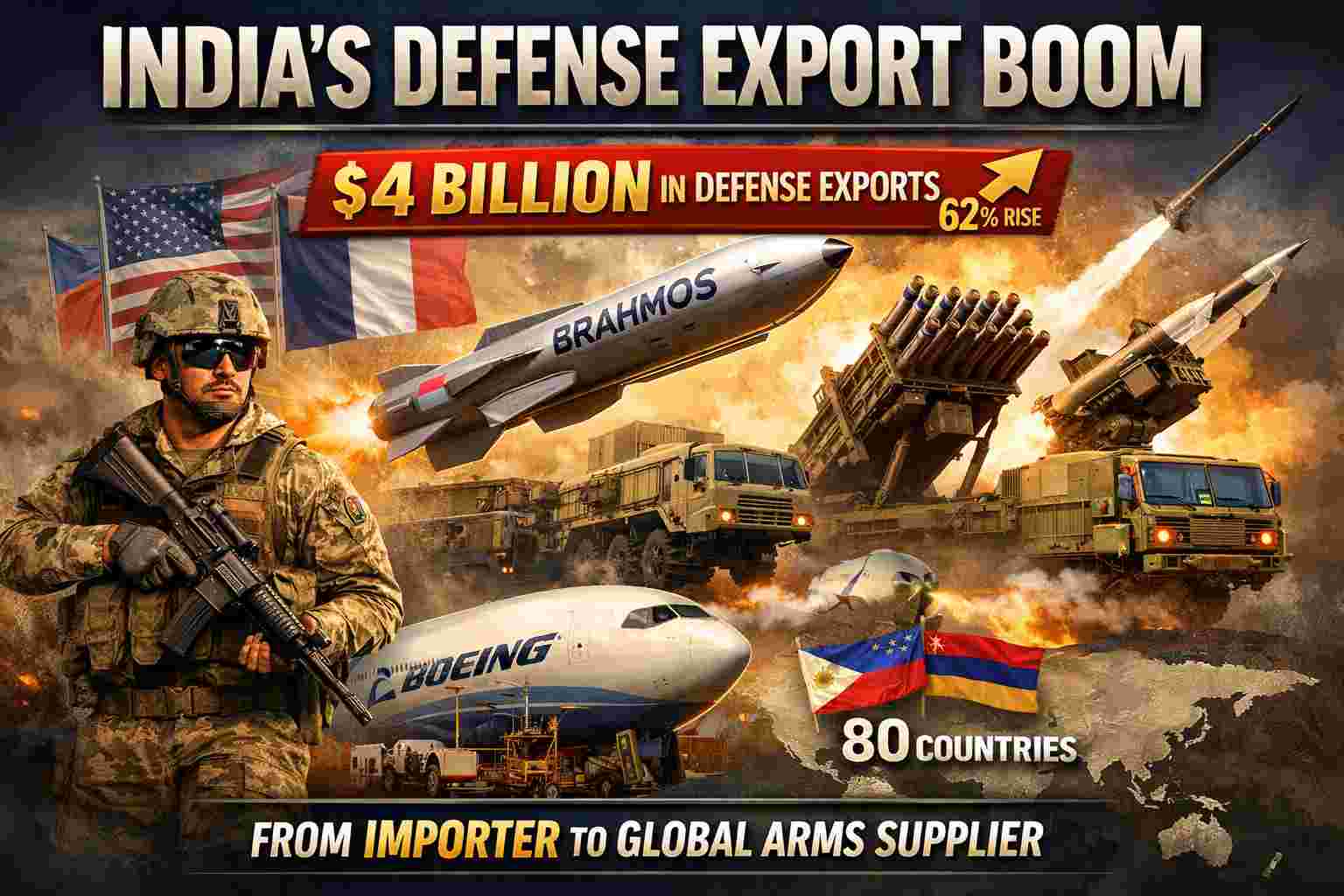
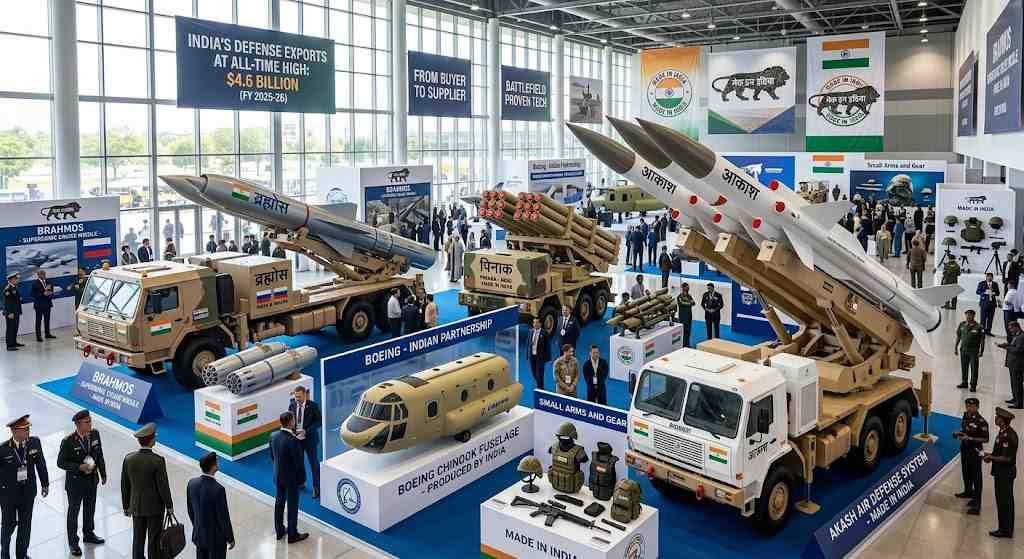
But the tide has turned. According to the latest figures released for the 2025-26 financial year, India has officially transitioned from a buyer to a formidable supplier. India’s defense exports have surged to an all-time high of approximately $4.6 billion (₹38,424 crore), marking a staggering 62.66% growth over the previous fiscal year.
This isn’t just a statistical blip; it’s a tectonic shift in the global arms trade.
India’s Arms Exports The Anatomy of a 62% Surge
The Dragon Slayer: How India’s Arms Exports Hit a Historic $4.6 Billion High : In the 2024-25 fiscal year, India’s defense exports stood at a respectable $2.8 billion (₹23,622 crore). Fast forward twelve months, and that figure has ballooned to $4.6 billion. To put this in perspective, India’s defense exports have nearly tripled in the last five years.
| Metric | FY 2024-25 | FY 2025-26 | Growth % |
| Total Export Value | $2.8 Billion (₹23,622 Cr) | $4.6 Billion (₹38,424 Cr) | 62.66% |
| Public Sector (DPSUs) | ₹8,389 Crore | ₹21,071 Crore | 151% |
| Private Sector | ₹15,233 Crore | ₹17,353 Crore | 14% |
A key highlight of this growth is the performance of Defense Public Sector Undertakings (DPSUs). While the private sector has traditionally led the export charge, the state-run firms saw a massive 151% jump this year, now accounting for nearly 55% of total trade. This suggests that India’s legacy ordnance factories and shipyards have finally modernized their production lines to meet international standards.
Who is Buying “Made in India” Weapons?
The Dragon Slayer: How India’s Arms Exports Hit a Historic $4.6 Billion High : India now exports to more than 80 countries. While the government remains tight-lipped about the specifics of every contract, a clear pattern of “top-tier” customers has emerged:
- The United States: The Component Giant
The US remains India’s largest market, but the relationship is symbiotic. Top American defense giants like Boeing and Lockheed Martin have integrated Indian factories into their global supply chains.
- What they buy: Small arms, advanced helmets, body armor, and critical aerospace components.
- The Boeing Connection: Indian factories now produce complex fuselage and airframe components for global platforms. In fact, nearly half of India’s arms exports to the US consist of these specialized, high-value parts.
- Armenia: The Strategic Partner
In the South Caucasus, Armenia has become the primary destination for complete Indian weapon systems. Seeking to counterbalance the “Three Brother” alliance of Pakistan, Turkey, and Azerbaijan, Armenia has turned to New Delhi for high-tech, reliable hardware.
- Akash Air Defense System: Armenia has reportedly purchased two batches of this medium-range system, which can engage targets up to 80 km away.
- Pinaka Multi-Barrel Rocket Launchers: India has sold both guided and unguided versions. The latest versions of the Pinaka can strike targets at a range of 120 km.
- Southeast Asia: Countering Hegemony
Countries like the Philippines and Indonesia are looking for “lethal yet affordable” deterrents against maritime aggression.
- BrahMos Missiles: In 2022, the Philippines inked a $375 million deal. Recently, Indonesia followed suit with a deal valued between $200 million and $350 million. Vietnam is also reportedly in final negotiations for a $400 million BrahMos contract.
India’s Arms Exports The Power of “Battlefield Provenance”
One of the biggest drivers of this export boom is the “proven” nature of Indian tech. Theoretical specs are one thing; real-world performance is another.
Last year, during Operation Sindoor (May 2025), Indian indigenous systems were tested in a high-intensity aerial conflict. Reports suggest that BrahMos supersonic cruise missiles—which travel at Mach 2.8—successfully bypassed sophisticated air defenses. Simultaneously, the Akash Air Defense system proved its mettle by successfully intercepting incoming threats.
When weapons perform in a live conflict, global demand naturally follows. Nations are no longer just looking at the price tag; they are looking at the track record.
Why Now? The Global Vacuum
The timing of India’s rise is no coincidence. The global arms market is currently facing a supply-side crisis:
- Russia: Traditionally a top exporter, Russia is currently “bogged down” in its own conflict in Ukraine, consuming its production for domestic use.
- The United States: While a powerhouse, Washington’s stockpiles are being stretched thin by support for various allies, including ongoing tensions in the Middle East.
This has created a vacuum. Emerging “flashpoints”—such as the Armenia-Azerbaijan border, the South China Sea (Philippines vs. China), and the Thai-Cambodian border—have left regional powers searching for new, reliable suppliers. India, offering high-tech systems that are compatible with existing Russian-origin hardware but built with modern Western-style precision, has become the “third way” for these nations.
The Road to $6 Billion and Beyond
The Indian government isn’t stopping at $4.6 billion. Prime Minister Narendra Modi’s administration has set an ambitious target of $6 billion (₹50,000 crore) in annual exports by 2029.
To achieve this, the focus is shifting from selling “parts” to selling “platforms.”
- LCA Tejas: India is aggressively pitching its Light Combat Aircraft to nations in Africa and Southeast Asia.
- Advanced Towed Artillery Gun System (ATAGS): Indigenous artillery is gaining traction for its precision and mobility.
- Naval Platforms: With the inauguration of the “Sagar Sankalp” initiative, India aims to become a top-five shipbuilding nation by 2047, exporting frigates and patrol vessels.
“This milestone showcases the power of a collaborative and self-reliant defense ecosystem,” said Defense Minister Rajnath Singh. “India is no longer just a consumer; we are a provider of security solutions for the world.”
Conclusion: A New Global Identity
The “Turnaround of the Decade” is well underway. India’s transition from a net importer to a top-25 global arms exporter is more than just a business success; it is a diplomatic masterstroke. By selling weapons to 80 countries, India is building long-term strategic dependencies and proving that “Atmanirbhar Bharat” (Self-Reliant India) is a reality, not just a slogan.
As traditional superpowers find their capacities stretched, India is stepping into the light—offering a lethal, affordable, and battlefield-tested alternative. The world is buying, and India is just getting started.