
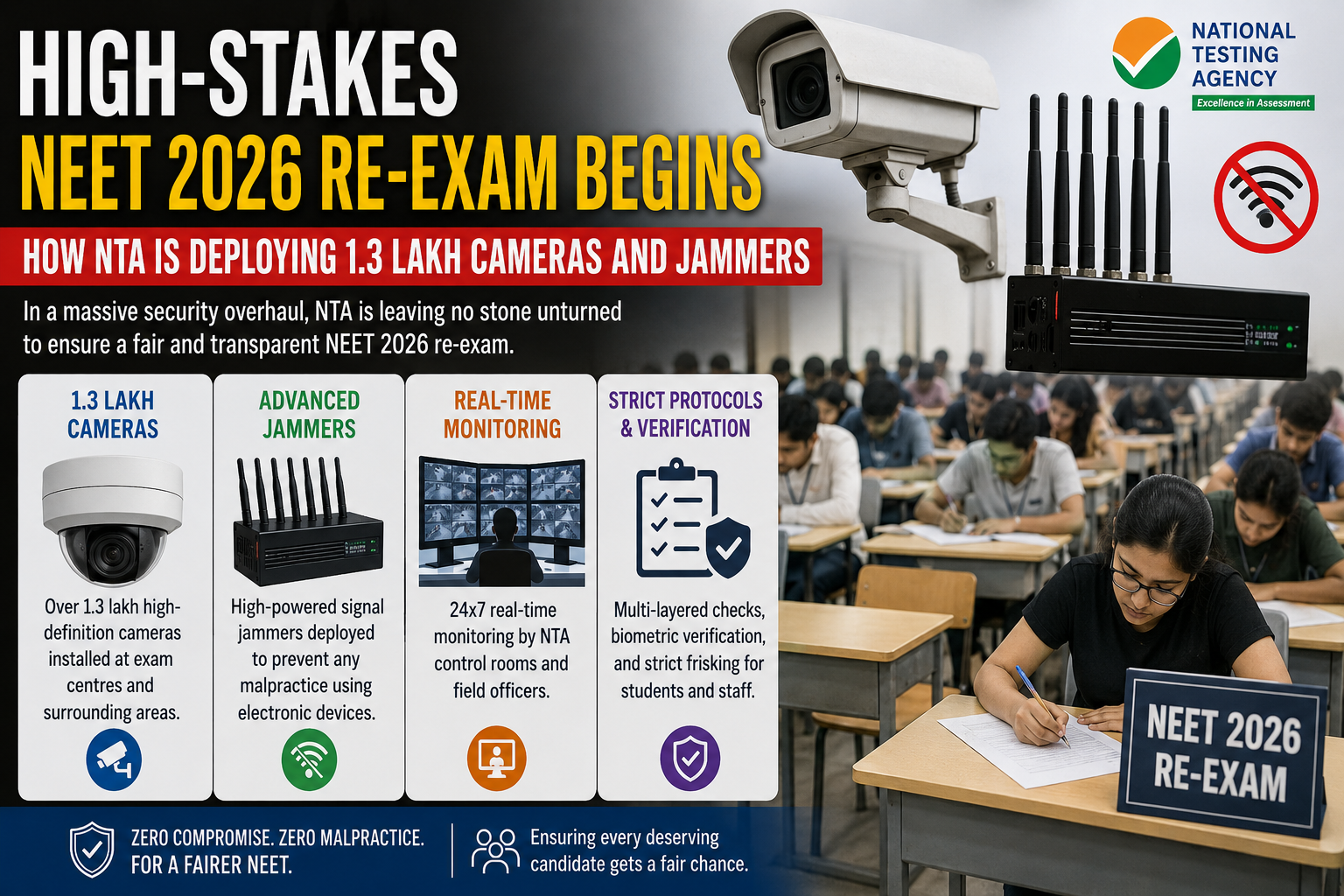
The National Eligibility cum Entrance Test (NEET) is arguably the most stressful academic milestone for medical aspirants in India. However, today’s NEET 2026 re-exam is not just a test of knowledge for over 22 lakh students; it is an ultimate trial of administrative capability for the National Testing Agency (NTA) and the central government. Following the massive public outcry, street protests, and widespread political pressure that trailed the paper leak and subsequent cancellation of the May 3 examination, authorities have essentially locked down the national testing infrastructure to execute an unprecedented security operation.
From airlifting question papers via the Indian Air Force to completely shutting down popular messaging networks across the country, the Indian education ministry is leaving absolutely no room for error. The stakes could not be higher. For the lakhs of families who have spent years funding coaching classes and enduring sleepless nights, today is about reclaiming a fair shot at their dreams. For the NTA, it is a desperate, multi-layered bid to salvage its institutional credibility.
The Scale of the NEET 2026 Re-Exam Logistics
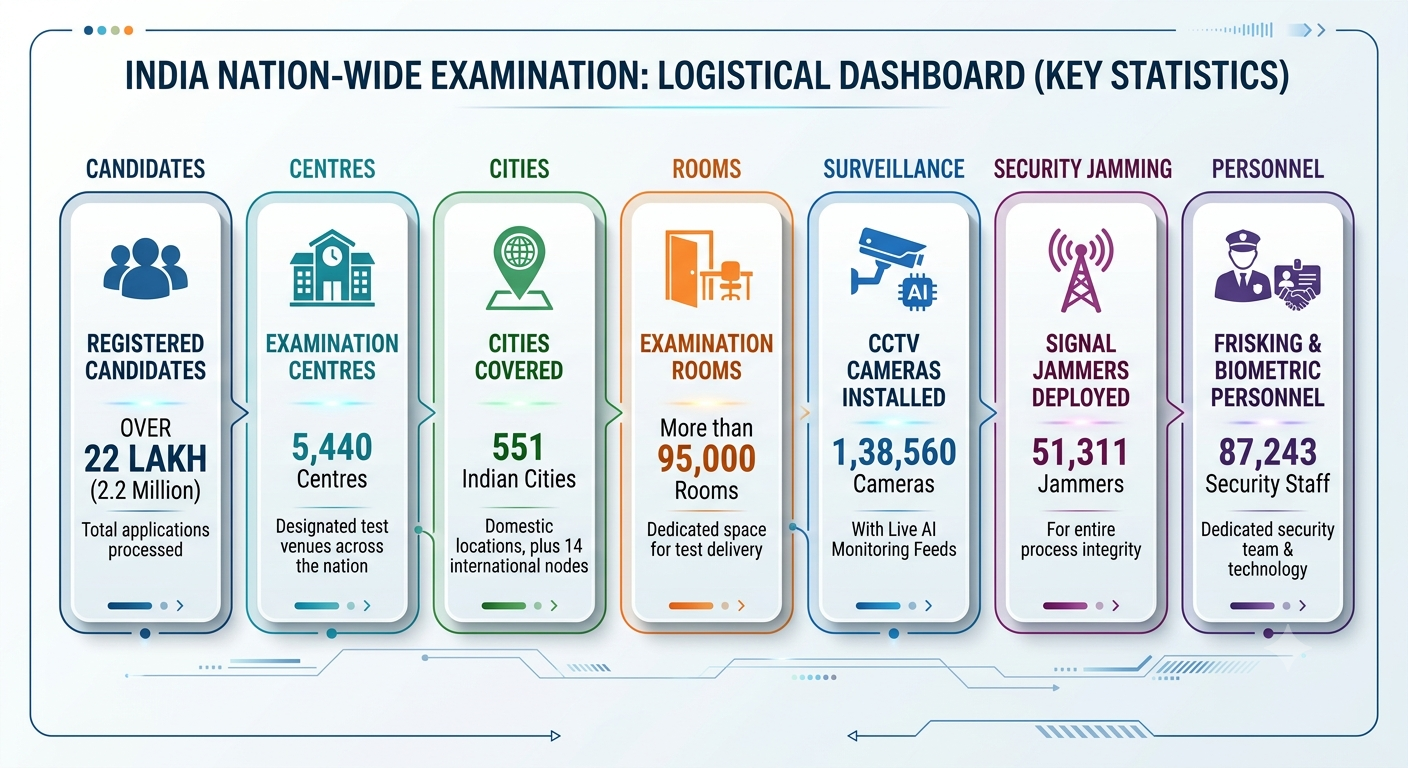
To appreciate the sheer gravity of what is unfolding today, one must look at the numbers. Managing an exam for more than 2.2 million candidates simultaneously is a logistical nightmare even under normal circumstances. Under a high-security mandate, it requires an apparatus larger than the internal security deployment of some small countries.
The examination window is tightly constrained. The standard test runs from 2:00 PM to 5:15 PM, giving students exactly 3 hours and 15 minutes to solve the highly competitive paper. In a bid to remain inclusive amid the chaos, candidates with disabilities who are eligible for compensatory time have been allocated an extended window, allowing them to write their papers until 6:20 PM.
However, the real work for the students began hours before the first question booklet was opened. The NTA enforced a strict lockdown on centre entry gates. Candidates were ordered to arrive between 11:00 AM and 1:30 PM, armed only with their vital documents: the official NEET 2026 re-exam admit card, a valid government-issued photo ID, and two recent passport-size photographs. At precisely 1:30 PM, gates across all 5,440 centres were slammed shut, leaving latecomers entirely out of options—a harsh but necessary measure, according to officials, to maintain the sanctity of the timeline.
Unprecedented Security: Air Force Jets, AI, and a National Telegram Ban
The cancellation of the May exam exposed deep vulnerabilities in how test papers were stored, transported, and distributed. To counter this, the government has overhauled the entire chain of custody, transforming a civil academic exercise into a military-grade logistical operation.
1. Secure Chain of Custody via the IAF
In previous iterations, papers relied on standard secure transit methods, which left local vulnerabilities open to exploitation by organized paper-leak mafias. For today’s NEET 2026 re-exam, the question papers were literally airlifted by the Indian Air Force (IAF) to key regional hubs. From there, they were transferred directly to approximately 1,500 heavily guarded custodian bank branches.
To ensure the loop remains uncompromised on the return journey, the Department of Posts has established a synchronized network involving dedicated teams across 700 collection centers nationwide. These teams are tasked with the immediate, secure retrieval and transit of the students’ optical mark recognition (OMR) answer sheets.
2. Artificial Intelligence and the 1.3 Lakh Camera Web
Once the papers reached the local exam halls, the digital surveillance network took over. The NTA has installed an astounding 1,38,560 CCTV cameras across more than 95,000 examination rooms.
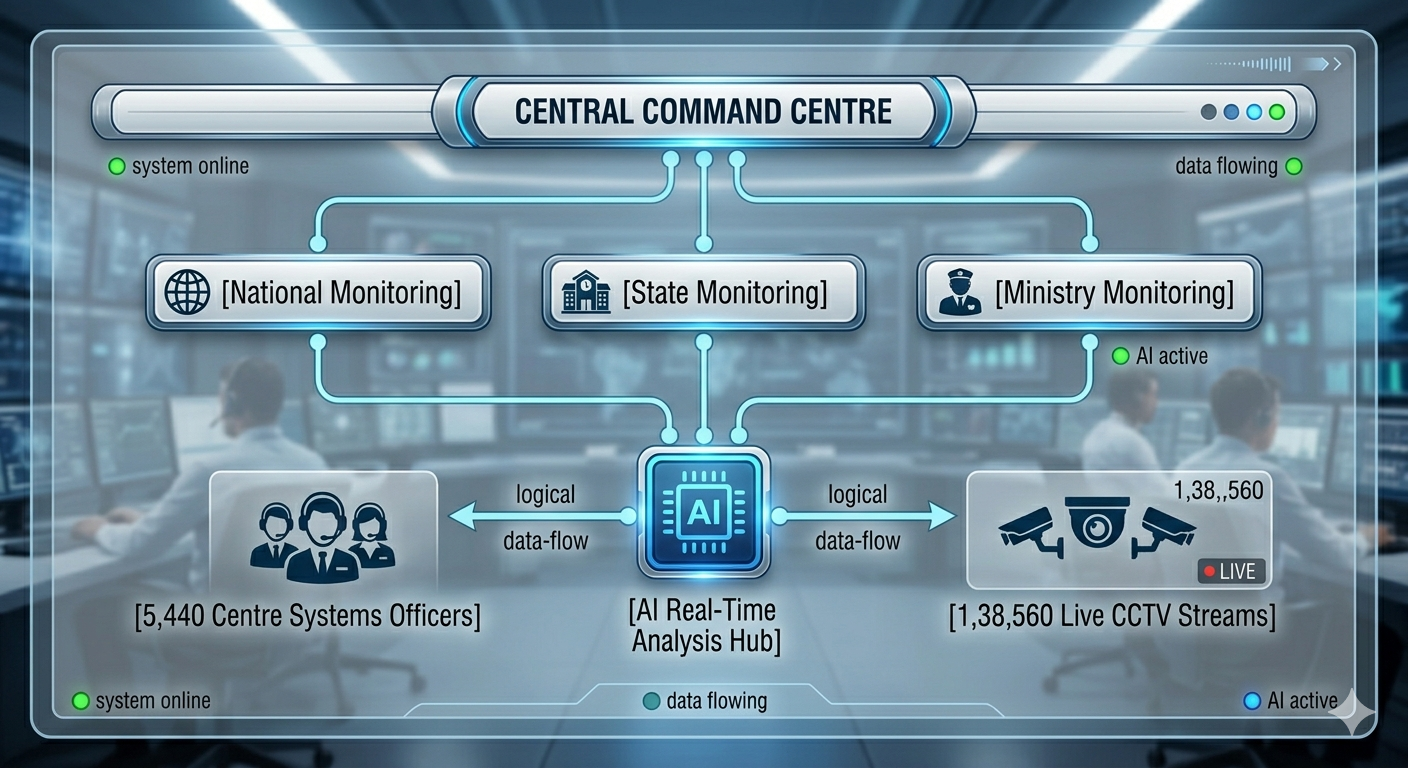
What makes this attempt different? For the first time in the history of Indian competitive exams, these camera feeds are not just recording footage for post-exam reviews. They are hooked up to an Artificial Intelligence-powered live surveillance system.
This AI monitors the feeds in real-time, flagged for behavioral anomalies, unauthorized movements, or suspicious patterns. The live feeds are being broadcast directly to virtual command hubs monitored at the National, State, and Ministry levels, with a designated Centre Systems Officer (CSO) stationed at every single venue to fix technical bugs and address red flags instantly.
3. Electronic Warfare Against Malpractice
To combat high-tech cheating methods—such as the use of micro-Bluetooth earpieces, hidden transmitters, and proxy communication devices—the ministry has deployed 51,311 signal jammers. These jammers effectively turn every exam hall into a digital dead zone for the entire duration of the test.
Furthermore, student verification has been heavily fortified. The NTA has deployed 38,795 frisking staff alongside 48,448 personnel dedicated exclusively to biometric verification. Digital identity checks have been doubled, utilizing advanced facial authentication systems alongside fingerprint scanning to guarantee that no proxy candidates sit for the exam.
4. The Digital Blackout: Why Telegram Went Dark
Perhaps the most drastic measure taken by the central authorities is the temporary, nation-wide block on the popular messaging platform, Telegram. Recognizing that the app’s encrypted, large-group format has historically been the primary breeding ground for paper-leak syndicates and rumor-mongering, access has been restricted across India until June 22.
The strategy is clear: cut off the digital communication pipelines used by bad actors to distribute fake question papers, sell fraudulent answer keys, or incite panic among vulnerable students on the eve of the exam.
Political Pressure and the Fight for Systemic Transparency
The decision to completely scrap the initial May exam results did not happen in a vacuum. It was the direct result of intense public fury. When evidence of a systemic paper leak emerged earlier this year, it triggered massive student protests in the capital and across major educational hubs like Kota and Patna.
Opposition parties quickly rallied behind the aggrieved youth. In New Delhi, protests organized by groups like the Cockroach Janta Party kept the pressure on the ruling administration, with repeated, loud demands for the resignation of Union Education Minister Dharmendra Pradhan.
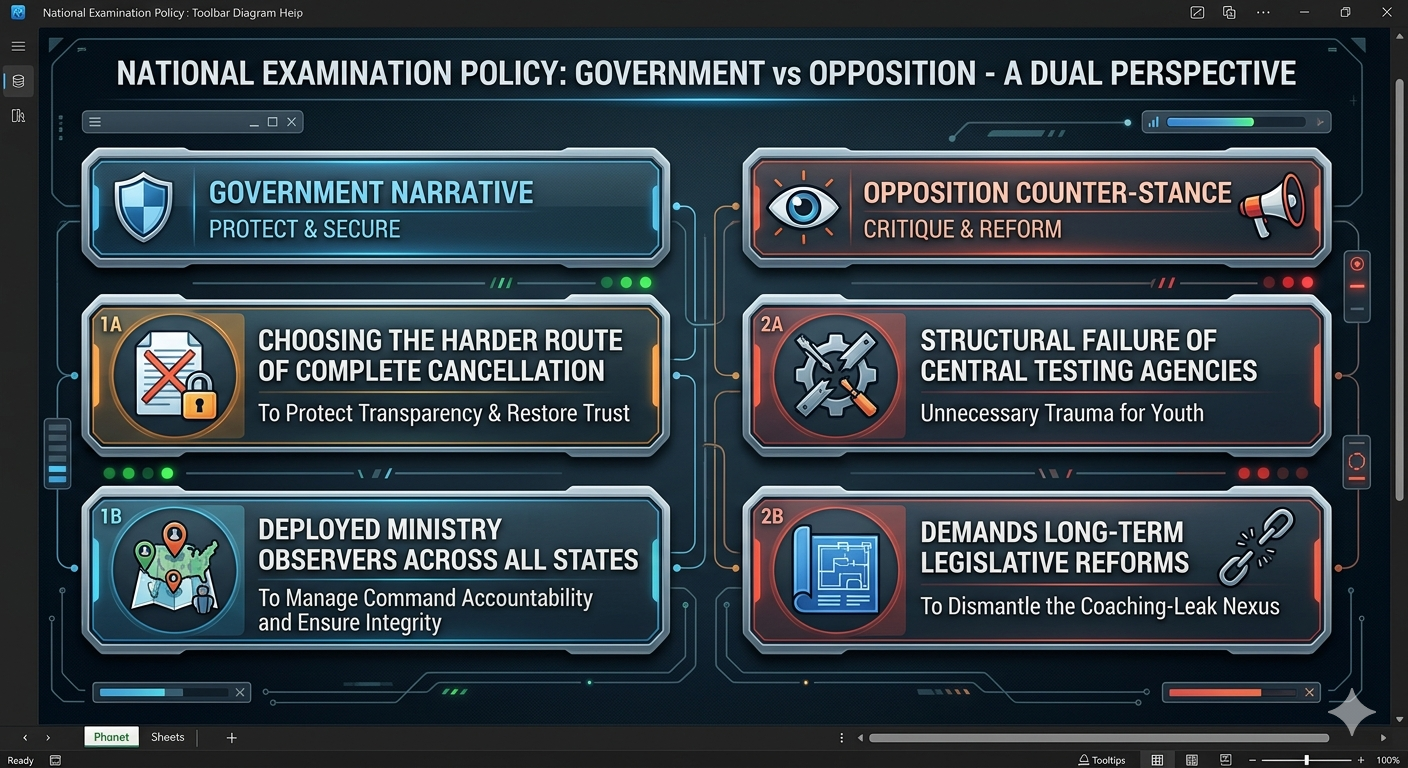
In the days leading up to today’s crucial test, Education Minister Pradhan held marathon review meetings with state Chief Secretaries, emphasizing a zero-tolerance policy for administrative lapses. The Ministry of Education has went as far as deploying its own dedicated officers to every state, bypassing standard bureaucratic layers to report directly to a central command centre headed by the NTA Director General.
Meanwhile, the political battle continues to simmer. Congress MP and Leader of the Opposition, Rahul Gandhi, who has consistently amplified student grievances on social platforms, released a direct video message on X addressed to the medical aspirants.
“I hope you have a wonderful, excellent exam and you all do really, really well,” Gandhi stated, offering a supportive message to students while taking a sharp swipe at the administration. “To the Prime Minister and to the government, I would like to say, please, please ensure that there are no glitches this time. The students have been through enough stress and they really cannot afford to go through it again.”
Dealing with Extreme Weather: Cooling Zones and Candidate Support
Beyond the high-stakes security operations, organizers faced an environmental challenge: India’s brutal summer heat. With temperatures soaring into dangerous territory across multiple northern and central states, forcing students to stand in long queues or leaving parents waiting outside for hours under the direct sun was a recipe for a medical emergency.
Recognizing this, several state administrations stepped up with comprehensive humanitarian support frameworks:
Cooling Zones: In Delhi, the local administration set up dedicated cooling zones outside all 97 examination centers in the city. These zones feature shaded seating areas designed to protect waiting parents from heatstroke.
Hydration Stations: Emergency supplies of chilled drinking water, Oral Rehydration Salts (ORS) packets, and fresh lemonade are being distributed continuously at test sites to keep people hydrated.
Medical Desks: Every single testing center is equipped with first-aid kits and on-call medical assistants to handle sudden heat-induced fainting or anxiety attacks.
Free Commute: In a major relief measure for student transit, the Delhi government announced free travel for all valid NEET 2026 re-exam admit card holders across its extensive Delhi Transport Corporation (DTC) bus network today.
Transit Help Desks: Major railway stations and inter-state bus terminals in states like Uttar Pradesh, Gujarat, Karnataka, and Tripura have established dedicated student help desks, complete with emergency transport shuttles to ensure out-of-town students reach their designated venues without losing their way.
The Abu Dhabi Centre Glitch: Administrative Error or User Mistake?
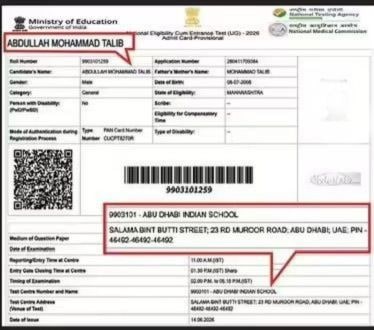
Even with months of preparation, the eve of the massive re-exam was hit by a major scare when reports of a bizarre administrative glitch went viral. Abdullah Mohammad Talib, an aspirant based out of Nagpur, downloaded his freshly issued NEET 2026 re-exam admit card only to discover that his testing venue was located thousands of miles away—in Abu Dhabi, United Arab Emirates.
The candidate’s family quickly raised an alarm, presenting proof that during the formal correction and application windows, Abdullah had clearly locked in Nagpur, Wardha, and Bhandara as his three regional preferences. The news sparked immediate panic online, with critics pointing to it as early evidence that the NTA’s digital infrastructure was still compromised or deeply flawed.
The NTA immediately launched an internal audit of its system logs to track how the international shift occurred. According to an official statement issued by the agency, the system did not malfunction:
“The city change was made through the candidate’s own registered login, with a consistent single-user access pattern.”
The agency clarified that their digital trail showed a manual request originating from the account to change the geographic location. However, recognizing the extreme duress of the student and prioritizing his academic future over technical arguments, the NTA intervened manually. They processed a last-minute emergency override, successfully re-allotting Talib a functional seat back in his home city of Nagpur.
“The NTA’s priority is that no candidate misses the examination over an administrative doubt,” the testing authority stated, hoping to permanently quiet the online controversy before it disrupted exam morning.
Cracking Down on the Social Media Information WarThe NTA’s fight today isn’t just happening at physical frisking lines; it is also being fought in cyberspace. The leak in May demonstrated how swiftly bad actors can exploit digital spaces to create mass panic, sell fake answer keys, or coordinate cheating rings.
To prevent a repeat of this disruption, cyber-surveillance units have been tracking social media platforms around the clock. Intelligence agencies noted that even in the days leading up to the re-test, several fraudulent channels on alternative messaging apps and dark-web forums were actively attempting to exploit desperate students. These syndicates were caught uploading edited, old question papers from previous years, rebranding them as “leaked NEET 2026 documents,” and demanding heavy digital payments from vulnerable families.
The NTA has taken a remarkably aggressive public stance this time, issuing strict legal warnings against rumor-mongering. The agency, backed by state police cyber cells, has initiated criminal cases against multiple online handles found circulating fabricated material. Both parents and students have been continuously reminded via SMS updates and official bulletins to completely ignore third-party leaks and trust only verified, official circulars hosted on the NTA’s portal.
What Lies Ahead for India’s National Testing Framework?
As the minutes tick away and millions of students bubble in their answers across thousands of rooms, the collective hope of a nation rests on a glitch-free evening. This NEET 2026 re-exam is more than an emergency fix; it is a turning point for the future of centralized testing in India.
If today passes without a single security breach, systemic leak, or major digital malfunction, it will offer a blueprint for how future national-level entrance tests—like JEE, CUET, and UPSC—can safeguard their operations against advanced, modern threats. It will prove that rigorous administrative will, backed by cutting-edge technology like live AI feeds and military logistics, can reclaim the sanctity of fair competition.
However, if even a minor lapse comes to light, it will fundamentally shatter what remains of the public’s trust in centralized testing agencies, likely forcing a massive structural shift toward decentralized, state-level entrance examinations.
For today, however, the focus remains entirely on the 22 lakh young minds inside those rooms. After a chaotic year filled with protests, judicial interventions, and immense emotional distress, these students deserve nothing less than a perfectly fair, completely transparent, and deeply secure environment to write their destinies.