
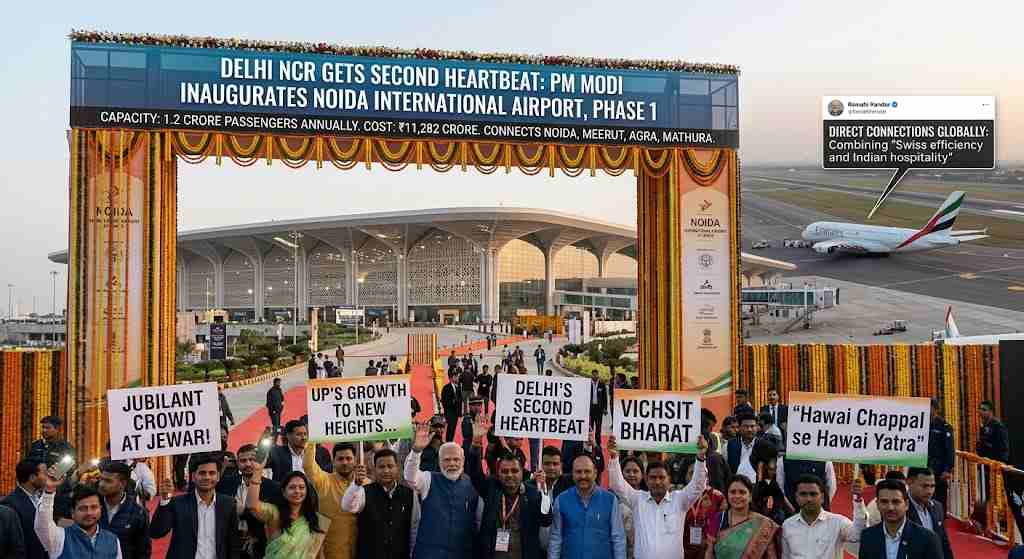
JEWAR, UTTAR PRADESH — In a historic moment for India’s aviation sector and the National Capital Region (NCR), Prime Minister Narendra Modi officially inaugurated Phase 1 of the Noida International Airport (NIA) at Jewar on Saturday, March 28, 2026.
Termed by the government as a “major international gateway,” the airport is set to become a primary aviation hub for North India, easing the immense pressure on Delhi’s Indira Gandhi International Airport (IGIA). The Prime Minister was accompanied by Uttar Pradesh Chief Minister Yogi Adityanath, Governor Anandiben Patel, and Union Civil Aviation Minister Ram Mohan Naidu.
A Vision Realized: “Swiss Efficiency, Indian Hospitality”
“Delhi’s Second Heartbeat”: PM Modi Inaugurates Phase 1 of Noida International Airport at Jewar : The inauguration follows years of meticulous planning and a construction phase that saw the project overcome multiple global supply chain hurdles. Developed under a Public-Private Partnership (PPP) model by Zurich Airport International AG, the airport aims to blend “Swiss efficiency with Indian hospitality,” according to NIA CEO Christoph Schnellmann.
During the ceremony, Prime Minister Modi took a walkthrough of the terminal building, reviewing the state-of-the-art facilities before addressing a jubilant crowd of thousands. In a symbolic gesture, the Prime Minister asked the attendees to switch on their phone flashlights, stating that the airport belongs to the people and they should be the ones to “unveil” their future.
“Delhi, the capital and the heartbeat of the country, has today found a second heartbeat.” — Ram Mohan Naidu, Union Minister of Civil Aviation
Phase 1: Scale and Investment
Delhi’s Second Heartbeat”: PM Modi Inaugurates Phase 1 of Noida International Airport at Jewar : Phase 1 of the project has been completed at an estimated cost of ₹11,282 crore. The scale of the infrastructure is unprecedented for a debut phase:
- Capacity: Initially equipped to handle 1.2 crore (12 million) passengers annually.
- Infrastructure: Features a 3,900-metre runway capable of handling wide-body aircraft like the Boeing 777-300ER.
- Investment Split: Of the Phase 1 cost, ₹6,876 crore was invested by the concessionaire, while the Uttar Pradesh government spent ₹4,406 crore, primarily on land acquisition.
The entire project, spread over 3,000 acres, is planned in four phases with a total projected investment of ₹29,560 crore. Once fully complete, it is expected to be Asia’s largest airport.
A Multi-Modal Hub for Northern India
The Noida International Airport is designed as more than just an aviation site; it is a multi-modal transport hub.
- Connectivity: The airport is linked to the Delhi-Mumbai Expressway, the Yamuna Expressway, and the Eastern Peripheral Expressway.
- Rail & Metro: Integration plans include the Amritsar-Kolkata industrial line and extended Delhi Metro corridors, significantly reducing logistics costs for the region.
- Cargo Hub: 87 acres have been dedicated to a Multi-Modal Cargo Hub, featuring an investment of ₹800 crore in Phase 1 alone. It is designed to handle 255,000 metric tonnes of cargo annually, eventually scaling to 1.8 million tonnes.
Impact on Uttar Pradesh and NCR
Chief Minister Yogi Adityanath described the airport as a “launchpad for UP’s bright future.” With this inauguration, Uttar Pradesh is on track to become the first state in India to boast five international airports.
The airport will serve as the primary international gateway for several key cities:
- Industrial Hubs: Noida, Greater Noida, Ghaziabad, and Meerut.
- Tourism & Heritage: Agra (Taj Mahal) and Mathura/Vrindavan.
- Economic Boost: Filmmaker Boney Kapoor, present at the event, noted that the airport would provide a massive boost to the upcoming International Film City project along the Yamuna Expressway.
Cultural Identity and Sustainability
The terminal’s design is a tribute to Indian heritage. The architecture incorporates elements inspired by the Ghats of Varanasi and Haridwar, featuring haveli-style courtyards and intricate lattice screens.
Simultaneously, the project is a pioneer in sustainability. It is designed as a net-zero emissions airport, utilizing natural light, advanced ventilation, rainwater harvesting, and renewable energy sources.
Security and Logistics
Given the high-profile nature of the event, Noida Police implemented a five-tier security system in coordination with the Special Protection Group (SPG). Nearly 5,000 personnel from the UP Police, PAC, RAF, and ATS were deployed, and the area was declared a no-fly zone for the duration of the visit.
Traffic diversions were in place from 7 AM to 11 PM on Saturday to manage the influx of visitors from Meerut, Ghaziabad, and Mathura, ensuring that emergency services remained uninterrupted.
The Road Ahead
The inauguration marks a pivotal step toward the “Viksit Bharat” (Developed India) vision. As Civil Aviation Minister Ram Mohan Naidu noted, the integrated aviation system of IGIA and NIA will position Delhi-NCR among the leading global aviation hubs, rivaling cities like London and New York.
For the common citizen, the goal remains accessibility. As Deputy CM Keshav Prasad Maurya remarked, “We aim to build a country where even a man in ‘Hawai Chappals’ can afford ‘Hawai Yatra.’ This airport is a major step toward that vision.”