
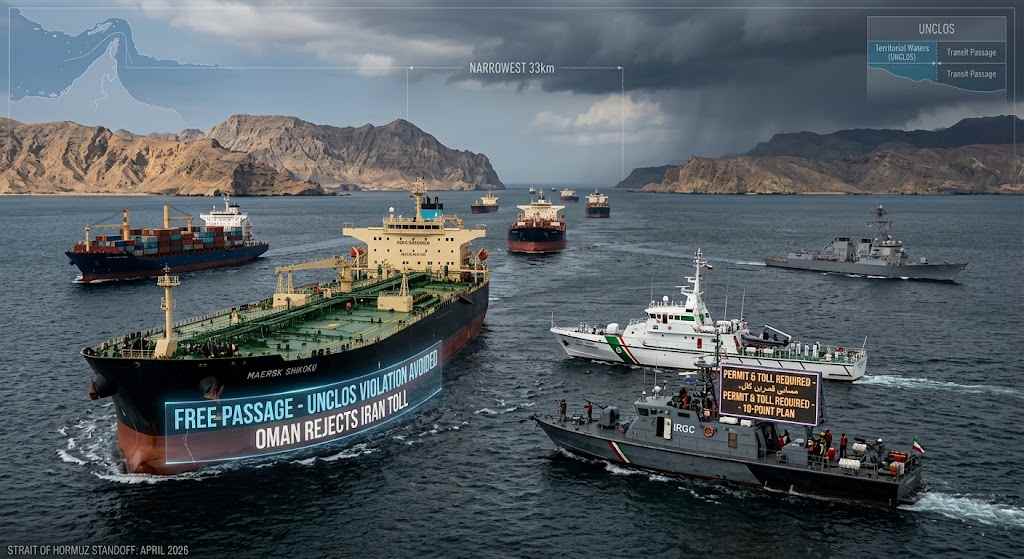
Oman Rejects Iran’s Hormuz Toll Demand: In a geopolitical maneuver that has sent shockwaves through global energy markets, the Sultanate of Oman has formally rejected a controversial Iranian proposal to levy transit tolls on ships traversing the Strait of Hormuz. The proposal, embedded within a fragile 10-point ceasefire framework mediated between Tehran and Washington, marks a radical departure from centuries of maritime tradition and current international law.
As of April 2026, the Strait of Hormuz remains the ultimate “pressure cooker” of global trade. With roughly one-fifth of the world’s oil supply passing through this narrow 33-kilometer (21-mile) stretch of water, any attempt to monetize or restrict passage isn’t just a regional dispute—it’s a direct challenge to the global economic order.
The Explosive 10-Point Proposal
Oman Rejects Iran’s Hormuz Toll Demand: The Battle for the World’s Most Critical Chokepoint : The tension began on February 28, 2026, following a series of military strikes that crippled regional stability. In the ensuing negotiations to find a diplomatic exit, Iran’s deputy foreign minister, Kazem Gharibabadi, confirmed that Tehran was seeking a new “facilitation” system.
The proposal suggested that Iran and Oman, as the two states bordering the strait, should have the authority to:
- Levy transit tolls on all commercial vessels.
- Require permits and licenses prior to entry.
- Establish a joint maritime monitoring body to manage the waterway’s traffic.
Tehran argued that these measures were necessary to ensure “smoother passage” and to fund the heightened security required during the current conflict. However, the international community viewed the move as a blatant attempt to weaponize one of the world’s most vital geographic “chokepoints.”
Muscat Breaks the Silence: “No Fees on Passage”
Oman Rejects Iran’s Hormuz Toll Demand: The Battle for the World’s Most Critical Chokepoint : While Iran framed the plan as a joint venture, the Sultanate of Oman was quick to distance itself. Omani Transport Minister Said bin Hamoud bin Saeed Al Maawali delivered a firm rebuttal, stating that Oman remains committed to its existing international obligations.
“We have signed all maritime transport agreements that stipulate no fees on passage through the Strait of Hormuz,” Al Maawali stated.
Oman’s refusal is a significant blow to Tehran’s legal and diplomatic strategy. For the toll to have any semblance of legitimacy, both “coastal states” would need to be in agreement. By siding with international norms, Muscat has effectively isolated Iran’s proposal, aligning itself with other Gulf powers like the UAE and Qatar, who fear that such fees would destabilize the region further and set a dangerous global precedent.
The Legal Verdict:Is it Lawful to Charge for the Sea?
The core of this dispute lies in the United Nations Convention on the Law of the Sea (UNCLOS), often referred to as the “Constitution of the Oceans.” Under UNCLOS, the Strait of Hormuz is classified as a strait used for “international navigation.”
1. The Right of Transit Passage
According to Article 38 of UNCLOS, all ships and aircraft enjoy the right of transit passage, which must be “continuous and expeditious.” Crucially, this passage cannot be impeded or suspended by the bordering states.
2. Prohibition of Tolls
International law is explicit: states bordering a strait cannot demand payment in exchange for the right to pass. While countries can charge for specific, tangible services—such as pilotage (guiding a ship through narrow waters), tugging, or pollution cleanup—they cannot levy a tax simply for the “privilege” of sailing through territorial waters that form part of an international strait.
3. The Customary Law Gap
There is a legal wrinkle: neither the United States nor Iran has fully ratified UNCLOS. However, both nations have historically recognized its provisions as “customary international law.” This means that even without a signed treaty, the rules are considered binding through long-standing global practice.
Expert Analysis: “Fragile Sovereignty”
Experts warn that Iran’s attempt to redefine the strait as a “controlled corridor” could unravel the fabric of global shipping. Sanjeet Ruhal, a professor at the International Maritime Law Institute, notes that while Iran and Oman retain sovereignty over their respective waters, that sovereignty is legally “capped.”
“Passage shall not be impeded,” Ruhal explains. “Once you introduce selective access or conditional tolls, you are no longer operating within the bounds of international navigation law. You are practicing maritime extortion.”
Other experts, like Saleem Ali from the University of Delaware, point out that international law is only as strong as the willingness of nations to comply. If a superpower or a major regional player ignores the rules, the “fragile” nature of these treaties is exposed. There is also a political ghost in the room: U.S. President Donald Trump has previously mused about the possibility of charging for protection in key waterways, leading some to fear a “tit-for-tat” erosion of free navigation.
Economic Impact: The “Hormuz Tax”
Since the conflict flared up in February 2026, maritime transit through the strait has plummeted. Shipping giants like Maersk and Hapag-Lloyd have already rerouted vessels around the Cape of Good Hope, adding weeks to transit times and millions to fuel costs.
If a $2 million toll (as rumored in some shipping circles) were actually implemented, the “Hormuz Tax” would result in:
- Skyrocketing Oil Prices: Immediate inflationary pressure on global energy.
- Insurance Surges: War-risk premiums would make the strait uninsurable for many.
- Supply Chain Collapse: Significant delays for commodities like aluminum, fertilizer, and helium.
The Road Ahead: Peace or Stagnation?
The two-week ceasefire announced by President Trump has provided a momentary “cooling-off” period. Trump’s warning was characteristically blunt, threatening the “destruction of a whole civilization” if the blockade wasn’t lifted.
For now, the guns are quiet, but the legal battle over the Strait of Hormuz is just beginning. Iran continues to claim a “historic victory” for its 10-point plan, while Oman’s rejection provides the international community with the legal leverage needed to keep the waterway open.
As the world watches the April 2026 deadline approach, one thing is certain: the waters of Hormuz are no longer just a path for tankers—they are a high-stakes arena where the future of international law will be decided.
Frequently Asked Questions (FAQ)
Q: Can Iran legally block the Strait of Hormuz?
A: No. Under UNCLOS and customary international law, the right of transit passage is non-suspensible. A blockade would be considered an act of war and a violation of maritime law.
Q: Why doesn’t the U.S. just pay the toll to keep things moving?
A: Paying a toll would set a legal precedent, effectively acknowledging Iran’s right to charge for transit. This would undermine the “Freedom of Navigation” principle that the U.S. Navy has defended for decades.
Q: What happens if the ceasefire expires?
A: If the two-week ceasefire (announced April 7, 2026) ends without a permanent agreement on the “Hormuz Toll,” military analysts fear a return to direct strikes on energy infrastructure and a total shutdown of the Persian Gulf.