
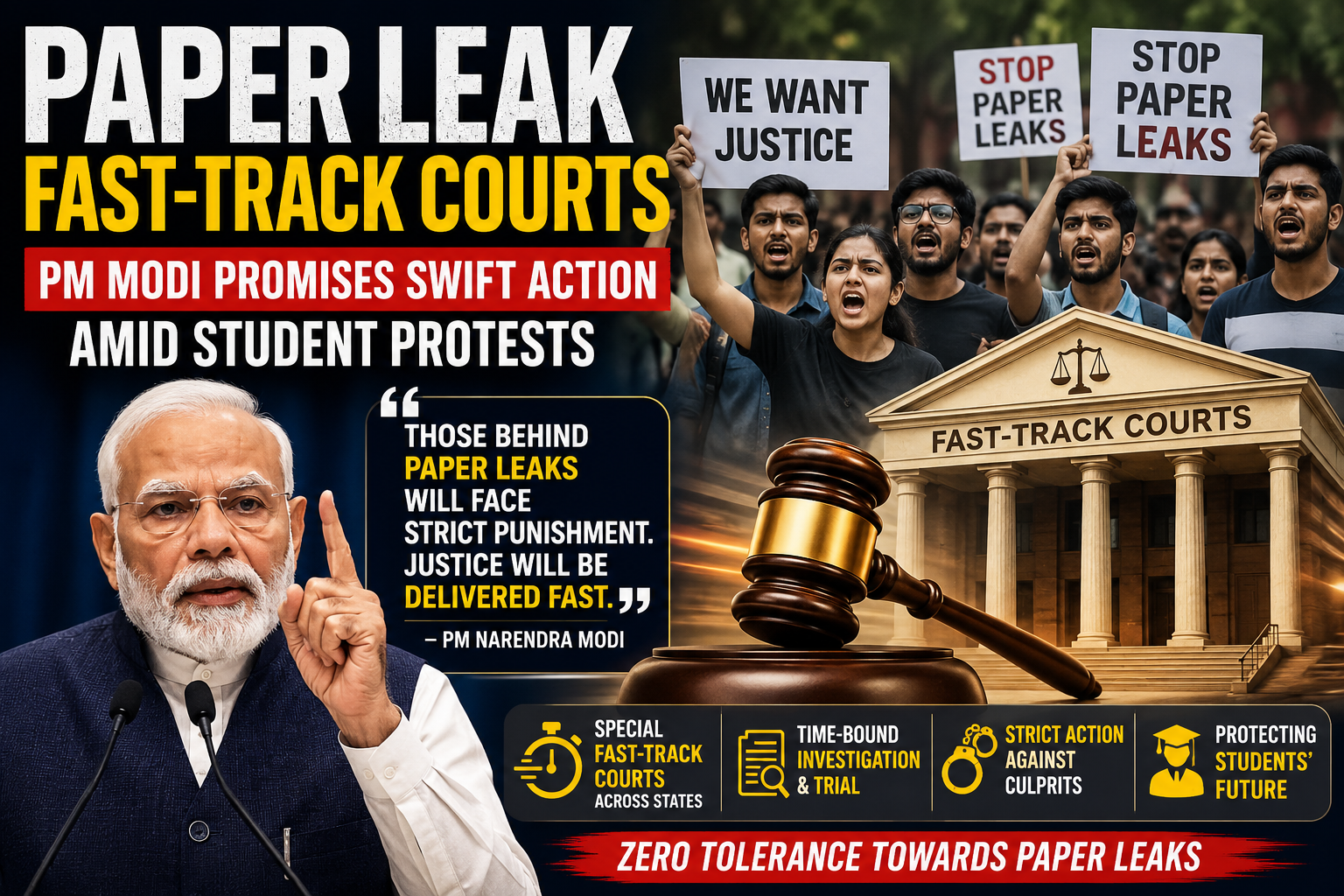
Paper leak fast-track courts have officially been announced by Prime Minister Narendra Modi as a major step to protect the future of India’s youth following widespread student demonstrations and severe uproar in Parliament. Addressing the nation through a post on social media platform X, the Prime Minister emphasized that nothing holds more value to his administration than the well-being and security of young citizens.
The announcement comes at a crucial moment when the national capital is witnessing heavy protests by student groups, Opposition parties, and satirical front Cockroach Janta Party (CJP). Demonstrators have hit the streets over alleged irregularities and paper leaks in major competitive exams, including NEET-UG, demanding immediate accountability, police restraint, and political resignations.
PM Narendra Modi Promises Strict Punishment for Paper Leak Offenders
In his first direct public statement addressing the current wave of protests, PM Narendra Modi assured students that those who attempt to compromise their academic journey will face severe legal consequences.
“Nothing is more important than the welfare and future of our youth!” the Prime Minister posted on X. “We have decided to set up fast-track courts to ensure swift and stringent punishment for those involved in paper leaks. I have directed the concerned authorities and officials to take all necessary steps in this regard.”
Modi reinforced that the establishment of these specialized judicial benches is part of a broader, continuous effort to clean up the examination framework across the country. Addressing members of the ruling alliance at a recent NDA leadership meeting, the Prime Minister described exam leaks as a “ghor paap” (grave sin), reiterating that individuals who attempt to harm the careers of young aspirants will not be spared.
Rahul Gandhi Hits Back: Points Out Past Record and Demands Action
Shortly after the Prime Minister’s announcement, Leader of Opposition Rahul Gandhi launched a strong counterattack on social media, accusing the government of allowing systemic damage to India’s educational institutions.
Rahul Gandhi claimed that despite over 150 instances of paper leaks occurring over the past decade, there has not been a single major conviction. He argued that setting up new courts does not address the core issue of administrative accountability.
In his response on X, the Congress leader wrote:
“You are the one who has harmed the future of our youth the most. You allowed and encouraged the total capture and destruction of our education system – and protected every person responsible for it.”
Rahul Gandhi outlined three main demands put forward by protesting students and the Opposition:
Immediate removal of Education Minister Dharmendra Pradhan.
An official apology from the government to the affected candidates.
Strict legal and disciplinary action against police officials who allegedly assaulted peaceful student protesters.
Parliamentary Deadlock and Demands for Resignation
The political showdown over paper leaks has effectively brought parliamentary proceedings to a standstill. The Opposition, along with activist groups like the Cockroach Janta Party (CJP), has insisted that any constructive discussion on exam reforms can only begin after Education Minister Dharmendra Pradhan steps down from his post.
While the government has stated its readiness to hold a full debate on the floor of the House regarding examination security, Treasury benches have accused Opposition parties of stalling legislative business by imposing non-negotiable preconditions.
Meanwhile, the CJP renewed its call for accountability following the PM’s message, posting a succinct demand online stating that the Education Minister must resign immediately to restore trust among aspirants.
Key Takeaways: What the Fast-Track Courts Mean for Students
Accelerated Trials: Fast-track courts aim to drastically cut down the time required to complete investigations and legal proceedings in paper leak cases.
Higher Conviction Rates: By establishing dedicated judicial infrastructure, the administration hopes to address the historical lack of swift convictions in examination fraud.
Deterrence: Stricter mechanisms and speedy sentencing are intended to act as a strong deterrent against organized exam mafias and complicit officials.
National Policy Focus: Exam security has escalated into a central political issue, likely leading to updated national protocols for test administration going forward.
As public pressure continues to build across the country, all eyes remain on how quickly these fast-track judicial bodies will be set up and whether the proposed legal measures can restore confidence among millions of hardworking students.