
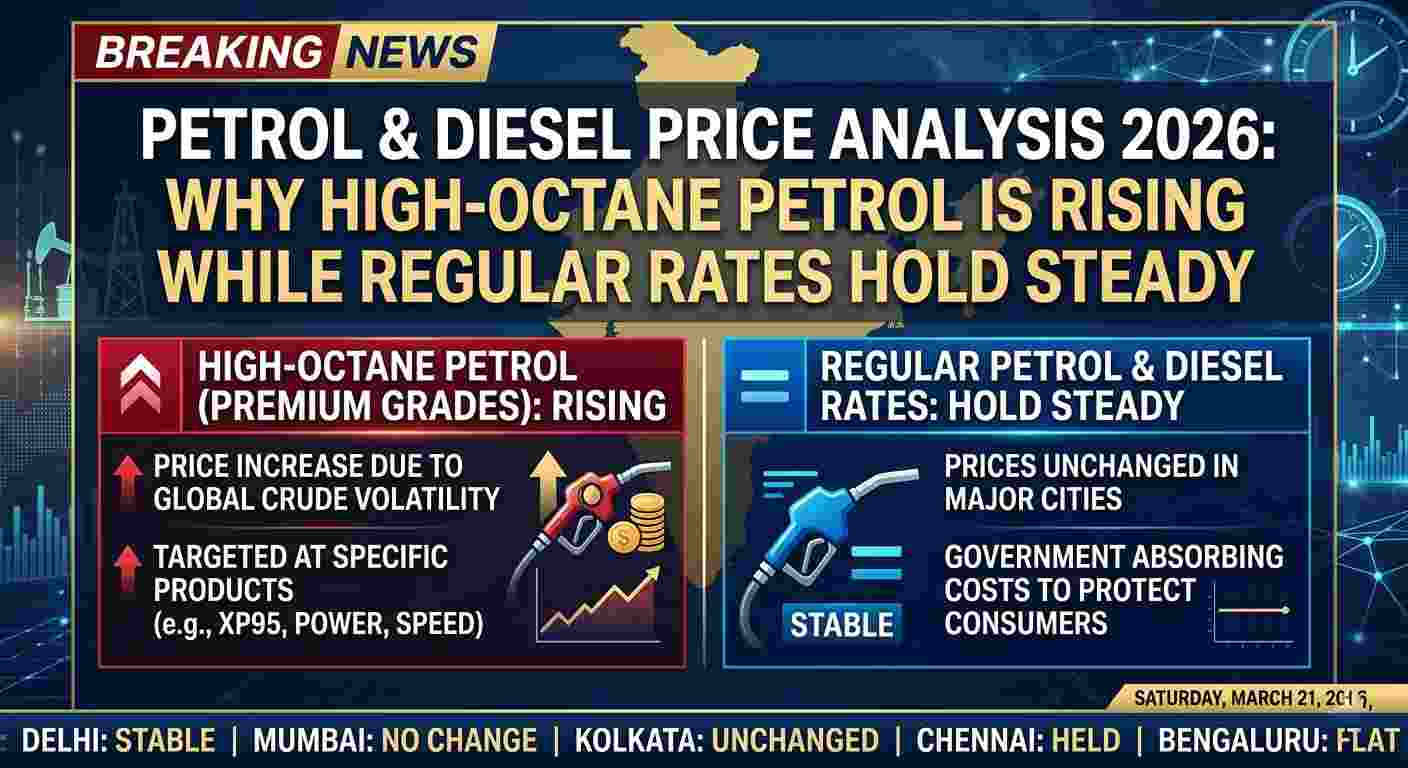
New Delhi | March 21, 2026 —Petrol, Diesel price today Price Analysis 2026: Indian commuters woke up to a mix of confusion and relief this Saturday. While headlines buzzed with news of “fuel price hikes,” a closer look reveals a strategic, calibrated move by State-run Oil Marketing Companies (OMCs). While your regular petrol and diesel prices remain largely untouched, the “premium” segment is feeling the heat of the ongoing Middle East crisis.
The Core Update: What has actually changed?
Petrol, Diesel price today Price Analysis 2026: Why High-Octane Petrol is Rising While Regular Rates Hold Steady
On March 20, 2026, the trio of Indian oil giants—Indian Oil Corporation (IOCL), Bharat Petroleum (BPCL), and Hindustan Petroleum (HPCL)—announced a price revision. However, this hike is specifically targeted at high-octane (premium) fuels and industrial diesel.
Premium Petrol Hike: Prices for branded fuels like BPCL’s Speed, HPCL’s Power, and IOCL’s XP95 have been increased by ₹2.09 to ₹2.35 per litre.
Industrial Diesel: In a more significant move, bulk/industrial diesel prices saw a sharp jump of over ₹22 per litre (rising from approx. ₹87.57 to ₹109.59 in Delhi).
Regular Petrol & Diesel: Prices for the common man remain unchanged in almost all major cities today, March 21.
State-Wise & City-Wise Fuel Price Toolbar (March 21, 2026)
Below is the latest retail price data for regular petrol and diesel across major Indian hubs.
Metro Cities Comparison
Other Key Cities
The Global Catalyst: Why the Hike?
The primary driver behind this volatility is the escalating US-Israel conflict with Iran, which began in late February 2026. This has placed the Strait of Hormuz (SoH)—the world’s most critical energy chokepoint—under severe threat.
The “Hormuz” Factor
The Strait of Hormuz is the lifeline for India’s energy security. According to a report by Kotak Institutional Equities, the SoH accounts for:
50–55% of India’s Crude Oil and LNG imports.
88% of India’s LPG (cooking gas) imports.
With the SoH currently at a virtual standstill, OMCs are facing surging import costs, higher freight insurance, and a squeeze on their marketing margins.
Financial Expert Insights: Kotak & Elara Capital
Market analysts are keeping a close eye on the $110 per barrel mark.
The Kotak View
Analysts at Kotak suggest that while the OMCs have a “cushion” from previous profitable years and discounted Russian oil, the pressure is mounting. They note that LPG shortages and negative public sentiment make a massive hike in regular petrol/diesel politically and socially difficult right now.
The Elara Capital Forecast
A report from Elara Capital paints a grimmer picture if the conflict prolongs:
At $110/bbl Crude: Retail price hikes become “unavoidable.”
At $125/bbl Crude: Even with government excise duty cuts, retail prices would need to rise by ₹8–14 per litre.
At $150/bbl Crude: A spike of ₹26–30 per litre would be required to keep OMCs afloat, potentially triggering a massive inflation shock.
What This Means for You
If you drive a standard vehicle: You are safe for now. The government is absorbing the “crude shock” through tax flexibility and strategic reserves.
If you use Premium Fuel (XP95, Speed, Power): You will pay roughly ₹2 more per litre starting today. These high-octane fuels only account for about 2–4% of total petrol sales in India.
Inflation Concerns: While petrol is stable, the ₹22/L hike in industrial diesel could eventually lead to higher logistics costs for manufactured goods, subtly impacting inflation.
Summary Table: The Burden of Crude
Final Verdict
The “hike” you are hearing about is a precision strike on premium consumers and industrial users, designed to protect the average Indian commuter from immediate inflation. However, as the Middle East situation remains fluid and Brent Crude hovers at multi-month highs, the stability of regular fuel prices depends entirely on how long the government can hold the line.