
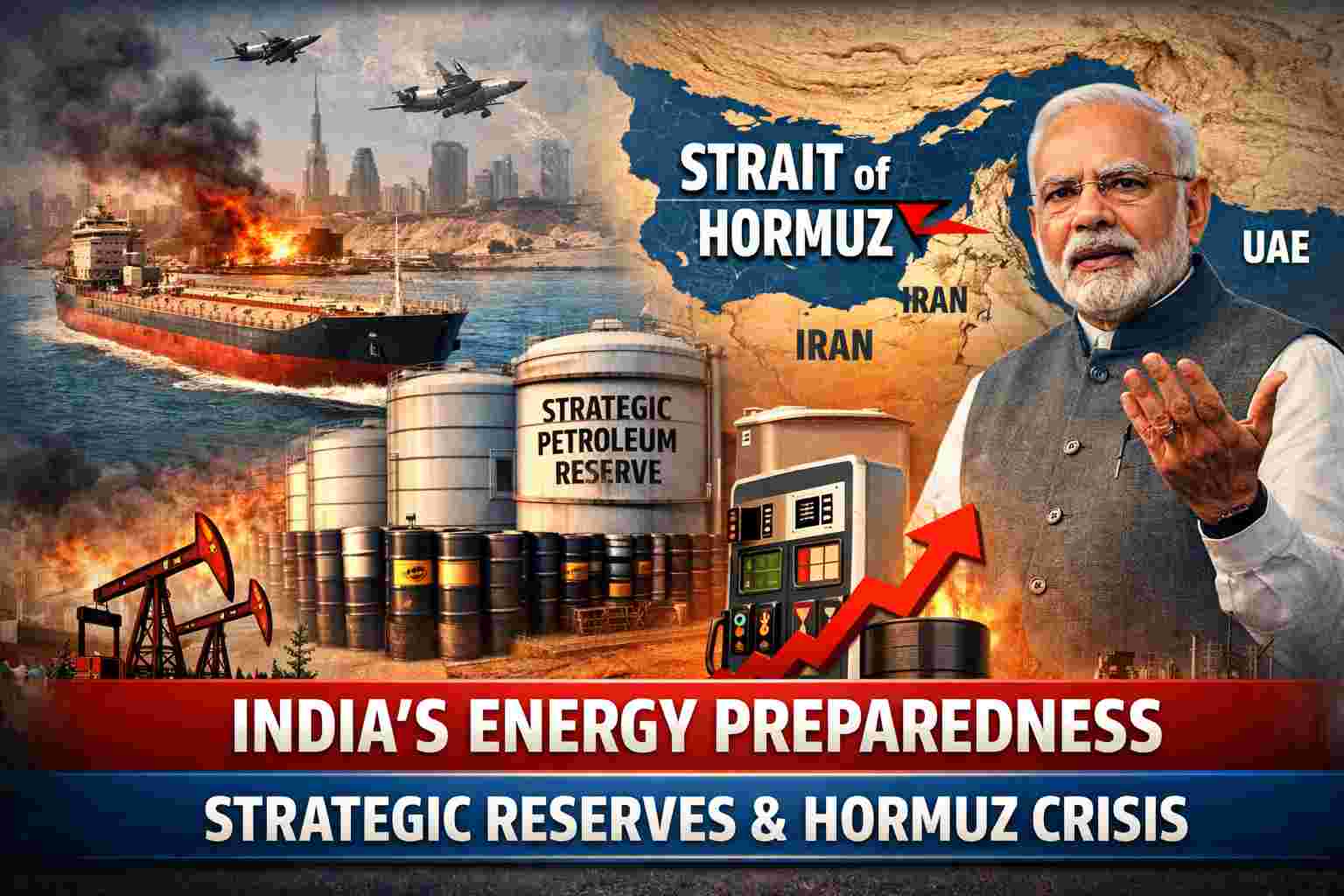
New Delhi | March 26, 2026 —”PM Modi Reassures Nation: As the sun sets over the Arabian Sea, the gaze of India’s energy planners is fixed firmly on a 33-kilometer-wide strip of water thousands of miles away. The Strait of Hormuz, the world’s most vital maritime chokepoint, has once again become the epicenter of a global geopolitical earthquake. With tensions in West Asia reaching a boiling point, the threat of a prolonged blockade looms large.
For India, this is not a distant conflict or a mere headline; it is a direct challenge to the kitchen fire and the factory floor. However, in a landmark address to the nation this week, Prime Minister Narendra Modi sent a clear signal to the world and a reassuring message to 1.4 billion citizens: India is prepared.
The Buffer: Understanding India’s “74-Day” Shield
“PM Modi Reassures Nation: India’s 74-Day Oil Buffer and Diversified Strategy Ensure No Fuel Crisis Despite Global Tensions”: The cornerstone of India’s confidence lies in its multi-layered storage strategy. While the global market shudders at the thought of supply lines being cut, India has spent the last decade quietly building a formidable cushion.
At the heart of this defense are the Strategic Petroleum Reserves (SPR). Managed by the Indian Strategic Petroleum Reserve Limited (ISPRL), these underground rock caverns in Visakhapatnam, Mangaluru, and Padur hold approximately 5.33 million metric tons of crude oil.
While these dedicated emergency reserves can power the country for roughly 9.5 days, the “real” shield is much larger. When you factor in the operational stocks held by oil marketing companies (OMCs) like IOCL, BPCL, and HPCL, India’s total storage capacity reaches an estimated 74 days.
“Even if the world stops moving tomorrow, India has enough oil in its veins to keep the lights on and the wheels turning for over two months,” a senior official from the Petroleum Ministry noted.
The Chokepoint: Why Hormuz Matters
“PM Modi Reassures Nation: India’s 74-Day Oil Buffer and Diversified Strategy Ensure No Fuel Crisis Despite Global Tensions” Roughly one-fifth of the world’s total oil consumption passes through the Strait of Hormuz. For India, the stakes are even higher. Nearly 40% to 50% of India’s crude oil imports transit this narrow corridor.
Recent escalations have seen insurance premiums for tankers skyrocket and shipping routes disrupted. In a diplomatic breakthrough reported today, March 26, 2026, Iran has reportedly granted “friendly passage” to Indian vessels, alongside those from China and Russia. While this provides immediate relief, the volatility of the region means that “guaranteed passage” can turn into a “total blockade” within hours.
Strategy Over Reaction: The Diversification Pivot
India’s resilience is not just a result of filling tanks; it is a masterclass in geographic diversification. Gone are the days when India was tethered solely to a few Gulf nations. Today, the country draws its energy from 41 different nations, up from 27 just a few years ago.
- The Russian Pivot: India has significantly increased its intake of Russian Urals, which often bypass the traditional Middle Eastern routes.
- Atlantic & Pacific Sources: Growing imports from the United States, Brazil, and Guyana provide a “geographic hedge” against any crisis in the Persian Gulf.
- Expansion on the Horizon: Under “Phase II” of the SPR program, India is moving to add another 6.5 million metric tons of capacity at Chandikhol (Odisha) and an expansion in Padur.
The Economic Ripple: A Warning Beneath the Surface
Despite the physical supply being secure, the “War Premium” on oil prices remains a formidable foe. With Brent crude hovering between $105 and $115 per barrel this month, the economic pressure is palpable.
| Economic Indicator | Impact of Sustained High Oil Prices ($100+/bbl) |
| Inflation | Upward pressure on transport, logistics, and food prices. |
| Currency | The Indian Rupee hit a record low of 93.94 against the USD this week. |
| Fiscal Deficit | Every $10 rise in oil prices can widen the Current Account Deficit by 0.4% of GDP. |
| Subsidies | Increased government burden on fertilizers and LPG to protect farmers and households. |
The Prime Minister’s address was careful to balance reassurance with reality. While India can survive a short-term shock, a permanent closure of the Strait would transition the crisis from a “supply issue” to a “macroeconomic challenge.”
Beyond the Barrel: The Long-Term Vision
The current crisis has acted as an accelerator for India’s green transition. In his speech, PM Modi highlighted that India is no longer just looking for more oil; it is looking for less oil.
- Ethanol Blending: Moving rapidly toward a 20% blending target to reduce crude dependency.
- Renewables: Non-fossil fuel sources now account for nearly half of India’s installed power capacity.
- Natural Gas: A massive push for Piped Natural Gas (PNG) is underway to reduce the vulnerability of the LPG supply chain, which remains more sensitive to Hormuz disruptions than crude.
Conclusion: A Nation in Control
The message from New Delhi is clear: There is no need for panic. The “Energy Lockdown” rumors circulating on social media have been dismissed by the government as “mischievous misinformation.” With 60 to 74 days of physical stock and a battle-hardened diplomatic strategy, India is navigating the West Asia storm with a level of strategic autonomy rarely seen in its history.
The cushion is thick, the reserves are ready, and the strategy is diversified. India is not just watching the crisis; it is outmaneuvering it.