
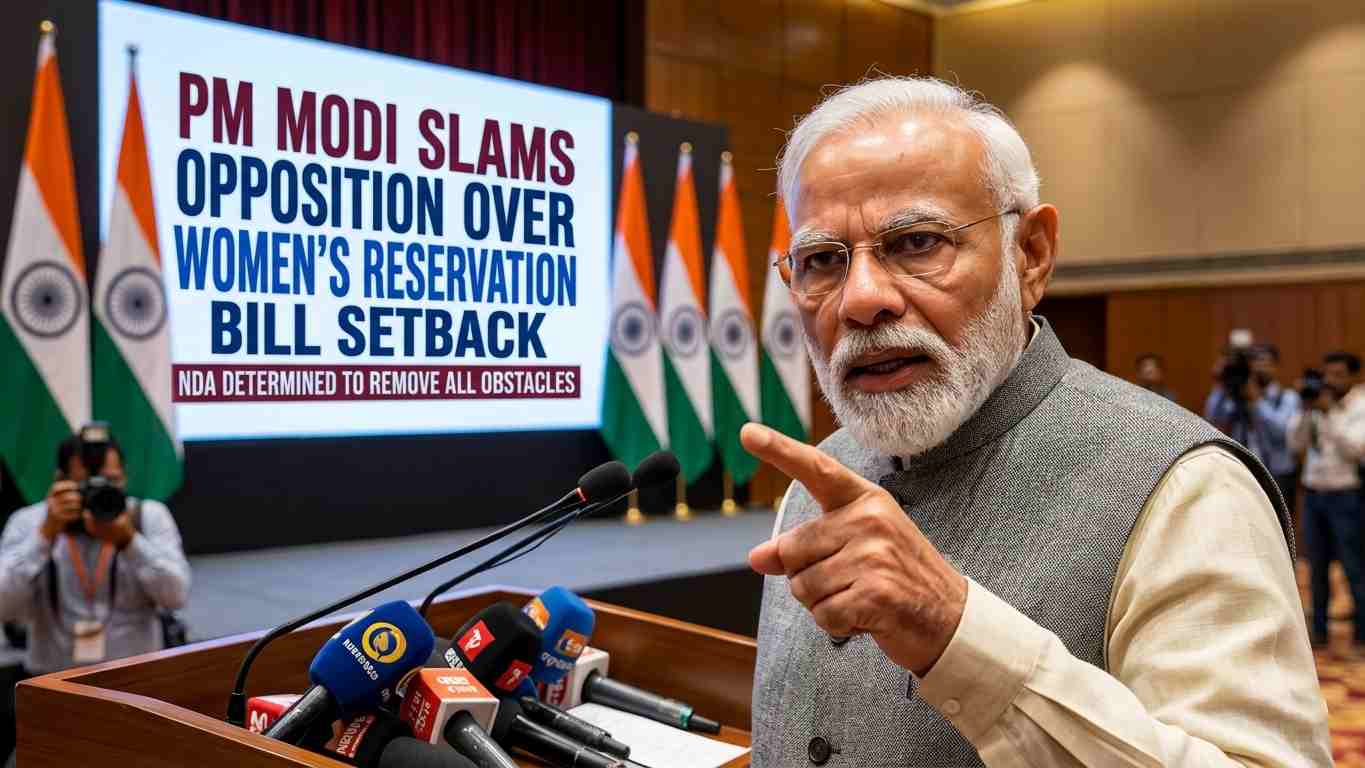
PM Modi Slams Opposition After Women’s Reservation Bill Setback,The landscape of Indian politics witnessed a dramatic shift this Saturday as Prime Minister Narendra Modi addressed the nation following a significant legislative hurdle. In a speech that resonated with both resolve and disappointment, the Prime Minister reaffirmed the NDA government’s unwavering commitment to the Women’s Reservation Bill, despite the recent defeat of the Constitution (131st Amendment) Act and the Delimitation Bill in the Lok Sabha.
For a nation on the brink of crucial elections, this development isn’t just about policy; it’s about the soul of representation in the world’s largest democracy.
The 1 Key Obstacle: Why the 33% Reservation Bill Stalled
PM Modi Slams Opposition After Women’s Reservation Bill Setback : The proposed legislation, which sought to mandate a 33% reservation for women in the Lok Sabha and State Assemblies, failed to secure the necessary passage on Friday. This setback has sent shockwaves through the political corridor, especially considering the long-standing demand for increased female participation in lawmaking.
Prime Minister Modi, in his 30-minute address, didn’t hold back. He expressed profound sadness over the blockade, specifically pointing the finger at the coalition of Opposition parties. According to the PM, the defeat of the bill is not just a procedural failure but a “betrayal of the aspirations of India’s daughters.”
The Anatomy of the Opposition’s Resistance
The Prime Minister’s critique was sharp and direct, naming specific “family-run” parties that he claims stood in the way of progress:
The Congress: Accused of historical apathy toward the bill.
Samajwadi Party (SP) & DMK: Criticized for prioritizing regional or internal dynamics over national gender parity.
Trinamool Congress (TMC): Slammed for missing a “golden opportunity” to empower women in West Bengal.
PM Modi remarked that he was “startled” to see these parties celebrating the fall of the bill, an act he described as a direct insult to the “mothers and sisters” of India.
Election Heat: Poll Dates in Tamil Nadu, West Bengal, and Beyond
The timing of this legislative battle is crucial as several key states prepare for high-stakes assembly elections. The Prime Minister’s speech served as both an apology and a rallying cry, particularly for the states where voters are heading to the booths this month.
According to the official schedule, Tamil Nadu and West Bengal will go to the polls on April 23, 2026. While Tamil Nadu will vote in a single phase, West Bengal is scheduled for an additional phase on April 29 to complete its electoral process.
“DMK had the opportunity to make even more Tamils, MPs, and MLAs. It could have further strengthened the voice of Tamil Nadu. But it lost that opportunity. TMC too had the chance to lead from the front, but they chose the path of obstruction,” the PM noted.
Beyond the immediate battles in the South and East, the political focus is also shifting toward the Hindi heartland. Uttar Pradesh is set to hold assembly elections in February–March 2027, where the Samajwadi Party—one of the parties criticized by the PM—will be a major contender. By framing the Women’s Reservation Bill as a central theme now, the NDA is clearly looking to build a long-term narrative that will resonate through the upcoming UP polls.
The Road Ahead: 7 Reasons Why This Bill is Non-Negotiable for the NDA
Despite the setback, the Prime Minister insisted that the government is “determined to remove all obstacles.” Here is why the NDA is doubling down on this 33% mandate:
Direct Representation: Ensuring that women have a seat at the table where laws are written.
Socio-Economic Development: Data suggests women-led constituencies prioritize health and education.
Correcting Historical Imbalance: Bringing India’s female representation up to global standards.
Strengthening the Grassroots: Building on the success of Panchayati Raj institutions.
Economic Growth: Gender-inclusive governance leads to more stable economies.
Political Accountability: Reducing “muscle power” by introducing diverse voices.
National Pride: Positioning India as a global leader in gender equity.
An Emotional Appeal: “Apologising to All Mothers and Sisters”
In a rare emotional moment, PM Modi apologized to the women of India. This move is seen by analysts as a powerful strategy to connect directly with the female electorate. By taking personal responsibility for the bill’s failure—while highlighting the Opposition’s blockade—the PM is turning a legislative loss into a potent campaign message.
The phrase “deeply saddened” signal that the NDA intends to bring this bill back to the floor with even more vigor. Whether through a special session or a renewed consensus, the government is signaling that the Constitution (131st Amendment) Act remains their top priority.
Conclusion: A Defiant Resolve
The defeat of the Delimitation Bill and the 131st Amendment is undoubtedly a setback. However, with elections in Tamil Nadu and West Bengal just days away, and Uttar Pradesh on the horizon for 2027, the Prime Minister has successfully turned this parliamentary hurdle into a national debate. As the nation watches, the fight for 33% reservation is set to define the future of Indian democracy.