
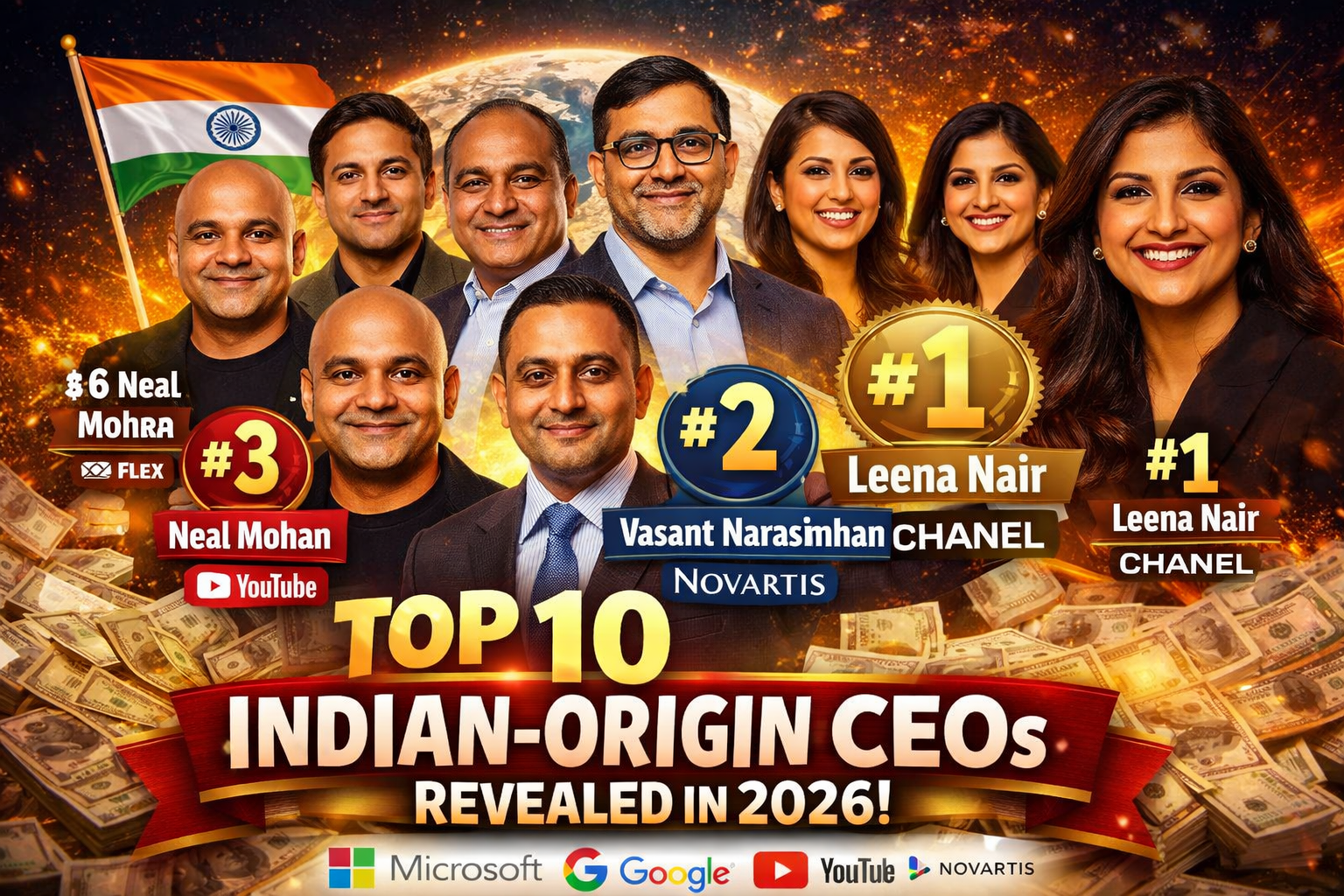
Top 10 Indian-Origin CEOs 2026: In the high-stakes arena of the 2026 global economy, leadership has officially transcended geographical boundaries. The most influential boardrooms—stretching from the glass towers of Silicon Valley to the historic fashion houses of Paris and the pharmaceutical hubs of Europe—are increasingly being steered by visionaries of Indian origin. These leaders are not just managing corporate entities; they are architecting the future of Artificial Intelligence, sustainable manufacturing, and digital consumerism.
What truly captures the public imagination, however, is the sheer scale of their influence paired with their astronomical compensation packages. In an era where “CEO pay” is a subject of intense scrutiny, these individuals stand out for wealth driven by high-octane performance, massive stock grants, and long-term incentives that align their personal fortunes with the prosperity of their shareholders.
In this comprehensive analysis, we take a deep dive into the Top 10 Indian-origin CEOs of 2026, breaking down their salary structures, net worth, and the strategic maneuvers that have made them some of the wealthiest professionals on the planet.
Top 10 Indian-Origin CEOs 2026: How Global CEO Compensation Works
Before dissecting the list, it is crucial to understand that a CEO’s “take-home pay” is rarely just a monthly paycheck. In 2026, executive compensation is a complex financial architecture designed to ensure the leader remains “hungry” for company growth.
Base Salary: Surprisingly, this is often the smallest portion of the package. While it covers living expenses and provides a steady floor, it usually represents less than 10% of the total compensation for a top-tier CEO.
Stock Awards & Equity: This is the engine of generational wealth. Most Indian-origin CEOs receive Restricted Stock Units (RSUs) or Performance Stock Units (PSUs). If the company’s stock price doubles, their wealth doubles.
Annual Bonuses: These are tied to specific, short-term KPIs—such as hitting revenue targets for a specific fiscal year or successfully launching a new product line like a generative AI suite.
Perks and Benefits: This includes everything from private security and corporate jet usage to high-end insurance and deferred compensation plans.
Revathi Advaithi continues to break barriers as the CEO of Flex (formerly Flextronics). In an era focused on diversifying supply chains away from single-country dependence, her leadership has been pivotal.
Estimated Net Worth: ~$98 Million
The Strategy: Advaithi has pivoted Flex toward high-growth sectors, specifically Electric Vehicle (EV) components and advanced healthcare technology.
Compensation Breakdown: Her wealth is a masterclass in long-term equity. By meeting rigorous operational milestones, her stock incentives have vested at a premium, reflecting Flex’s indispensable role in the global semiconductor and manufacturing ecosystem.
#9 – Yamini Rangan: Scaling the SaaS Heights (HubSpot)
As the tech world shifted toward integrated customer experiences, Yamini Rangan steered HubSpot into becoming a legitimate challenger to legacy CRM giants.
Estimated Net Worth: ~$58 Million
The Strategy: Rangan focused on “platform play”—ensuring that HubSpot wasn’t just a tool but an ecosystem.
Compensation Breakdown: Her earnings are heavily weighted toward performance bonuses. As HubSpot expanded its global footprint in 2025 and early 2026, her equity value surged, proving that mid-market SaaS remains a goldmine for savvy leadership.
#8 – Arvind Krishna: The Architect of the Hybrid Cloud (IBM)
Arvind Krishna has done what many thought impossible: he made IBM “cool” and relevant again in the age of AI. By spinning off legacy business units and doubling down on Red Hat and Watsonx, he has redefined Big Blue.
Estimated Net Worth: $55M+
Annual Salary: ~$15 Million (Total Compensation)
The Strategy: Krishna’s leadership is defined by technical depth. He is one of the few CEOs who truly understands the “plumbing” of quantum computing and AI, which has earned him massive trust from the board and investors.
#7 – Shantanu Narayen: The King of Subscriptions (Adobe)
Shantanu Narayen is often cited as the pioneer of the “SaaS revolution.” By moving Adobe from boxed software to a cloud-based subscription model years ago, he ensured a recurring revenue stream that continues to pay dividends.
Estimated Net Worth: ~$450 Million
Annual Salary: ~$40–45 Million
The Strategy: In 2026, Narayen has integrated Firefly (Adobe’s AI) into every facet of the Creative Cloud. This “AI-first” approach has kept Adobe’s stock price at record highs, directly inflating his net worth through his massive shareholdings.
#6 – Nikesh Arora: The Cybersecurity Titan (Palo Alto Networks)
Nikesh Arora remains one of the most handsomely compensated executives in the history of the tech industry. Leading Palo Alto Networks, he sits at the intersection of national security and corporate safety.
Estimated Net Worth: ~$1.4 Billion
Peak Compensation: Up to ~$266 Million in a single fiscal year.
The Strategy: Arora’s philosophy is “platformization”—getting companies to buy all their security needs from one place. In a world of increasing cyber warfare, this strategy has made Palo Alto Networks a trillion-dollar contender, catapulting Arora into the billionaire club.
#5 – Satya Nadella: The AI Trailblazer (Microsoft)
Perhaps no CEO has had a more profound impact on the 2020s than Satya Nadella. Under his watch, Microsoft surpassed Apple as the world’s most valuable company multiple times.
Estimated Net Worth: ~$1.3 Billion
2025/26 Compensation: $96.5 Million
The Strategy: By betting early on OpenAI and integrating “Copilots” into every Windows and Office product, Nadella has ensured Microsoft’s dominance for the next decade.
Wealth Factor: Over $80 million of his annual pay typically comes from equity. He doesn’t just run Microsoft; he owns a significant stake in its future.
#4 – Sundar Pichai: The Guardian of Information (Alphabet & Google)
Sundar Pichai oversees the gateway to the internet. As CEO of Alphabet, he manages a conglomerate that touches everything from search and YouTube to autonomous driving (Waymo) and life sciences.
Estimated Net Worth: ~$1.1–1.5 Billion
Compensation Profile: His cycles of stock grants are legendary, sometimes totaling over $600 million over a three-year vesting period.
The Strategy: Pichai is currently navigating the “Gemini era,” ensuring that Google Search remains the primary destination in an AI-driven world. His wealth is a direct reflection of Alphabet’s ability to maintain its advertising monopoly while pivoting to AI.
#3 – Neal Mohan: The Content Economy King (YouTube)
Taking over the reins from Susan Wojcicki, Neal Mohan has successfully navigated YouTube through the challenges of short-form video competition (TikTok) and the rise of the creator economy.
Estimated Net Worth: ~$148 Million
The Strategy: Mohan has championed “YouTube Shorts” and integrated sophisticated AI tools for creators, keeping engagement metrics at an all-time high.
Compensation Breakdown: As a key executive within the Alphabet structure, his pay is tied to the hyper-growth of YouTube’s subscription models (Premium and TV), which have become massive revenue drivers in 2026.
#2 – Vasant Narasimhan: The Healer of Balance Sheets (Novartis)
In the high-stakes world of Big Pharma, Vasant Narasimhan stands out for his ability to balance life-saving innovation with fiscal discipline.
Estimated Net Worth: High Hundreds of Millions
The Strategy: Narasimhan has refocused Novartis as a “pure-play” medicines company, shedding non-core businesses to focus on gene therapy and advanced oncology.
Wealth Factor: In the pharmaceutical industry, compensation is often tied to “pipeline success”—how many drugs clear FDA hurdles. Narasimhan’s track record here has made his incentive packages some of the richest in Europe.
#1 – Leena Nair: The Icon of Luxury (Chanel)
Topping our list for her cultural and corporate significance is Leena Nair. Moving from HR at Unilever to the CEO chair of Chanel, she represents a new breed of “human-centric” leadership in the luxury sector.
Estimated Net Worth: High Multi-Million Range
The Strategy: While Chanel is a private company and doesn’t disclose exact salary figures, industry insiders peg her compensation at the very top of the global elite.
Impact: Nair is tasked with maintaining the exclusivity of the Chanel brand while modernizing its digital footprint. Her influence stretches across fashion, fragrance, and high-end retail, making her arguably the most powerful Indian-origin woman in business today.
Deep Dive: Why Tech and Luxury Command the Highest Premiums
You might notice a pattern: Tech CEOs dominate the wealth rankings. This isn’t accidental. In 2026, the “Multiplier Effect” of software allows a company like Microsoft or Google to add billions in market cap with a single software update. Because their CEOs are paid in stock, they capture a percentage of that value creation.
Conversely, in the Luxury sector (Chanel), the value is in the “Brand Equity.” Leena Nair’s value lies in her ability to ensure that a Chanel bag remains a coveted asset 50 years from now. This “Legacy Premium” results in massive, stable compensation packages that rival the volatile tech gains.
The “India Factor”: A Global Leadership Pipeline
The dominance of Indian-origin CEOs in 2026 is the result of decades of academic rigor and a unique cultural adaptability. Most of these leaders share a common trajectory:
Technical Foundation: Initial education in premier Indian institutes (like the IITs).
Management Mastery: Advanced degrees from global powerhouses like Stanford, Harvard, or Wharton.
Adaptability: The ability to navigate diverse global markets, a skill often attributed to the multicultural environment of India.
Conclusion: The Future of Global Leadership
As we look toward the remainder of 2026 and beyond, the trend is clear: the “Indian-Origin CEO” is no longer a novelty; it is a standard of excellence. Whether it’s Satya Nadella redefining how we work with AI or Leena Nair redefining how we perceive luxury, these leaders are at the forefront of the global economy.
Their massive salaries and net worth are more than just numbers on a balance sheet—they are a testament to the value of visionary leadership in a complex, tech-driven world. For investors and aspiring professionals alike, these ten individuals offer a roadmap for success: prioritize innovation, embrace equity-based growth, and never stop adapting to the next technological frontier.