
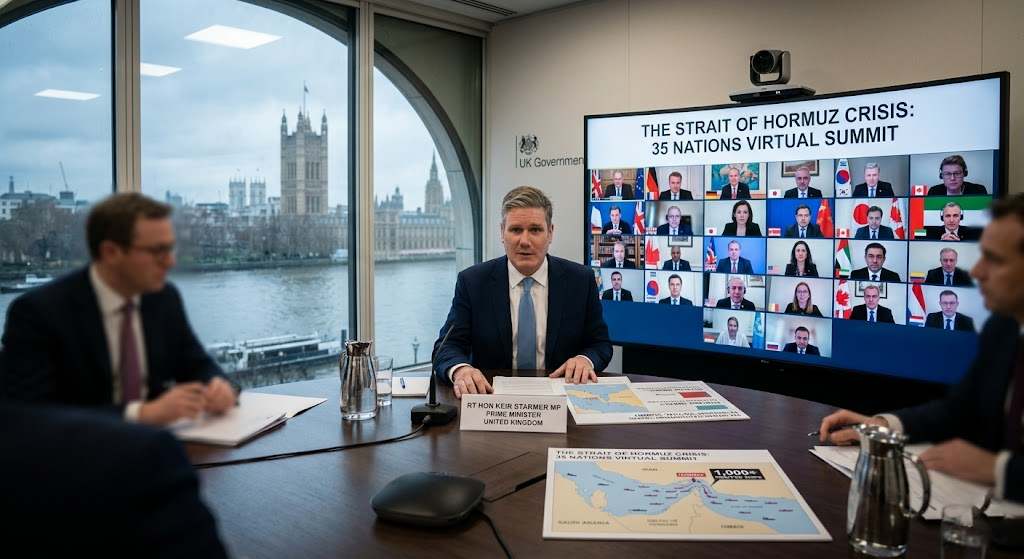
UK PM Convenes 35-Nation Summit : As the global energy crisis enters a perilous new phase, British Prime Minister Keir Starmer has announced an emergency diplomatic offensive to break the Iranian stranglehold on the Strait of Hormuz. In a high-stakes move that underscores the deepening rift between European allies and Washington, the UK will host a virtual summit of 35 nations this week—notably excluding the United States—to draft a roadmap for restoring maritime security to the world’s most critical oil transit route.
The announcement comes at a moment of extreme geopolitical volatility. The US-Israeli war on Iran, which erupted in late February 2026, has seen the Strait of Hormuz effectively shuttered by the Islamic Revolutionary Guard Corps (IRGC). With one-fifth of the world’s oil and gas supply and one-third of global fertilizer production trapped behind an Iranian naval blockade, the economic fallout is being felt from the gas stations of London to the factories of New Delhi and Tokyo.
The “35-Nation” Coalition: A Diplomatic Counter-Offensive
The Battle for the Strait: UK PM Convenes 35-Nation Summit to Reopen World’s Vital Oil Chokepoint : Prime Minister Starmer confirmed that the summit, chaired by Foreign Secretary Yvette Cooper, will bring together a diverse coalition of nations including France, Germany, Italy, Japan, the Netherlands, Canada, South Korea, New Zealand, the UAE, and Nigeria.
The objective is clear: to move beyond rhetoric and establish a concrete plan to:
- Restore Freedom of Navigation: Establishing protected corridors for commercial shipping.
- Rescue Trapped Assets: Ensuring the safety of the roughly 1,000 ships and their seafarers currently stranded in the Gulf.
- Resume Commodity Flow: Re-opening the taps for oil, LNG, and fertilizers to stave off a global depression.
“The impact of this war will define us for a generation,” Starmer warned, comparing the current energy shock to the devastating oil crises of the 1970s. “This [reopening] will not be easy. We need a united front of military strength and diplomatic activity.”
The “Hormuz Chokepoint”: A Statistical Nightmare
The Battle for the Strait: UK PM Convenes 35-Nation Summit to Reopen World’s Vital Oil Chokepoint : To understand the gravity of the meeting, one must look at the sheer volume of trade that has vanished overnight. Under normal conditions, approximately 130 ships transit the Strait of Hormuz every single day. Since the conflict escalated, that number has dwindled to a trickle, with only 130 ships making the passage in the entire month since the war began.
| Commodity | Global Share via Hormuz | Impact of Blockade |
| Crude Oil | ~20% | Global prices surged past $150/barrel |
| Liquefied Natural Gas (LNG) | ~25% | Energy rationing in parts of Europe/Asia |
| Fertilizers | ~33% | Predicted 20% drop in global crop yields |
The IRGC has maintained a defiant stance, stating on Iranian state TV that the waterway remains under their absolute control and will stay closed to the “enemies of this nation.”
The Transatlantic Rift: Trump’s “Go Get Your Own Oil” Policy
The summit’s most controversial aspect is the exclusion of the United States. Relationships between 10 Downing Street and the White House have hit a historic low following President Donald Trump’s scathing criticism of allies who refused to join the initial “decapitation” strikes against Iran.
In a series of provocative posts on Truth Social, President Trump signaled a shift toward isolationism, suggesting that if European nations want energy security, they must fight for it themselves.
“All of those countries that can’t get jet fuel because of the Strait of Hormuz, like the United Kingdom… I have a suggestion for you: Number 1, buy from the U.S., we have plenty, and Number 2, build up some delayed courage, go to the Strait, and just TAKE IT,” Trump wrote.
The President further warned that the U.S. “won’t be there to help you anymore,” accusing Starmer and French President Emmanuel Macron of cowardice. The tension stems from Starmer’s refusal to allow U.S. forces to launch offensive strikes from British sovereign bases, though he eventually permitted “defensive missions” to protect British citizens in the region.
The Military Roadmap: Planning for the “Aftermath”
While the Thursday meeting is primarily diplomatic, Starmer revealed that British military planners have already been dispatched to coordinate with regional partners. The goal is to “marshal capabilities” to make the Strait accessible once active hostilities cease.
Industry leaders from the energy and shipping sectors, who met with Starmer earlier this week, have emphasized that the hurdle isn’t just financial. It is a matter of physical safety. Modern naval mines, drone swarms, and shore-based anti-ship missiles have turned the 21-mile-wide passage into a death trap for unescorted tankers.
National Interest vs. Global Pressure
Asked about the deteriorating relationship with the Trump administration, Starmer remained resolute, stating he would act in the British national interest “whatever the pressure on me.”
For the UK, the national interest is inextricably linked to the freedom of navigation. Without the Strait of Hormuz, the UK’s transition away from Russian energy (following the Ukraine conflict) is effectively neutralized, leaving the country vulnerable to extreme price spikes and fuel shortages.
Conclusion: A Generational Challenge
The UK-led summit represents a desperate attempt to find a “Third Way” between Iran’s total blockade and the United States’ “Stone Age” bombing campaign. With the US President vowing to continue “blasting Iran into oblivion” until the Strait is cleared, and Iran holding the world’s energy supply hostage, the 35 nations meeting this Thursday carry the weight of the global economy on their shoulders.
As Starmer “leveled” with the public, the path to reopening the world’s most important waterway will be neither quick nor bloodless. The world waits to see if diplomacy can succeed where “fire and fury” have so far only led to a stalemate.