
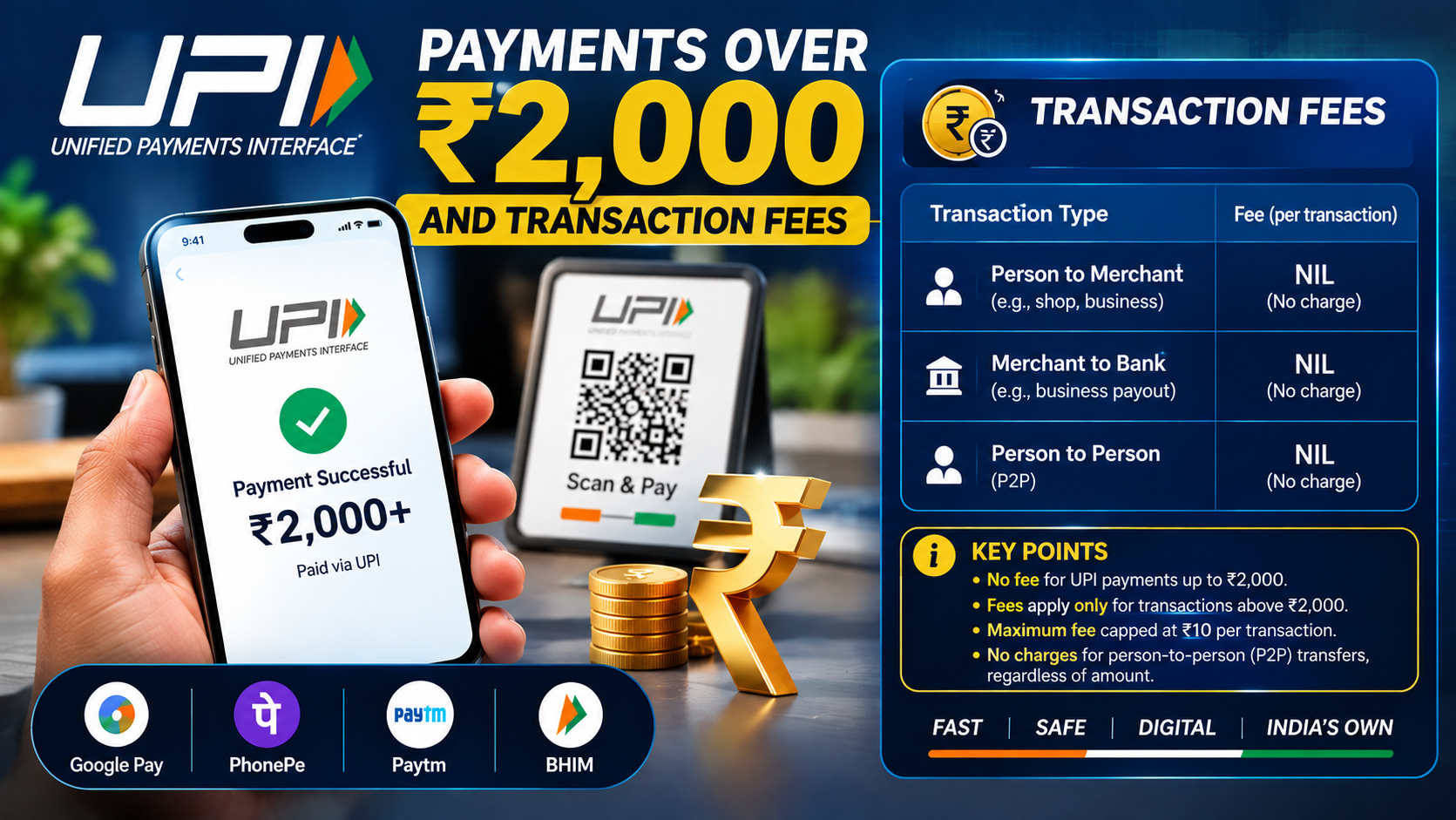
India’s digital UPI Payments landscape is undergoing a massive regulatory shift. The Central Government has officially notified amendments to Section 10A of the Payment and Settlement Systems Act, 2007, establishing clear rules regarding transaction fees across digital networks.
Under the updated framework, the Ministry of Finance has explicitly prohibited banks and payment system providers from levying any direct or indirect charges on UPI transactions up to ₹2,000 as well as all RuPay-powered debit card payments.
However, by creating a statutory ceiling at the ₹2,000 mark for UPI, the government has cleared the legal path to reintroduce the Merchant Discount Rate (MDR) on higher-value UPI transactions.
Here is an in-depth, human-written analysis of what this notification actually means, who will pay, and why your everyday routine payments remain entirely safe.
1. Small Payments Stay Completely Free
The main goal of the gazette notification is to support everyday consumers, micro-merchants and street vendors who depend on small digital payments. The rule says that any UPI transaction worth ₹2,000 or less is protected by law. That means no bank app provider or payment gateway can charge fees to either the sender or the receiver for these low-value transfers.
For RuPay debit card transactions there is no limit. All RuPay debit card payments stay free of charge no matter how much you spend. Whether you pay for groceries buy a cup of tea at a roadside stall or pay an utility bill these common daily transactions will not have any extra charges added. This helps keep things affordable, for people making small purchases every day.
2. Paving the Way for MDR on High-Value UPI Payments
Since January 2020, India has operated under a strict zero-MDR mandate for all UPI and RuPay payments to accelerate nationwide adoption. While this policy expanded digital payments rapidly, banks and fintech platforms faced revenue constraints regarding infrastructure, cybersecurity, and server expansion.
By updating Section 10A, the government has removed the blanket prohibition on charging for larger digital payments. This paves the way for payment service providers to earn revenue on transactions exceeding ₹2,000 through a nominal Merchant Discount Rate.
3. Will End Consumers Have to Pay Extra?
No. The government and Finance Ministry have repeatedly clarified that consumers making daily purchases will not be taxed or charged.
Merchant-Side Charge: Merchant Discount Rate (MDR) is an operational fee paid exclusively by businesses and merchants to banks and payment processors to maintain the settlement network.
Person-to-Person (P2P) Transfers: Direct money transfers between individuals (like sending money to a friend or family member) are expected to stay entirely free.
The proposed fee model targets commercial merchant transactions rather than peer-to-peer transfers.
4. Who Decides the Actual Fee Structure?
While the Ministry of Finance provided the legal framework by issuing the gazette order, it has not set the actual fee percentages.
| MINISTRY OF FINANCE Sets Legal Architecture & Enforces ₹2,000 Cap |
⇓
| NPCI STEERING COMMITTEE & STAKEHOLDERS Determines MDR Rates, Merchant Tiers & Timelines |
The final decision on the precise fee schedule, merchant categories, and implementation dates rests with the UPI and Services Steering Committee, headed by the National Payments Corporation of India (NPCI). Detailed operational directives are expected from NPCI soon.
5. What is MDR and Why Is It Returning?
To understand the rationale behind this move, it helps to review how digital transaction processing operates behind the scenes:
| Feature | Zero-MDR Era (2020 – Present) | Proposed Framework |
| Transactions ≤ ₹2,000 | 100% Free for Everyone | Statutorily Free for Senders & Receivers |
| Merchant Payments > ₹2,000 | Free for Merchants | Nominal MDR May Apply to Merchants |
| RuPay Debit Card Use | 100% Free | Statutorily Free (No Value Limit) |
| System Sustainability | Supported via Govt Subsidies | Self-sustaining ecosystem funded by commercial MDR |
Processing billions of real-time transactions requires massive computing power, fraud monitoring, server hardware, and software maintenance. Reintroducing a controlled, nominal MDR for larger merchant payments gives banks and payment gateways the financial backing needed to upgrade security, reduce payment failures, and build next-generation fintech solutions.
6. Real-World Scenarios: How Does This Affect You?
To see how these rules apply in everyday life, consider the following examples:
Scenario A: Buying groceries worth ₹800 via UPI
Result: Zero Charges. It falls below the ₹2,000 threshold, so neither you nor the store owner pays any fee.
Scenario B: Transferring ₹5,000 to a family member
Result: Zero Charges. Person-to-person (P2P) transfers are designed to remain free for ordinary consumers.
Scenario C: Buying an electronic item worth ₹15,000 at a retail store via UPI
Result: You pay ₹15,000 directly. The store owner may be subject to a small merchant discount fee determined by NPCI guidelines once the operational rules kick in.
Scenario D: Swipe a RuPay Debit Card for ₹10,000
Result: Zero Charges. RuPay debit payments are fully exempt from transaction charges regardless of the bill amount.
7. What Lies Ahead for Digital Payments in India?
India’s UPI network processes billions of transactions every month, with the vast majority of micro-payments falling well under ₹500. By protecting payments up to ₹2,000, the government ensures that routine retail transactions remain entirely untouched.
As NPCI prepares to release its formal directive detailing the MDR percentage for higher-tier merchant transactions, businesses will need to align their payment systems accordingly. For the average citizen, UPI will continue to operate just as smoothly, quickly, and cost-effectively as it always has.