
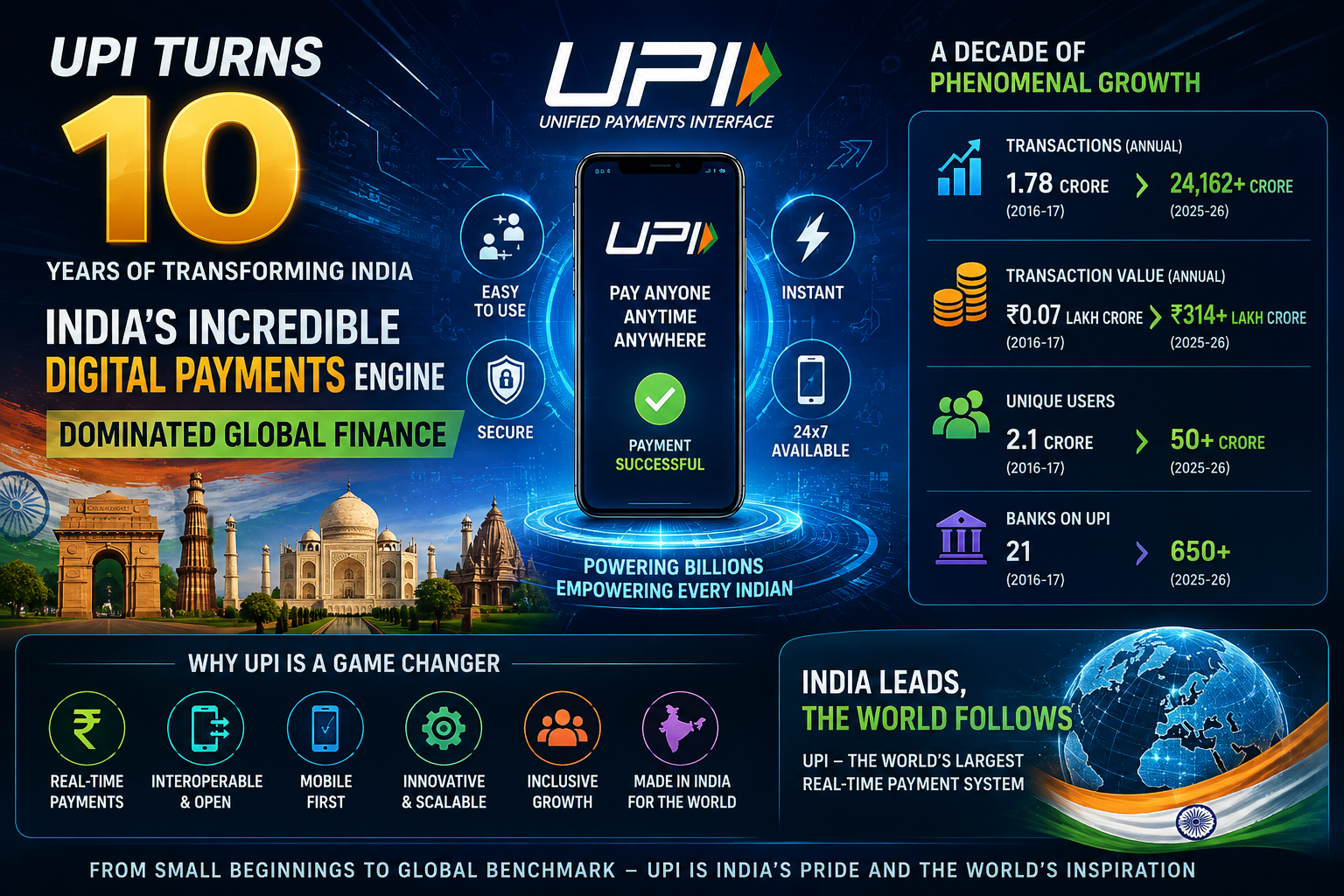
UPI turns 10 today, marking a major turning point in how money moves across India and the rest of the world. What started as an ambitious experiment in 2016 has officially completed a decade of operation, transforming everyday commerce from small roadside shops to international trade corridors. Prime Minister Narendra Modi praised the scale and impact of the Unified Payments Interface, calling its nationwide reach a point of pride for every citizen while inviting people to share their personal stories of using the platform.
When the National Payments Corporation of India launched the system under the guidance of the Reserve Bank of India on August 25, 2016, few predicted how rapidly it would replace cash. Over the past decade, the platform evolved into the backbone of India’s Digital Public Infrastructure, allowing instantaneous, fee-free money transfers between bank accounts using simple virtual addresses or QR codes.
A Decade of Explosive Growth
Launched on August 25, 2016, by the National Payments Corporation of India (NPCI) under the regulatory guidance of the Reserve Bank of India (RBI), UPI aimed to unify multiple bank accounts into a single mobile application.
The speed at which citizens adopted the platform shattered every initial expectation:
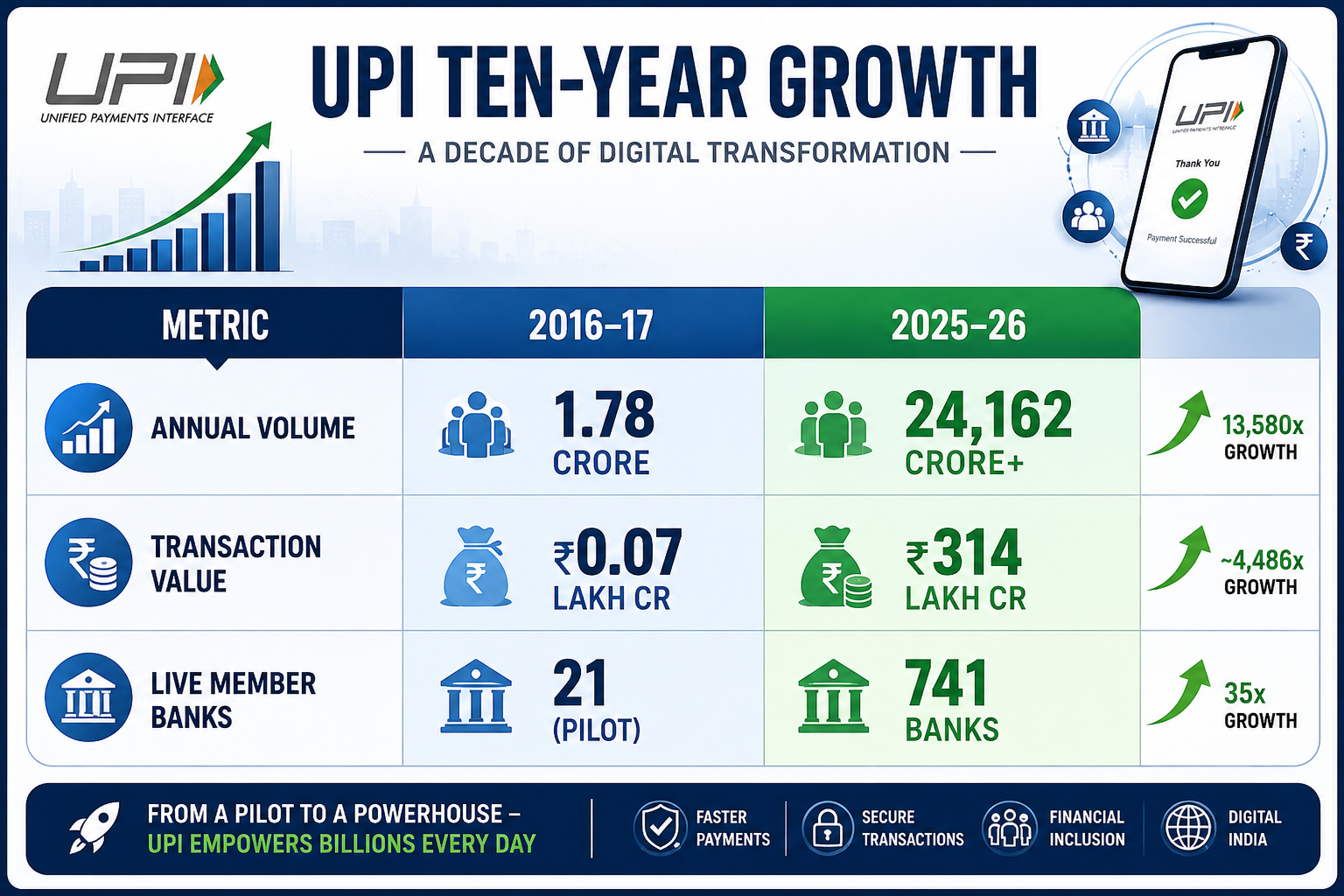
13,000-Fold Volume Surge: Annual transaction volume skyrocketed from just 1.78 crore in FY 2016–17 to over 24,162 crore in FY 2025–26.
4,000-Fold Value Jump: Total money transferred annually grew from ₹0.07 lakh crore to an extraordinary ₹314 lakh crore over the same period.
Peak Monthly Numbers: In July 2026 alone, the network processed 2,365.8 crore transactions worth ₹29.87 lakh crore across 741 participating banks.
The launch of the BHIM (Bharat Interface for Money) app in December 2016 further simplified access, turning smartphones into virtual debit cards for millions who previously lacked access to formal banking channels.
Dominating the Global Stage
UPI is no longer just an Indian success story—it is a global benchmark. According to the International Monetary Fund (IMF), UPI now accounts for nearly 49% of all global real-time digital payment volumes. Simply put, almost one out of every two real-time digital transfers on Earth happens through India’s UPI infrastructure.
The 11-Country Footprint
India’s cross-border payment integration continues to expand rapidly:
| Country | Integration Highlights |
| United Arab Emirates | Accepted at major retail and merchant locations across the UAE. |
| Singapore | Deep linkage with Singapore’s PayNow for instant cross-border remittances. |
| France | Seamless payments for tourists at iconic locations like the Eiffel Tower. |
| Maldives | Linked directly with the ‘Favara’ Instant Payment System for cross-border transfers. |
| Greece | Live cross-border remittances enabled in partnership with Eurobank. |
| Cambodia | Acceptance integration launched through ACLEDA Bank Plc. |
| Bhutan, Nepal, Sri Lanka, Mauritius, Qatar | Fully operational for retail payments, diaspora transfers, and local merchant networks. |
Why UPI Outpaced Legacy Financial Networks
Zero-Friction Interoperability: Unlike closed digital wallets, UPI allows instant transfer between any two bank accounts, regardless of the app being used.
QR Code Standardization: The interoperable QR code eliminated expensive point-of-sale hardware costs for small street vendors.
Public-Private Innovation: Built on Digital Public Infrastructure (DPI), it allowed private platforms like PhonePe, Google Pay, and Paytm to build user-friendly interfaces over a shared public architecture.
Security & Speed: Instant two-factor authentication combined with virtual payment addresses (VPAs) ensures security without sacrificing transaction speed.
As India enters the second decade of UPI, the focus shifts toward offline payments through sound-based technology, voice-assisted AI payments, and deeper integration with global central bank digital currencies (CBDCs). What began as a local experiment has fundamentally rewritten the rules of international commerce.