
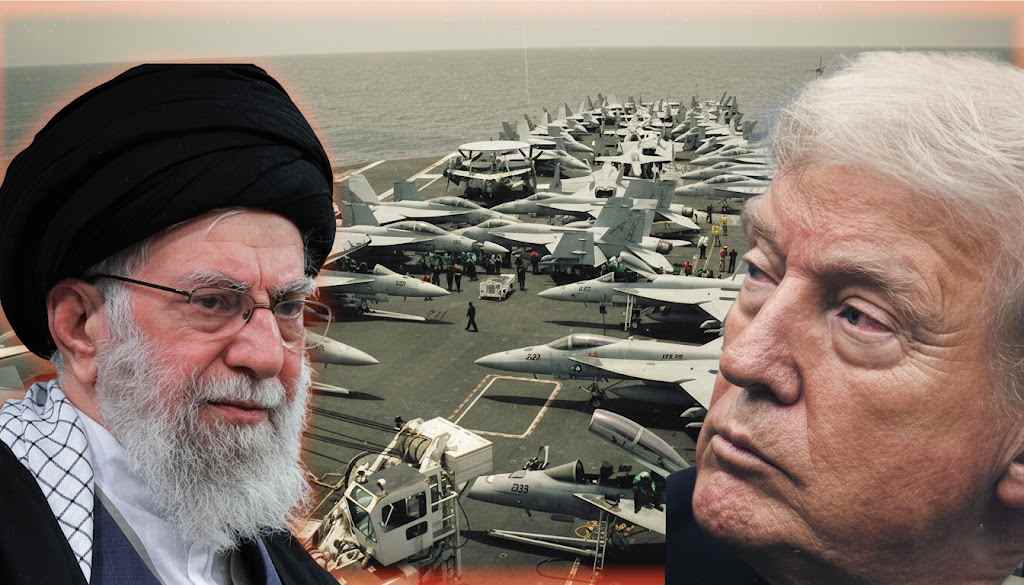
US-IRAN War Alert: The specter of a massive military confrontation is looming over West Asia as the Trump administration enters what advisors call a “fed-up” phase with the Islamic Republic of Iran. On Wednesday, February 18, 2026, the rhetoric from the White House reached a fever pitch, signaling that the United States military is positioned to launch a kinetic strike as early as this weekend—Saturday, February 21.
While diplomatic “guiding principles” were reportedly reached in Geneva just two days ago, the reality on the ground (and at sea) tells a different story. The United States has amassed what military analysts describe as the greatest concentration of air and naval power in the region since the 2003 invasion of Iraq.
US-IRAN War Alert: The “90 Percent” Probability: Is Saturday the Day?
Reports from CBS News and CNN indicate that top national security officials have briefed President Trump, confirming that the military “is ready” for potential strikes by Saturday. While the President has yet to give the final “nod,” an advisor quoted by Axios was blunt about the shift in temperament:
“The boss is getting fed up. Some people around him warn him against going to war with Iran, but I think there is a 90 per cent chance we see kinetic action in the next few weeks.”
Unlike the pinpoint operation that recently saw the capture of Nicolas Maduro in Venezuela, planners are preparing for a “weeks-long” campaign. This would not be a mere warning shot but a joint US-Israeli effort to dismantle Iran’s underground nuclear infrastructure and ballistic missile capabilities.
The “Beautiful Armada”: A Breakdown of US Firepower
President Trump has boasted of a “massive Armada” heading toward the Iranian coast. This is not hyperbole. The sheer volume of hardware currently in or transiting to the Middle East is staggering:
Naval Supremacy
- USS Abraham Lincoln: Already on station in the Arabian Sea since late January.
- USS Gerald R. Ford: The world’s largest aircraft carrier, redirected from the Caribbean, is currently making speed past Gibraltar.
- The Escorts: A total of 13 warships, including nine destroyers and three littoral combat ships, are currently in the theater, providing a dense “Aegis” umbrella against incoming missiles.
️ Air Power and Logistics
The US has deployed over 50 additional fighter jets to regional bases, including:
- F-22 Raptors & F-35 Stealth Fighters: Designed to penetrate Iran’s Russian-made air defenses.
- A-10C Thunderbolt II: Positioned at the Muwaffaq Salti Air Base in Jordan for potential ground-attack roles.
- KC-135 Stratotankers: Crucial for the mid-air refueling required for a sustained bombing campaign.
Iran’s “Bunker” Strategy and Retaliation Threats
Tehran is not standing still. Satellite imagery analyzed by the Institute for Science and International Security (ISIS) shows a frantic effort to “harden” nuclear sites.
At the Taleghan 2 facility and the Natanz nuclear site, workers are pouring massive concrete shells and piling layers of soil and rock—a process called “overburden”—to absorb the shock of American “bunker-buster” munitions.
The Asymmetric Threat
Iran’s Supreme Leader, Ayatollah Ali Khamenei, recently posted an AI-generated image of a US carrier in a “maritime grave.” His message was clear: Iran possesses “weapons that can send that warship to the bottom of the sea,” likely referring to their vast arsenal of anti-ship ballistic missiles and “swarm” drone capabilities.
Six Factors Pushing Trump Toward the “Button”
Why is the administration considering such a high-stakes gamble now? Analysts point to six intersecting drivers:
- The Nuclear Deadline: Trump demands a deal that “obliterates” Iran’s uranium enrichment entirely—a red line Tehran refuses to cross.
- Regime Weakness: Ongoing internal protests and the damage from the 12-day air war last June have led Washington to believe the clerical leadership is at its most vulnerable.
- Israeli Pressure: Prime Minister Benjamin Netanyahu has moved Israel’s security cabinet meeting to Sunday, signaling close coordination for a potential joint strike.
- “Chekhov’s Aircraft Carrier”: You do not move two carrier strike groups and dozens of refueling tankers at this cost merely for a “dress rehearsal.”
- The Oil Window: Global markets are currently well-supplied. Analysts believe a strike would cause a price spike, but it would be limited in duration as long as non-Iranian barrels continue to flow.
- The “Venezeula Success”: Fresh off the capture of Maduro, the administration may feel a sense of “operational momentum” to settle the Iran account.
Conclusion: Diplomacy at the “Natural End”?
Vice President JD Vance recently warned that while diplomacy is the first option, the President reserves the right to decide when it has reached its “natural end.”
The military buildup is now complete. The air defenses (Patriot and THAAD) are in place to protect US bases from the inevitable Iranian counter-retaliation. The tankers are gassed up. As the Islamic holy month of Ramadan approaches, the world waits to see if the “War Clouds” will break into a storm that reshapes the 21st-century Middle East.