
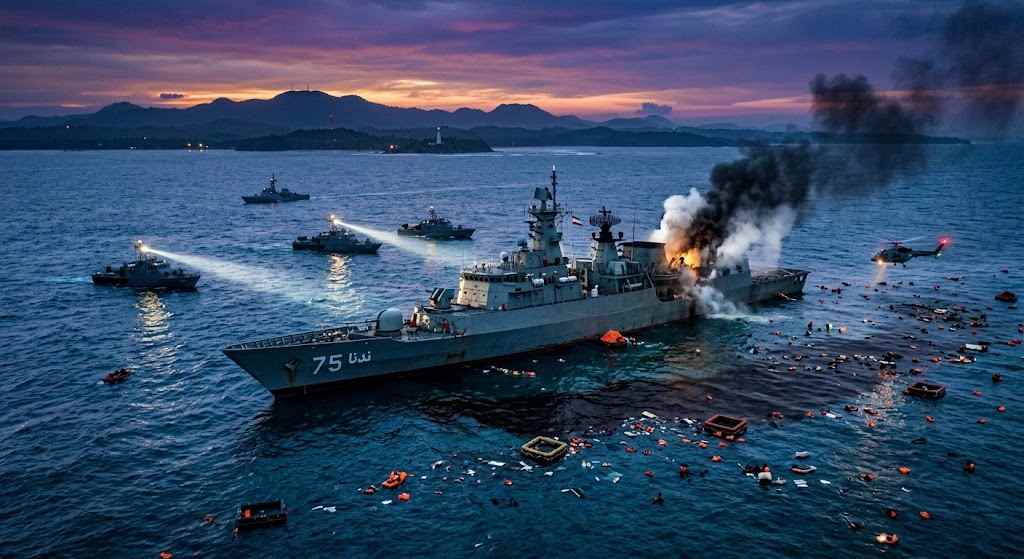
COLOMBO/WASHINGTON D.C. — US Submarine Sinks Iranian Warship IRIS Dena Off Sri Lanka Coast: 87 Dead in Indian Ocean Strike: In a chilling escalation of global hostilities, the Indian Ocean has become the latest theater of war. In the early hours of Wednesday, a United States Navy submarine torpedoed and sank the Iranian Moudge-class frigate IRIS Dena off the southern coast of Sri Lanka.
The strike, confirmed by the Pentagon, resulted in at least 87 confirmed deaths, marking the first time since World War II that an American submarine has sunk an enemy combatant ship in active warfare. The vessel was transitng back to Iran after participating in the MILAN 2026 multilateral naval exercises hosted by India in Visakhapatnam.
US Submarine Sinks Iranian Warship:A “Quiet Death” in International Waters
US Submarine Sinks Iranian Warship IRIS Dena Off Sri Lanka Coast: 87 Dead in Indian Ocean Strike: U.S. Defense Secretary Pete Hegseth, in an early morning briefing, characterized the operation as a display of American naval supremacy and “global reach.” Using the phrase “Quiet Death,” Hegseth confirmed that the IRIS Dena—a vessel that believed it was safe in international waters—was neutralized by a single Mk 48 torpedo launched from an Ohio-class fast-attack submarine.
“An American submarine sunk an Iranian warship that thought it was safe,” Hegseth told reporters. “Instead, it was sunk by a torpedo. Like in [World War II], we are fighting to win.”
The Pentagon took the unprecedented step of releasing black-and-white periscope footage of the attack. The video shows a massive explosion ripping through the rear of the frigate, lifting the stern from the water before the vessel began its rapid descent to the seabed. General Dan Caine, Chairman of the Joint Chiefs of Staff, noted that the “immediate effect” of the strike underscored the fact that the Iranian vessel likely never detected the stalking American predator.
The Human Toll: Rescue Operations off Galle
The sinking occurred approximately 40 nautical miles off the coastal city of Galle, Sri Lanka. At approximately 5:30 AM local time, the IRIS Dena issued a desperate distress call.
The Sri Lankan Navy and Air Force immediately launched a search-and-rescue mission. However, by the time rescuers arrived, the ship had disappeared, leaving only a massive oil slick and debris.
| Status of the Crew | Count (Estimated) |
| Total Estimated on Board | 180 |
| Confirmed Deceased | 87 |
| Rescued/Survivors | 32 |
| Missing/Unaccounted For | 61 |
Sri Lankan Foreign Minister Vijitha Herath confirmed that the 32 survivors were transported to Karapitiya Teaching Hospital in Galle. Many remain in critical condition, suffering from severe trauma and the effects of prolonged exposure in the water.
“We responded to the distress call under our international obligations,” said Navy spokesman Commander Buddhika Sampath. While Sri Lanka maintains a policy of neutrality, the incident occurred within its designated search-and-rescue zone, forcing the island nation into the middle of a spiraling geopolitical conflict.
From Diplomacy to Disaster: The India Connection
The timing of the attack adds a layer of diplomatic complexity. Just two weeks ago, the IRIS Dena was a guest of honor in India. It had participated in the International Fleet Review (IFR) and MILAN 2026, an exercise designed to “strengthen interoperability and collective response capabilities” among global navies.
The Indian Navy’s Eastern Naval Command had originally extended a warm welcome to the vessel, citing “long-standing cultural links.” Ironically, the US Navy destroyer USS Pinckney was also scheduled for the exercise but withdrew at the last minute due to “emergent requirements”—a move that military analysts now believe may have been linked to the onset of the current conflict.
The incident has already sparked political friction in New Delhi. Congress leader Pawan Khera questioned India’s regional influence on social media, asking if Indian waters and the surrounding neighborhood had been “quietly ceded to Washington and Tel Aviv” following the destruction of an invited guest’s vessel so close to home.
Context: A Rapidly Escalating War
The sinking of the IRIS Dena is not an isolated event. It follows a series of high-stakes military strikes launched on February 28 by the United States and Israel, which reportedly killed Iran’s Supreme Leader, Ayatollah Ali Khamenei, and several top regime officials.
The U.S. Department of War has signaled that its primary naval objective is to “wipe out” the Iranian Navy. Concurrent with the strike near Sri Lanka, reports confirmed that a Soleimani-class corvette was also sunk in the Strait of Hormuz.
Strategic Implications in the Indian Ocean
The waters south of Sri Lanka are among the world’s busiest maritime corridors, linking the Middle East and Europe to East Asia. The presence of Ohio-class submarines, which routinely patrol from the U.S. base on Diego Garcia, ensures that Washington maintains a constant, “invisible” eye on these lanes.
Military analysts in Chennai suggest that the U.S. submarine may have been passively tracking the IRIS Dena since it left Iranian shores for India. “It is common for navies to track others for intelligence,” one analyst noted. “What is uncommon is for that surveillance to turn into a lethal strike in a neutral corridor.”
The IRIS Dena, named after Mount Dena, was a symbol of Iranian domestic military manufacturing. Armed with Qader anti-ship missiles and a 76mm naval gun, it was designed for regional dominance. Against the silent, high-tech weaponry of a U.S. nuclear submarine, however, its defenses proved insufficient.
The Road Ahead
As Sri Lankan authorities continue to pull bodies from the water, the international community watches with bated breath. The sinking of a warship returning from a multilateral “peace” exercise is a grim reminder of how quickly diplomatic waters can turn red.
The U.S. has made its stance clear: the Indian Ocean is no longer a safe haven for Iranian assets. For India and Sri Lanka, the challenge now lies in navigating a backyard that has suddenly become a primary battleground in a burgeoning global war.