
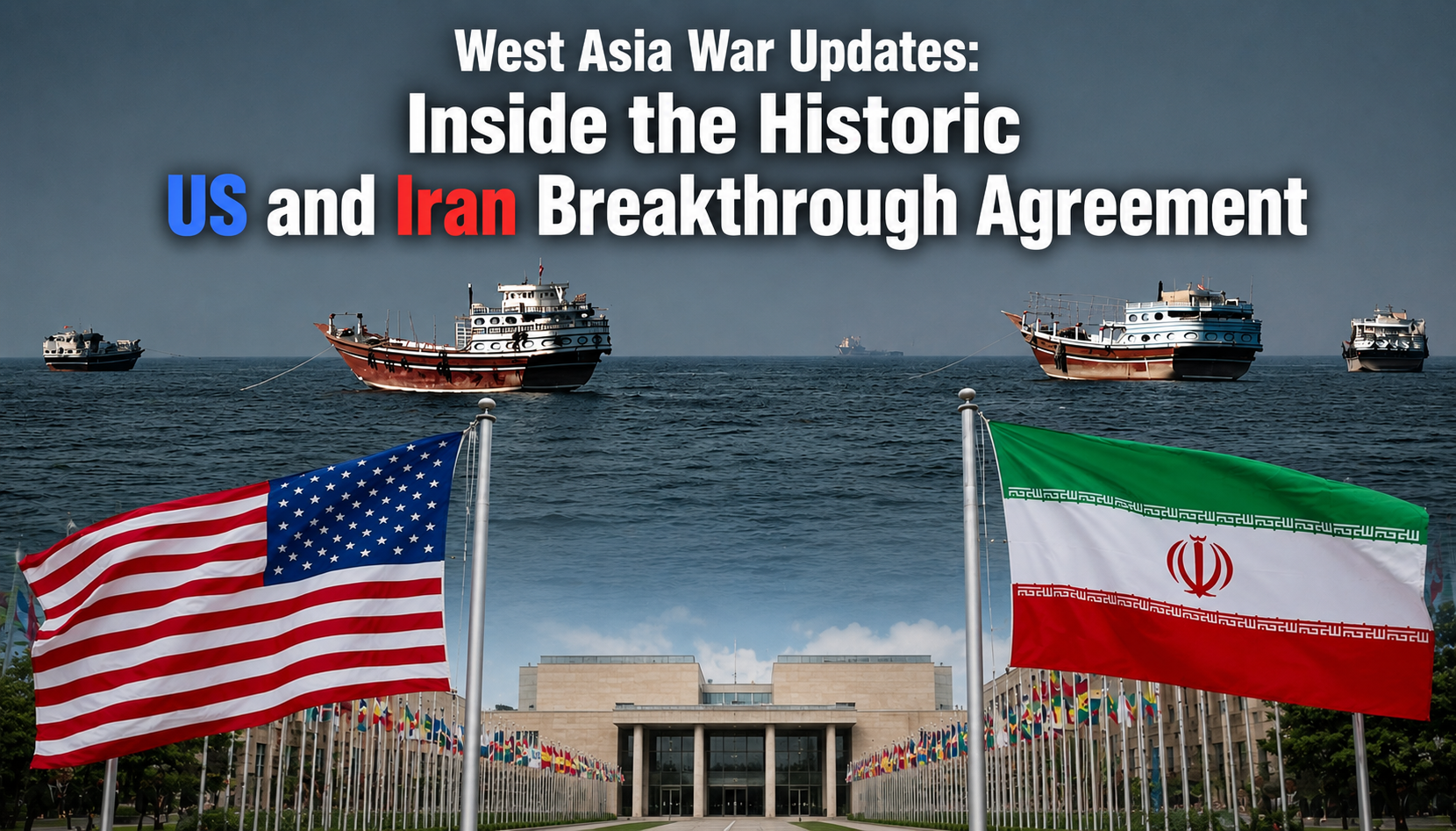
West Asia war updates take a dramatic and unexpected turn today as the United States and Iran have officially agreed to a mutual halt in military strikes. In a high-stakes diplomatic breakthrough reported by Axios, the two adversarial nations are scheduled to convene for emergency technical talks in Doha, Qatar, on Tuesday, June 30, 2026. The sudden de-escalation aims to directly resolve the intensifying conflict over the Strait of Hormuz—a vital maritime corridor responsible for a massive share of the world’s global oil shipments.
According to a senior U.S. official speaking on the condition of anonymity, both Washington and Tehran have agreed to “stand down” their respective military operations immediately. This temporary truce ensures that commercial shipping vessels can once again navigate the critical trade route freely without the imminent threat of missile or drone attacks.
While international markets have reacted with a cautious sigh of relief, the situation on the ground remains incredibly volatile. Even as the maritime arena cools down, parallel conflicts involving Israel, Lebanon, Syria, and Gaza continue to threaten the fragile stability of the region.
The Doha Mandate: Navigating the Strait of Hormuz Crisis
The upcoming meeting in Doha represents the most significant diplomatic engagement between Washington and Tehran in recent years. The core focus of Tuesday’s emergency session is to hammer out an operational framework based on a preliminary Memorandum of Understanding (MoU).
“Technical talks are slated to continue on all areas of the MOU. Both sides will stand down for now and vessels can move freely,” the U.S. official confirmed to reporters.
The primary objective is to establish long-term security parameters for the Strait of Hormuz. In recent weeks, U.S. and Iranian forces had been trading direct attacks across the vital seaway, grinding global logistics to a near-halt and spiking global energy prices. Under the terms of this temporary stand-down, both nations will halt offensive actions, creating a safe window for international shipping lines to resume normal operations.
Tehran Asserts Sovereignty Amid Diplomatic Maneuvers
Despite agreeing to sit down at the negotiating table in Qatar, Iran’s political leadership is maintaining a fiercely uncompromising stance regarding its maritime jurisdiction. On Sunday, June 28, 2026, Iranian Foreign Minister Abbas Araghchi sent a clear, unyielding message to the international community.
Araghchi publicly insisted that the ultimate responsibility for the security and regulation of the Strait of Hormuz lies solely with Tehran. He firmly warned that any attempt by global shipping conglomerates or foreign navies to bypass Iran’s preferred routing protocols within the waterway would be viewed as a hostile act.
“Any attempt to bypass our preferred route in the waterway will cause nothing but further tension and escalation across West Asia,” Araghchi stated during a press briefing in Tehran.
This rigid stance highlights the immense friction that negotiators will face in Doha. While Iran is willing to halt active strikes to avoid an all-out war with the United States, it refuses to back down on its core claim of total geopolitical dominance over the Persian Gulf’s gateway.
The Lebanese Front: A Fragile Truce Shattered
The breakthrough between the U.S. and Iran comes at a time when neighboring conflicts are threatening to spin completely out of control. Just two days after Israel and Lebanon signed a heavily brokered bilateral agreement aimed at ending active hostilities, bloodshed has already returned to the border regions.
On Sunday, the Israel Defense Forces (IDF) officially announced the death of Captain David Hazutt. The 21-year-old platoon commander was killed during active combat operations in southern Lebanon. The loss of life so soon after a formal ceasefire underscores how incredibly fragile the peace process remains.
Hezbollah Defiant
Adding to the tension, Lebanon’s powerful paramilitary and political organization, Hezbollah, issued a separate declaration. The group stated explicitly that it reserves the right to “defend its homeland” against what it characterizes as continued Israeli provocations and airspace violations.
Domestic Opposition in Beirut
Simultaneously, the diplomatic framework between Israel and Lebanon is facing severe internal political opposition within Beirut itself. Lebanese Parliament Speaker Nabih Berri openly condemned the current deal, stating bluntly that the agreement will face roadblock after roadblock.
Berri’s Stance: He declared that the framework agreement “will not pass” and “will not be implemented” in its current form.
The Core Grievance: The Lebanese leadership argues that the negotiated terms fail to firmly guarantee Lebanon’s sovereign territorial rights and security parameters.
Regional Spillover: Escalations in Gaza and Syria
As the international community shifts its focus toward the maritime diplomacy unfolding in Doha, the broader ground realities of the West Asia crisis remain grim. The humanitarian and military tolls continue to mount across multiple fronts.
Fatalities in Gaza
In the Gaza Strip, Israeli military operations show no signs of stopping. Recent airstrikes and ground incursions resulted in the deaths of at least four more Palestinians. Local medical authorities report that civilian infrastructure continues to bear the brunt of the ongoing tactical maneuvers.
Syrian Sovereignty Incursions
Further north, Syria has officially issued a fierce diplomatic condemnation against Israel. Damascus warned of severe consequences following a series of sudden Israeli military incursions into its southern provinces, specifically targeting the volatile regions of:
Quneitra
Deraa
The Syrian government warned that these continued cross-border attacks risk triggering a massive, uncontrollable escalation that could completely undermine any diplomatic progress achieved by the U.S.-Iran talks in Qatar.
What to Expect Next: The Stakes in Doha
As June 30 approaches, the global community will be watching Doha with immense scrutiny. The success or failure of these technical talks will likely dictate the economic and military trajectory of the region for the remainder of 2026.
| Key Agenda Item | United States Position | Iran Position |
| Strait of Hormuz Security | Demands unrestricted, free international navigation for all commercial vessels. | Insists on exclusive administrative control and veto power over shipping routes. |
| Military Presence | Seeks a reduction of Iranian ballistic and drone threats targeting naval fleets. | Demands a pullback of Western coalition warships from the Persian Gulf. |
| MOU Implementation | Wants structured, verifiable benchmarks before permanent sanctions relief. | Demands immediate economic assurances in exchange for holding back proxy forces. |
If the technical teams can successfully transform the current “stand-down” agreement into a permanent maritime treaty, global energy markets will quickly stabilize. However, if Iran holds firm to its aggressive stance regarding sole control of the strait, or if the ongoing violence in Lebanon and Syria spills over, this temporary truce could disintegrate as quickly as it was formed. Stay tuned for further West Asia war updates as this high-stakes diplomatic puzzle unfolds.