
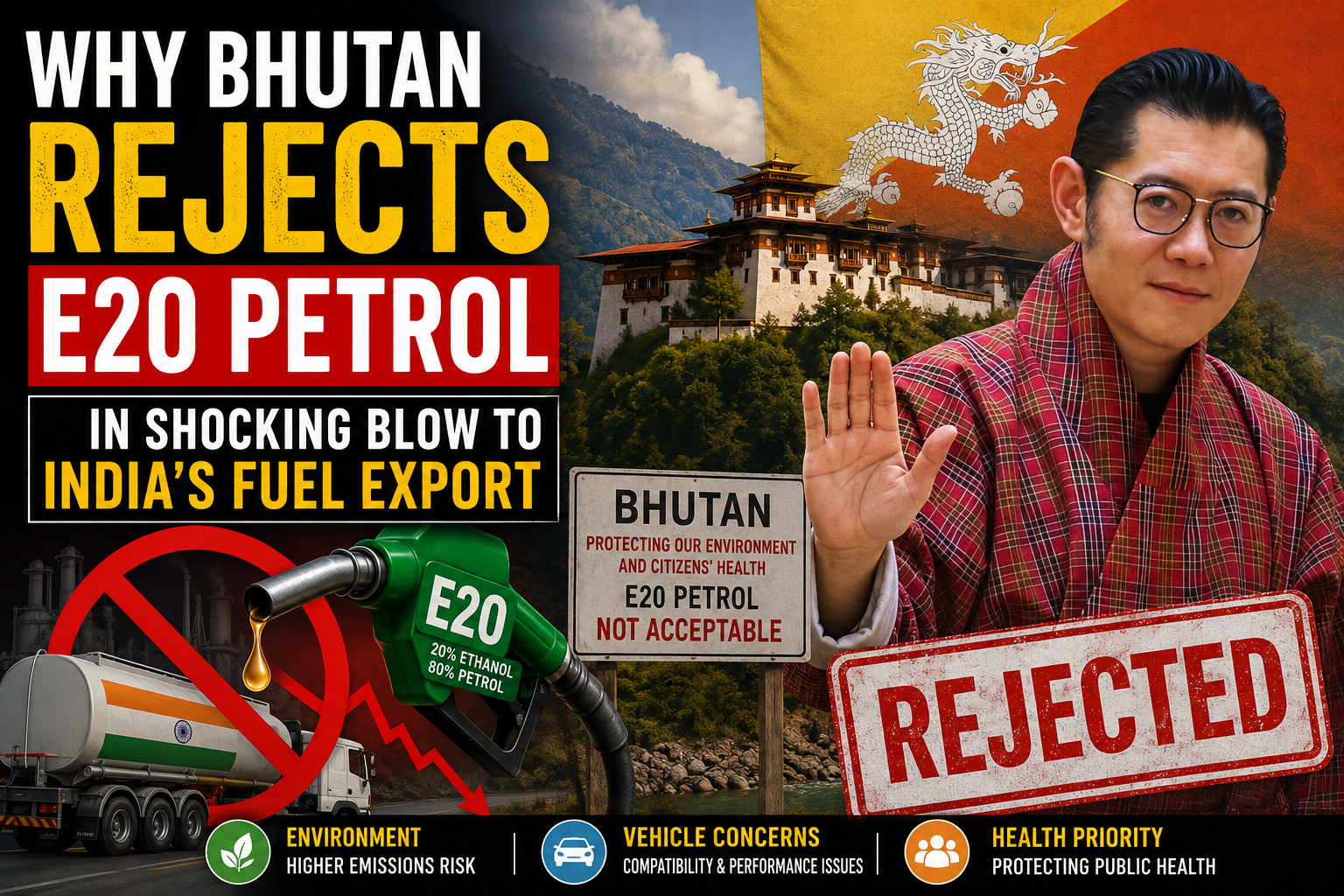
Bhutan rejects E20 petrol from Indian oil companies, sparking a major conversation on how geography and infrastructure dictate green energy transitions. While New Delhi aggressively pushes its ambitious ethanol-blending mandate domestically to curb crude oil imports, its closest Himalayan neighbor has quietly but firmly said “no.”
According to reports initially published by The Bhutanese, Bhutan’s Department of Trade has requested Indian Oil Marketing Companies (OMCs)—including IOCL, BPCL, and HPCL—to continue supplying conventional, unblended petrol. Bhutan sources 100% of its petroleum products directly from India, typically purchasing premium export-quality fuel. However, the sudden shift toward an 80:20 petrol-ethanol blend has hit a massive roadblock at the border.
This decision highlights an often-overlooked reality of global climate policies: green initiatives cannot follow a one-size-fits-all blueprint. Here is a deep dive into the technical, geographical, and economic reasons why Bhutan has declined India’s E20 fuel offer.
The Chemistry Problem : Why Ethanol and Water Don’t Mix
To understand why Bhutan rejected the offer, one must look at basic chemical properties. Unlike conventional fossil fuels, ethanol contains a hydroxyl group ($-OH$), which makes it highly hygroscopic. In plain terms, ethanol acts like a sponge, readily absorbing moisture and water vapor from its surrounding environment. Pure petrol, by contrast, does not mix with water.
When an E20 blend (20% ethanol and 80% petrol) is exposed to moisture, a phenomenon known as phase separation occurs. If even a small amount of water seeps into the fuel supply:
The ethanol bonds with the water molecules instead of the petrol.
The water-ethanol mixture becomes heavier than the gasoline.
The fuel separates into distinct layers, sinking to the bottom of the storage tank.
If this contaminated, diluted mixture is pumped into a vehicle, it can cause immediate engine misfires, severe stalling, and long-term mechanical degradation.
1. Ageing Underground Storage Infrastructure
The primary catalyst behind Bhutan’s refusal is the current state of its domestic fuel storage. A Bhutanese official noted that many of the kingdom’s commercial fuel depots and retail petrol pumps rely on ageing underground storage tanks.
“Considering the existing condition and quality of several of the underground storage tanks, the import and handling of ethanol-blended fuel may pose challenges in ensuring fuel quality,” the Bhutanese government officially stated.
Because these steel tanks have been buried for years, they are highly susceptible to minor groundwater seepage and moisture condensation. If Bhutan were to introduce E20 petrol into these legacy systems, the fuel would instantly degrade. Furthermore, the combination of water and ethanol accelerates the corrosion of steel pipelines and storage units, creating a massive maintenance liability for the nation’s fuel distributors.
2. Mountainous Terrain and Engine Power Demands
Geography plays a massive role in energy consumption. Bhutan is a land of steep climbs, high altitudes, and unforgiving mountainous roads. Vehicles operating in the Himalayas require maximum torque and consistent engine power to navigate high-altitude passes.
Ethanol has a significantly lower energy density than pure gasoline. Gram for gram, ethanol provides roughly 33% less energy than pure petrol. When blended at a 20% ratio (E20), it inevitably results in a drop in fuel efficiency and a noticeable reduction in engine pulling power.
Bhutanese authorities fear that E20 fuel will not deliver the reliable, high-performance output needed for heavy transport and passenger vehicles tackling steep terrains. A drop in power on a treacherous mountain cliff isn’t just an inconvenience; it is a major safety hazard.
3. High Humidity and Condensation in the Himalayas
It is not just the infrastructure under the ground that poses a problem; the atmosphere above it is equally challenging. Many of Bhutan’s primary fuel distribution hubs are located in high-altitude, high-humidity zones.
In these regions, rapid temperature fluctuations between day and night cause severe condensation inside fuel storage units. For regular petrol, this water simply settles at the very bottom and can be drained out mechanically. For E20 petrol, the atmospheric moisture triggers immediate phase separation, rendering entire batches of fuel useless. Bhutanese officials noted that keeping storage environments completely airtight under these regional weather conditions is practically impossible without multi-million-dollar upgrades.
[Atmospheric Moisture/Groundwater]
               │
               ▼
   [E20 Petrol Storage Tank]
               │
               ▼ (Chemical Reaction)
   [Phase Separation Occurs] ──► [Ethanol + Water Sinks to Bottom]
                                 [Corrodes Steel Tanks & Pipelines]
                                 [Causes Vehicle Engine Failure]
4. Consumer Backlash and Mileage Concerns in India
Bhutan’s cautious stance is also informed by the ongoing domestic controversy within India regarding E20 fuel. India’s rapid rollout of the 20% ethanol mandate has faced significant pushback from motorists, particularly those owning vehicles manufactured before 2023.
Indian consumers have logged widespread complaints regarding:
Reduced Mileage: A tangible drop in kilometers per liter (KPL), forcing drivers to fill up more frequently.
Accelerated Wear and Tear: Ethanol is corrosive to certain types of rubber gaskets, plastic fuel lines, and fuel pumps found in older engines.
High Maintenance Costs: Increased instances of fuel system clogging and component failures.
While the Indian government argues that the slight drop in mileage is compensated for by improved acceleration and reduced tailpipe emissions, the economic trade-off remains controversial. Bhutanese trade officials are hesitant to pass these increased maintenance costs and lower fuel efficiencies onto their own citizens.
5. Pricing Anomalies and Lack of Consumer Choice
In international markets like Brazil or the United States, high-ethanol blended fuels are heavily subsidized by governments. Because ethanol yields fewer kilometers per liter, it is sold at a lower price point at the pump to incentivize consumers and offset the loss in mileage.
However, in India, E20 petrol is retailed at the exact same price as conventional regular petrol. Motorists essentially pay the same premium price for a fuel that delivers less energy content.
Furthermore, unlike European or American fuel stations—where drivers can actively choose between different fuel nozzles offering E5, E10, or pure unblended gasoline—Indian fuel stations have largely transitioned to supplying the standard E20 blend as the default option. This leaves owners of legacy or vintage vehicles with zero alternatives. Bhutan, observing this market dynamic, prefers to stick with high-quality, pure unblended fuel imports to safeguard its consumer market.
The Supreme Court “Experiment” Controversy
Adding fuel to the fire, India’s E20 transition recently witnessed a public relations disaster. During a legal hearing, India’s Attorney General reportedly told the Supreme Court that the current E20 policy was an “experiment” and its definitive long-term mechanical impacts would only be fully understood by next year.
| Country / Entity | Fuel Strategy Approach | Consumer Choice Availability |
| India | Aggressive E20 rollout; testing E25 blends | Limited; E20 is becoming the standard pump default |
| Bhutan | Rejected E20; demands pure petrol due to terrain | Sticks exclusively to high-quality unblended fuel |
| Brazil / USA | High ethanol blends (E85); heavily subsidized | High; clear separation of fuel types at the pump |
While government departments quickly issued denials claiming the statement was misinterpreted, a video recording of the top law officer making the remark went viral across social media platforms. This admission raised red flags for neighboring trade partners like Bhutan, confirming that the long-term structural risks of the fuel are still being evaluated.
How Bhutan Plans to Detect Accidental E20 Shipments
Given that Bhutan shares a porous energy supply chain with India, what happens if an E20 shipment mistakenly crosses the border?
According to Bhutanese trade officials, accidental imports can be identified almost instantly without complex laboratory equipment. Due to the high moisture levels inherent to Bhutan’s storage climate, any accidental shipment of E20 fuel exposed to the elements would undergo phase separation and immediately turn milky or cloudy in appearance. This distinct visual indicator allows border checkpoints to test fuel quality on the spot and reject substandard or blended batches before they enter the national grid.
Lessons for Regional Energy Cooperation
Bhutan’s refusal to accept E20 petrol serves as a crucial reality check for India’s regional energy export strategy. India is currently testing E25 petrol (a 25% ethanol blend) and plans to expand its green energy footprint across South Asia. However, cross-border energy integration requires more than just exporting a product; it demands absolute infrastructure compatibility.
For Bhutan to adopt green fuels in the future, Indian OMCs will likely need to assist the kingdom by providing modern, leak-proof, moisture-resistant storage tanks and upgraded distribution networks. Until those capital investments are made, Bhutan’s decision to stick with traditional petrol remains a mathematically sound and practically necessary choice to protect its vehicles, its citizens, and its economy.