
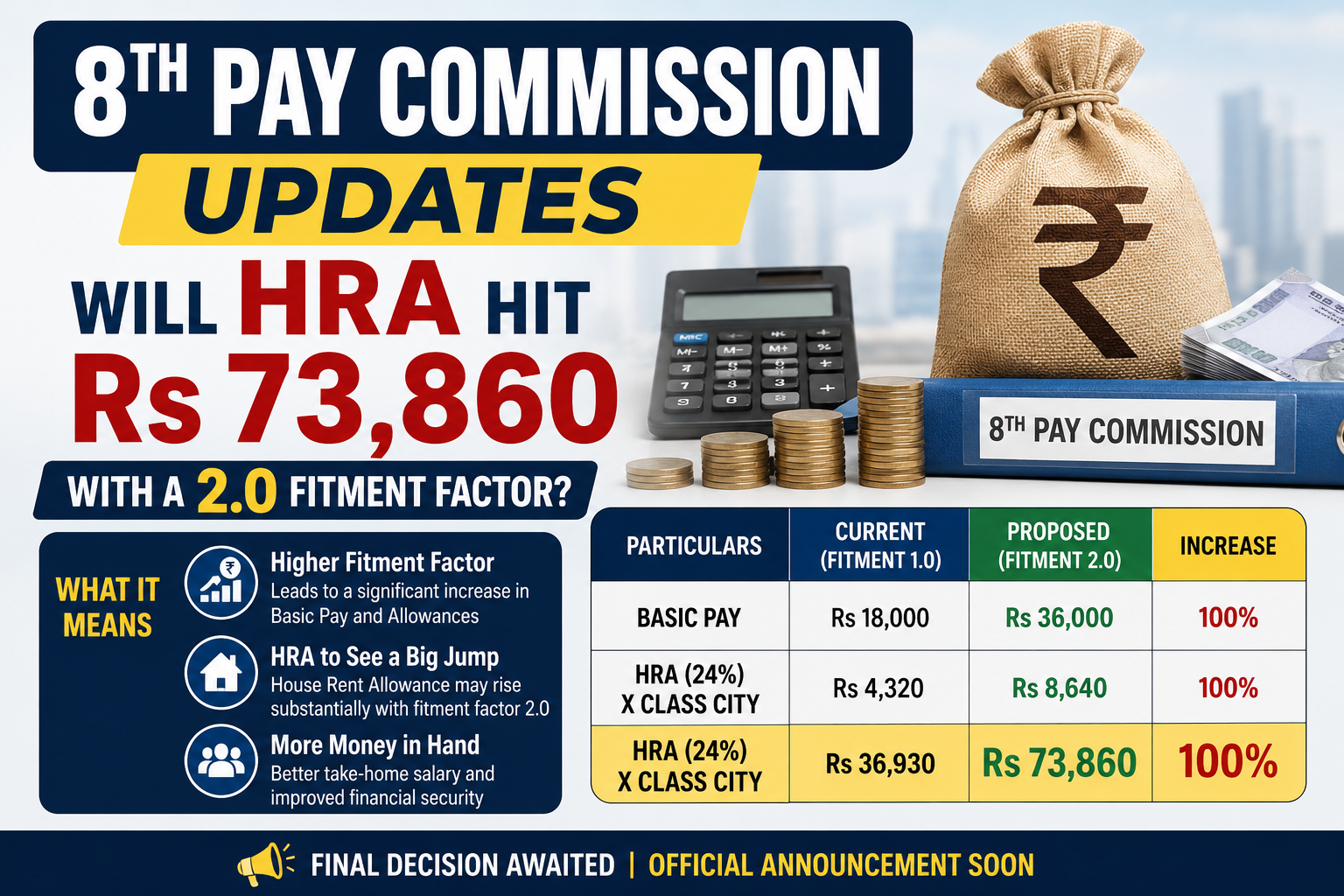
The 8th Pay Commission has officially set the wheels in motion, sparking widespread anticipation among millions of central government employees and pensioners across India. As the dialogue between employee unions, stakeholder associations, and the government panel intensifies, the math behind potential salary hikes is taking center stage. Among the various components of the salary structure, the House Rent Allowance (HRA) is drawing massive attention, with projections suggesting a massive jump for employees across different pay levels.
If the proposed revisions are accepted, high-level central government employees could see their monthly HRA soar to an astonishing Rs 73,860. However, everything hinges on a crucial multiplier known as the fitment factor. While unions are pushing for aggressive multipliers to counter inflation, the government faces the delicate task of balancing fiscal responsibility with employee welfare.
Here is an in-depth breakdown of how the allowance math changes under a prospective 2.0 fitment factor, alongside the top updates from the ongoing panel discussions.
Understanding the Fitment Factor Multiplier and HRA Connection
To understand how the 8th Pay Commission might alter your take-home pay, it is essential to look at how allowances are structured. The fitment factor is not applied directly to allowances like the House Rent Allowance. Instead, it acts as a baseline multiplier that revises the core Basic Pay.
Because HRA is calculated as a direct percentage of an employee’s Basic Pay, any upward shift in the fitment factor automatically triggers a cascading effect on allowances.
“Even a slight change in the multiplier (fitment factor) can significantly affect salaries at every pay level. Its impact also extends to benefits linked to basic pay, such as House Rent Allowance (HRA),” explains Adhil Shetty, CEO of BankBazaar.
The 2.0 Fitment Factor Math: X, Y, and Z Category Cities
Illustrative calculations highlight just how drastic the shift could be if a 2.0 fitment factor is implemented while keeping the current HRA percentage bands intact. The final allowance depends heavily on the geographic location of the employee, classified into X (metropolitan), Y (semi-urban), and Z (rural/smaller towns) categories.
1. Level 13 Senior Executives (Top Tier Impact)
For a senior employee at Pay Level 13, a 2.0 fitment factor would elevate the revised basic pay to Rs 2,46,200.
X Category Cities (30% HRA): The monthly housing allowance would climb to a staggering Rs 73,860.
Y Category Cities (20% HRA): The allowance would stand at Rs 49,240.
Z Category Cities (10% HRA): The monthly payout would be Rs 24,620.
2. Level 4 Employees (Mid-Tier Impact)
The formula remains identical across the entire pay matrix. Consider a Level 4 employee currently earning a basic pay of Rs 25,500. Under a 2.0 multiplier, their revised basic pay would jump to Rs 51,000.
X Category Cities: The monthly HRA works out to Rs 15,300.
Y Category Cities: Employees will receive Rs 10,200.
Z Category Cities: The allowance drops to Rs 5,100.
Salary Revision Matrix at a Glance (Under 2.0 Fitment Factor)
| Pay Level | Current Basic Pay | Revised Basic Pay (2.0 Factor) | X-City HRA (30%) | Y-City HRA (20%) | Z-City HRA (10%) |
| Level 4 | Rs 25,500 | Rs 51,000 | Rs 15,300 | Rs 10,200 | Rs 5,100 |
| Level 13 | Varies | Rs 2,46,200 | Rs 73,860 | Rs 49,240 | Rs 24,620 |
Top 7 Latest Updates from the Panel Discussions
Beyond the theoretical salary calculations, the groundwork for the next pay restructuring is moving at a rapid pace. Here are the most critical updates regarding the panel’s timeline, union demands, and operational developments.
1. The Power Panel Behind the Revision
The current panel overseeing these monumental changes is chaired by Former Supreme Court Justice Ranjana Prakash Desai. She is joined by prominent economic and administrative minds, including Professor Pulak Ghosh (Tenured Professor of Finance and Member of the Economic Advisory Council to the Prime Minister) and Pankaj Jain (Former IAS, serving as Member-Secretary).
2. Massive Minimum Pay Demands by Major Unions
Prominent employee representations like the National Council — Joint Consultative Machinery (NC-JCM), the All India Defence Employees Federation (AIDEF), and the Maharashtra Old Pension Organisation have formally submitted aggressive minimum basic pay demands.
NC-JCM & AIDEF: Demanding a minimum basic pay of Rs 69,000.
Maharashtra Old Pension Organisation: Pitching for a minimum basic pay of Rs 65,000.
3. Alternative Demands from Railway Associations
The Indian Railways Technical Supervisors Association (IRTSA) has approached the calculation differently, requesting a minimum pay revision to Rs 52,600 adjusted for modern economic indicators. They have also argued for a varied fixation strategy, proposing fitment factors of 2.92, 3.50, and 3.80 for higher safety category posts at Level 6. Concurrently, the Railways Senior Citizens Welfare Society (RSCWS) insists that baseline minimum pay must strictly mirror the price index recorded on January 1, 2026.
4. Diverse Formulas for Dearness Allowance (DA)
Unions are not just looking at basic pay; they want structural changes to how Dearness Allowance handles inflation:
NC-JCM: Pushing for a fully inflation-linked wage model.
AIDEF: Demanding dynamic inflation-adjusted compensation models.
Maharashtra Old Pension Organisation: Requesting a minimum 4% DA hike alongside a complete DA merger into basic pay once it crosses the 50% threshold.
5. Data Submission Portals and Hard Deadlines
The panel has officially closed its physical memorandum submission window as of June 15, after extending the timeline twice to accommodate maximum participation. However, stakeholders looking to upload critical analytical metrics still have a window open. The online data collection portal is actively processing inputs until June 30, 2026.
6. Scheduled State Visits for Ground-Level Consultations
To gain a holistic view of regional economic disparities, the committee has been conducting extensive state tours. Following tours throughout April, May, and June, the panel has locked in vital upcoming consultation dates in July. Stakeholder groups in Odisha and West Bengal will meet the commission in Bhubaneswar on July 6–7 and in Kolkata on July 9–10, respectively.
7. Active Consultant Recruitment
To process the mountains of economic and demographic data submitted by over 1 crore beneficiaries, the commission is expanding its backend team. The panel has announced 20 vacancies for contractual full-time and part-time consultant roles. These positions feature a fixed one-year tenure (or until the commission wraps up its operations) and remain open until all slots are filled.
When Will the New Salary Matrix Take Effect?
For the 50 lakh central government employees and roughly 65 lakh pensioners awaiting relief, patience will be key.
Historically, a pay commission is established every decade, with the current panel expected to formalize its recommendations over an 18-month window. This points toward February 2027 as the earliest window for official report submissions. Some internal insiders, including Dr. Manjeet Singh Patel (National President of the All India NPS Employees Federation), suggest that a concrete announcement might land in April 2027, aligning perfectly with the start of the new financial year.
However, historical implementation trends show a gap between announcement and execution. Past rollouts have traditionally taken anywhere from two to three years to fully integrate into administrative structures. Consequently, while the structural blueprints will solidify by mid-2027, the actual bank account updates for employees may only reach full implementation between 2029 and 2030.
Until the central cabinet signs off on a finalized multiplier, the prospective 2.0 fitment factor and the resulting Rs 73,860 HRA remain an encouraging look at what the financial future holds for India’s public sector workforce.
Disclaimer: For educational purposes only. The investment insights and market views shared above belong solely to the respective analysts or broking companies. This is not financial advice. Please do your own research and consult a certified professional before investing your money.