
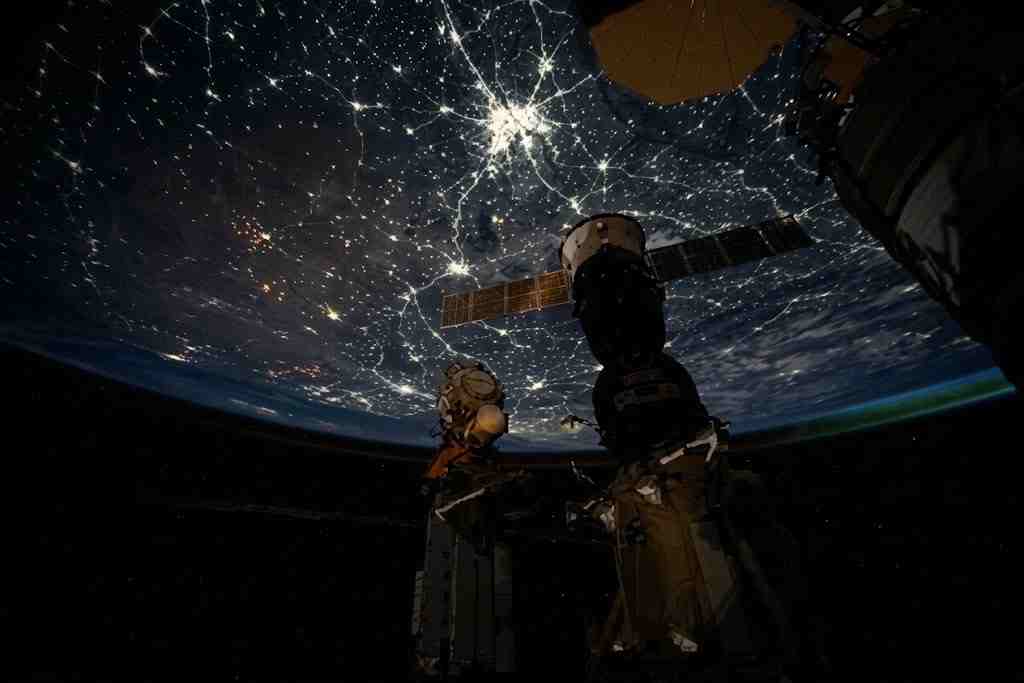
The Jewel of the Night: In a spectacular display of human civilization meeting the vastness of the cosmos, the International Space Station (ISS) has released a series of mesmerizing nighttime images of the Indian subcontinent. Captured from an altitude of approximately 400 kilometers, the photographs reveal a nation transformed into a glowing tapestry of light, tracing the heartbeat of one of the world’s most vibrant regions.
The images, shared via the official ISS account on X (formerly Twitter), were taken as the orbital laboratory soared over the Arabian Sea, crossing the rugged expanse of the Himalayas. The result is a dazzling celestial perspective that has captivated space enthusiasts and citizens across the globe.
A Web of Light: Mapping India from the Stars
The Jewel of the Night: International Space Station Captures Breathtaking Glowing View of India: From the unique vantage point of the ISS, the geographical boundaries of India are defined not by maps, but by the collective energy of its people. The photographs showcase an intricate, web-like network of light. Major metropolitan hubs like Delhi, Mumbai, Bengaluru, and Kolkata appear as intense, radiant clusters, acting as the primary nodes of the country’s glowing nervous system.
Connecting these massive urban centers are thin, golden threads—the national highways and transit corridors that remain illuminated through the night. Between these major arteries, smaller clusters of light reveal the presence of thousands of towns and villages, proving that even the most remote corners of the country are part of this luminous evolution.
“India is glowing from space, a reminder of how human energy and culture shine even brighter than city lights,” remarked one social media user, capturing the sentiment of millions who saw their homeland from a divine perspective.
The Science Behind the Snapshot
The Jewel of the Night: International Space Station Captures Breathtaking Glowing View of India: To achieve these “cityscape panoramas,” astronauts aboard the ISS use specialized digital cameras equipped with long-exposure settings.
Because the space station completes one full orbit of the Earth every 90 minutes, the window of opportunity to capture a clear, blur-free image of a specific region is incredibly narrow. Astronauts must track the Earth’s rotation and the station’s velocity with precision. These techniques allow for the sharp contrast seen in the recent photos: the pitch-black void of the Arabian Sea, the deep, jagged shadows cast by the Himalayan peaks, and the warm, incandescent glow of human habitation.
More Than Just a Pretty Picture: The Story of Development
While the aesthetic beauty of the “Glowing India” photos is undeniable, scientists and urban planners see more than just art. These images are vital components of datasets like NASA’s Black Marble, which uses nighttime lights to study human activity.
The density and expansion of these lights serve as a real-time indicator of economic progress and urbanization. Over the last two decades, the “light footprint” of India has expanded significantly, reflecting the nation’s rapid infrastructural growth and the electrification of rural areas. However, this brilliance also invites a conversation about light pollution and its impact on local ecosystems and our ability to observe the stars from the ground.
Understanding the ISS: Our Eye in the Sky
The International Space Station remains humanity’s only permanent residence outside of Earth. A collaborative masterpiece launched in 1998, it represents a partnership between the United States (NASA), Russia (Roscosmos), Canada (CSA), Japan (JAXA), and the European Space Agency (ESA).
| Feature | Specification |
| Altitude | 370 km to 460 km |
| Speed | ~28,000 km/h (8 km per second) |
| Size | Approximately the size of a football field |
| Weight | ~450,000 kg (Equivalent to a Boeing 747) |
| Orbits per day | 16 orbits |
The station serves as a microgravity laboratory where crews conduct experiments that could never be performed on Earth, ranging from biology and physics to meteorology. Yet, for many, its most important role is as a “watchful eye,” providing a perspective that fosters a sense of global unity.
A Global Connection
The release of these images sparked a wave of “home-spotting” on social media. Users zoomed in to find the specific glow of their own neighborhoods, creating a digital bridge between the high-tech world of space exploration and the daily lives of people on the ground.
One commenter noted that the view felt like “seeing Earth’s heartbeat.” Indeed, the contrast between the silent, dark mountains of the north and the bustling, lit-up plains below reminds us of the delicate balance between nature and civilization.
As the ISS continues its 90-minute journey around our planet, these snapshots serve as a powerful reminder of our shared home. In the darkness of space, the lights of India provide a warm, flickering proof of human ingenuity, resilience, and the tireless spirit of a nation that never truly sleeps.