
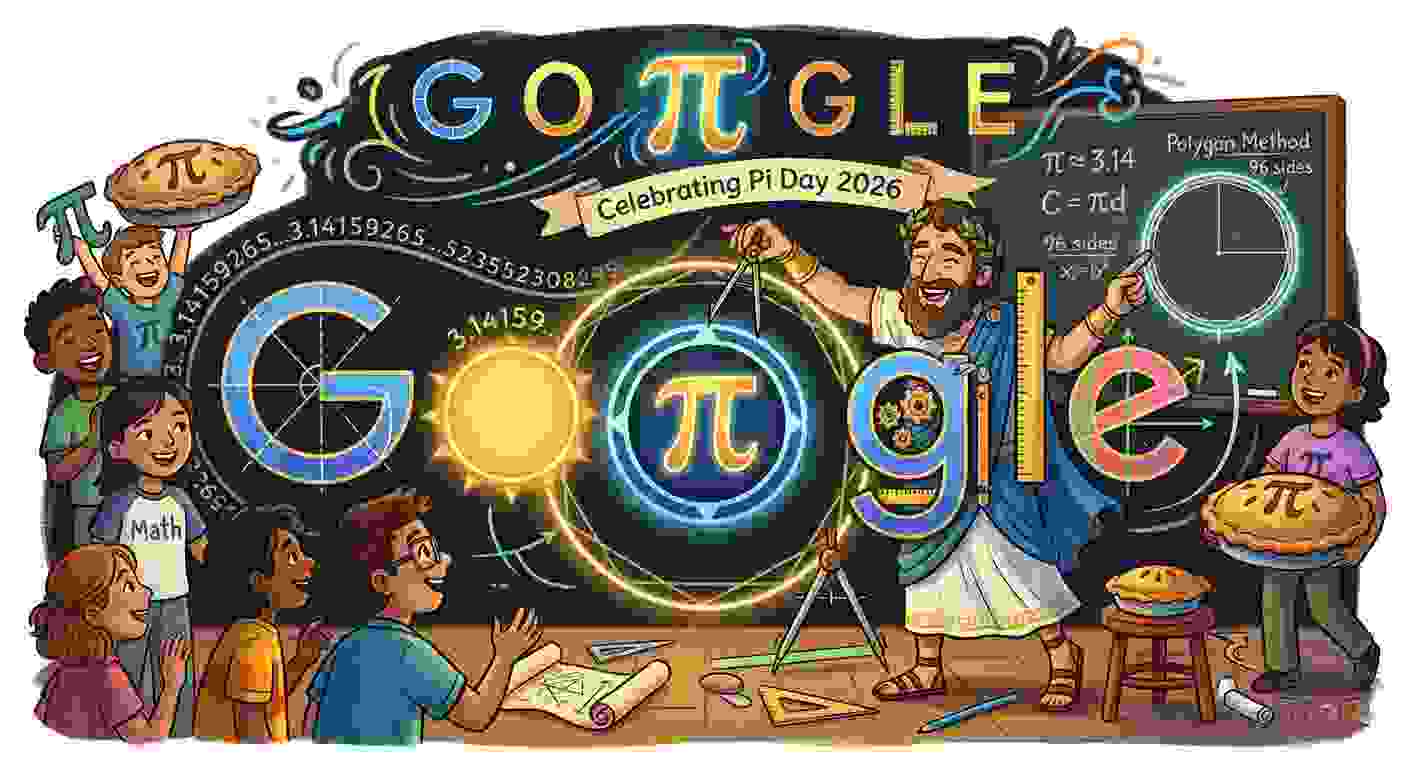
Google Doodle Celebrates Pi Day 2026:The world of mathematics and science is buzzing today as we hit March 14, the date that represents the most famous ratio in the universe. But this year, the celebration feels even more profound. Google has officially joined the festivities by unveiling a special, interactive Google Doodle for Pi Day 2026, specifically paying tribute to the “Father of Mathematics,” Archimedes of Syracuse.
From the bustling streets of India to the classrooms of the UK, Mexico, and Japan, millions are looking at their search screens to find a vibrant graphic that explains how a man over 2,000 years ago used simple geometry to define a number that now powers our modern spaceships and smartphones.
Google Doodle Celebrates Pi Day 2026: What is Pi ($\pi$)? Understanding the Constant
Before diving into the celebrations, it is essential to understand why this number holds such a grip on our collective curiosity.
Pi ($\pi$) is the ratio of a circle’s circumference (the distance around the circle) to its diameter (the distance across the circle through the center). Regardless of the size of the circle—whether it is a tiny atom or a massive galaxy—this ratio is always the same.
The Nature of an Irrational Number
As the 2026 Google Doodle highlights, Pi is an irrational number. This means:
Non-terminating: Its decimals go on forever.
Non-repeating: There is no predictable pattern in its sequence.
While most students use the fraction $22/7$ or the decimal $3.14$ for school calculations, Pi is actually an infinite mystery. In the modern era, supercomputers have calculated Pi to trillions of digits, yet it never ends.
The 2026 Google Doodle: A Tribute to Archimedes
The 2026 Doodle isn’t just a static image; it is a lesson in foundational geometry. Google stated that it wanted to honor the “foundational geometry first used to calculate the limits of Pi.”
The Polygon Method: “Sandwiching” the Circle
Long before we had calculators, Archimedes popularized a revolutionary approach to find the value of Pi. He didn’t just guess; he used a method of exhaustion.
He placed a circle between two polygons—one inscribed inside the circle and one circumscribed outside of it. By increasing the number of sides of these polygons, they began to look more and more like the circle itself.
In his most famous attempt, Archimedes used 96-sided polygons. By calculating the perimeters of these 96-sided shapes, he determined that Pi must fall between $3\frac{10}{71}$ and $3\frac{1}{7}$. This “sandwiching” technique provided the upper and lower bounds that mathematicians relied on for centuries.
The Global Reach of the 2026 Doodle
Google’s tribute to Archimedes has been rolled out across a vast range of countries, reflecting the universal language of math. The Doodle is currently visible to users in:
Asia: India, Japan.
Europe: UK, Belgium, Czechia, Iceland.
Americas: Mexico, El Salvador, Colombia, Ecuador, Uruguay, Brazil, Argentina, Chile, and Peru.
Oceania: Australia, New Zealand.
A Brief History of Google Doodles
The concept of the “Doodle” has come a long way since its inception.
1998: The first Doodle was a simple “out of office” message by founders Larry Page and Sergey Brin during the Burning Man festival.
2000: The first international Doodle honored Bastille Day in France.
2010: Google introduced its first interactive game Doodle to celebrate the 30th anniversary of Pac-Man.
Today, Doodles like the Pi Day 2026 edition serve as global educational tools, bringing complex historical achievements to the fingertips of the general public.
Pi Day: From a Physics Lab to a Global Phenomenon
While Pi has been studied for millennia, “Pi Day” as a holiday is relatively young.
1988: American physicist Larry Shaw organized the first known celebration at the San Francisco Exploratorium. He chose March 14 because the American date format (3/14) matches the first three digits of Pi.
2009: The U.S. House of Representatives passed a resolution making March 14 National Pi Day to encourage interest in math and science.
UNESCO Recognition: In 2019, UNESCO officially designated March 14 as the International Day of Mathematics (IDM), expanding the celebration beyond just the number Pi to the entire field of mathematics.
The Einstein Connection
Adding to the day’s significance, March 14 is also the birth anniversary of Albert Einstein, the physicist who reshaped our understanding of time and space. The coincidence of Pi Day and Einstein’s birthday creates a “perfect storm” for science enthusiasts to celebrate.
International Day of Mathematics 2026: “Mathematics and Hope”
Every year, the International Day of Mathematics carries a theme. For 2026, the theme is “Mathematics and Hope.”
UNESCO explained that this theme highlights how math is a universal asset for humanity. In a world facing climate change, economic uncertainty, and health crises, mathematics provides:
Rigorous reasoning: Helping us find truth in a world of misinformation.
Data Analysis: Creating models to predict and solve environmental issues.
Collaboration: Providing a shared language for scientists across different cultures.
“Mathematics helps societies navigate uncertainty and build trust in knowledge,” UNESCO stated, emphasizing that the discipline is a tool for building a more inclusive and sustainable future.
How the World Celebrates Pi Day
Pi Day is celebrated with a unique blend of “geeky” humor and serious academic competition.
1. Eating “Pie”
Because “Pi” and “Pie” are homophones (words that sound the same), the most common tradition is eating circular pies—apple, pumpkin, or even pizza pies! It is a delicious way to visualize the geometry of a circle.
2. Recitation Contests
Students around the world compete to see who can memorize the most digits of Pi. While most people stop at 3.14159, world record holders have memorized tens of thousands of digits!
3. “Pi-K” Runs
Many fitness enthusiasts organize “Pi-K” runs, which are 3.14 miles long (slightly more than a traditional 5K).
The Legacy of the “Archimedes Method”
Archimedes’ work, highlighted by Google today, was the precursor to Calculus. By breaking a curved shape into infinitely many straight-edged shapes, he touched upon the concept of limits—a cornerstone of modern engineering.
Without Pi, we wouldn’t be able to:
Calculate the trajectory of satellites.
Design efficient jet engines.
Understand the structure of DNA.
Build the very towers and bridges we live and travel on.
Conclusion: A Day for Everyone
Whether you are a math genius or someone who struggled with geometry in high school, Pi Day 2026 is a reminder of human ingenuity. The Google Doodle reminds us that over 2,000 years ago, a man with nothing but a stick and the sand could figure out the secrets of the circle. Today, we carry that legacy forward.
So, grab a slice of pie, appreciate the symmetry around you, and take a moment to marvel at the infinite beauty of $\pi$.