
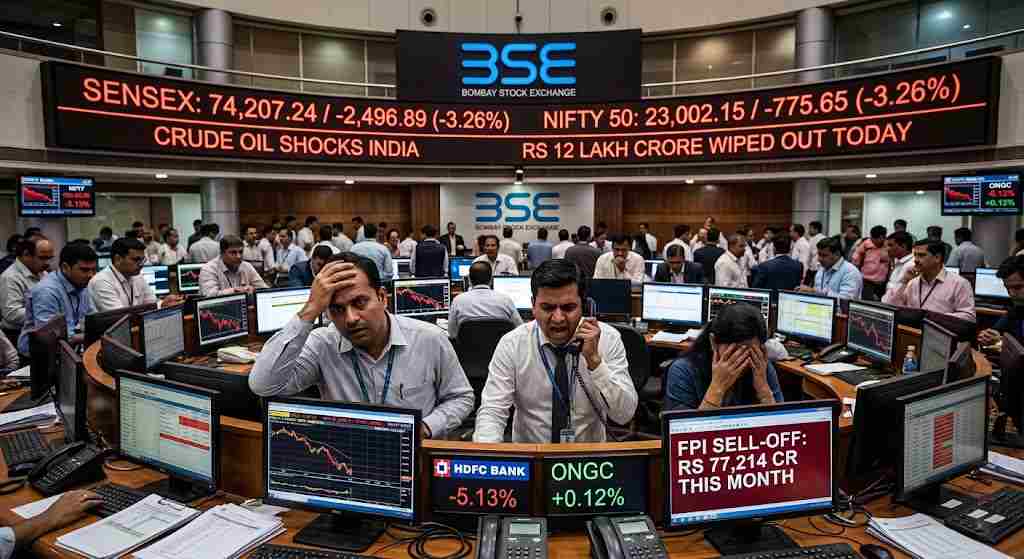
MUMBAI, March 19, 2026 —Indian Stock Market Crash In a day marked by sheer panic and a relentless wave of selling, the Indian equity markets witnessed one of their most brutal sessions in recent memory. A staggering Rs 12 lakh crore of investor wealth was incinerated in a single trading day as the “Oil Demon” returned to haunt Dalal Street. The benchmark indices, the BSE Sensex and the NSE Nifty 50, both plummeted by 3.26%, breaking a three-day winning streak and sending shockwaves through the financial ecosystem.
The carnage was primarily triggered by an escalating geopolitical nightmare in the Middle East, where a direct conflict involving Iran has pushed global energy prices to levels not seen in years. As the dust settled on Thursday’s trade, the Sensex had surrendered nearly 2,500 points, while the Nifty barely managed to cling to the crucial 23,000 psychological support level.
Indian Stock Market Crash The Bloodbath: Figures That Tell the Tale
The scale of the destruction was evident from the opening bell, but the intensity of the sell-off accelerated as reports of fresh attacks on Gulf energy facilities trickled in.
- BSE Sensex: Crashed 2,496.89 points to settle at 74,207.24.
- NSE Nifty 50: Tanked 775.65 points to finish at 23,002.15, having hit an intraday low of 22,930.
- Market Capitalization: The total valuation of BSE-listed companies dropped from Rs 439 lakh crore yesterday to Rs 427 lakh crore today.
The “bloodbath” was truly democratic, sparing almost no sector. In the Sensex pack, all 30 constituent stocks ended the day deep in the red. The losers’ list was topped by Eternal (down 5.65%), followed closely by Bajaj Finance (5.42%), Mahindra & Mahindra (5.25%), and the banking behemoth HDFC Bank (5.13%).
Within the broader Nifty 50, the story was equally grim. Only one stock, ONGC, managed to keep its head above water, gaining marginally as a direct beneficiary of rising crude prices. Conversely, Shriram Finance led the laggards with a 6.71% drop, reflecting the broader anxiety surrounding credit costs and inflation.
The Oil Factor: A Geopolitical Tsunami
The primary catalyst for this catastrophic decline is the deteriorating situation in the Middle East. Global oil benchmark Brent crude exploded past the $100 per barrel mark, eventually touching $111.4 today. The spike follows reports that Iran struck critical energy infrastructure in the Gulf, including a key gas facility in Qatar and refineries in Kuwait, in retaliation for earlier strikes on its own South Pars field.

The Strait of Hormuz Crisis
Further compounding the fear is the status of the Strait of Hormuz. This narrow maritime chokepoint handles roughly 20% of the world’s oil flow. With Iran threatening to strike any tankers attempting to cross and reports suggesting traffic has ground to a virtual halt, the specter of a global supply shock has become a reality.
“The markets are staring at a structural shift in energy costs,” said Ponmudi R, CEO of Enrich Money. “The increasing tensions and attacks on energy infrastructure have escalated supply concerns to a boiling point. If Brent stays above $110 for an extended period, the impact on India’s macroeconomic stability will be profound.”
Banking and Financials Lead the Retreat
The banking sector, often considered the backbone of the Indian economy, was the biggest drag on the indices today. High oil prices are traditionally viewed as a precursor to “sticky” inflation, which in turn limits the Reserve Bank of India’s (RBI) ability to cut interest rates.
HDFC Bank was at the center of the storm, falling over 5% to close at Rs 799.60. The sell-off in HDFC was exacerbated by internal news of the resignation of its part-time chairman, Atanu Chakraborty, who reportedly cited governance concerns. Other major lenders followed suit:
- Axis Bank: Down 3.69%
- ICICI Bank: Down 3.04%
- State Bank of India (SBI): Down 1.92%
- Kotak Mahindra Bank: Down 1.98%
The FPI Exodus and Global Cues
While oil was the headline-maker, the underlying pressure from Foreign Portfolio Investors (FPIs) continued to bleed the market. Data indicates that FPIs have pulled out a staggering Rs 77,214 crore in just 12 trading sessions this March. This aggressive “risk-off” sentiment is driven by two factors:
- US Fed Stance: The US Federal Reserve recently decided to keep interest rates unchanged while signaling a hawkish outlook. This has kept US bond yields attractive, prompting capital to flow out of emerging markets like India.
- Currency Weakness: The Indian Rupee hit a record low near the 92.50 mark against the US Dollar, further denting the dollar-denominated returns of foreign investors.
Across Asia, the sentiment was equally dour. Markets in Japan, Hong Kong, and South Korea all registered significant losses, trailing a weak overnight performance on Wall Street where the S&P 500 posted its lowest close in months.
What Lies Ahead?
As the Indian markets enter a period of extreme volatility, the India VIX (Volatility Index) has surged by over 20%, indicating that the turbulence is far from over. Analysts warn that unless there is a visible de-escalation in the Middle East conflict, the Nifty could test levels well below 23,000.
For the retail investor, the day serves as a stark reminder of how quickly geopolitical shocks can dismantle months of steady gains. With Rs 12 lakh crore gone in a matter of hours, the road to recovery now depends entirely on the price of a barrel of oil and the diplomatic efforts to reopen the world’s most vital energy arteries.
Disclaimer: The views and data expressed in this article are for informational purposes only. This does not constitute an investment recommendation. The stock market is subject to constant fluctuations and risks; therefore, the writer or platform shall not be held responsible for any financial losses incurred. Please consult with your financial planner or a certified expert before making any investment decisions.