
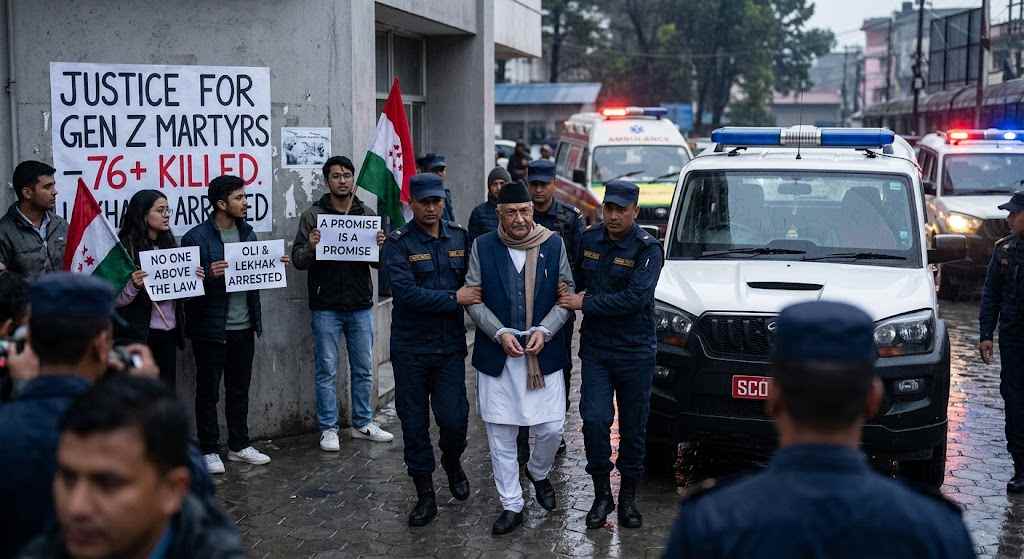
KATHMANDU —Nepal’s Political Earthquake: In a dramatic escalation of Nepal’s pursuit of accountability, former Prime Minister KP Sharma Oli was arrested early Saturday morning at his residence in Gundu, Bhaktapur. The arrest comes just 24 hours after the historic swearing-in of Balendra “Balen” Shah as the nation’s new Prime Minister, signaling a relentless start for the young administration.
Oli, the 74-year-old chairman of the CPN-UML, is accused of culpable homicide and negligence during the suppression of last year’s “Gen Z” protests. Alongside him, former Home Minister Ramesh Lekhak was also taken into custody. The duo is being held in connection with a crackdown that left dozens dead and eventually toppled the previous government.
The Morning of the Arrest
Nepal’s Political Earthquake: Ex-PM KP Sharma Oli Arrested as Balen Shah Era Begins: The police operation began at dawn. Following a series of formal complaints filed by the newly-minted Home Ministry, arrest warrants were executed at the residences of both leaders.
“They were arrested this morning, and the process will move forward according to the law,” stated Kathmandu Valley police spokesman Om Adhikari.
Shortly after the news broke, the newly appointed Minister of Home Affairs, Sudan Gurung—himself a prominent figure during last year’s youth uprising—took to social media to affirm the government’s stance. “A promise is a promise,” Gurung wrote on X. “No one is above the law. This is not revenge; it is the beginning of justice.”
A Legacy of Blood: The Gen Z Revolution
Nepal’s Political Earthquake: Ex-PM KP Sharma Oli Arrested as Balen Shah Era Begins: The charges stem from the violent events of September 8 and 9, 2025. What began as a protest against a brief social media ban quickly evolved into a nationwide anti-corruption movement fueled by economic hardship and frustration with the political elite.
- Death Toll: At least 77 people were killed during the unrest, with 19 young protesters shot dead by security forces on the very first day.
- The Crackdown: While a high-level probe commission concluded it could not establish a direct “order to shoot,” it found that Oli and Lekhak made “no effort to stop or control the firing.”
- The Fall: The violence reached a breaking point when government offices and parts of the parliament were set ablaze, forcing Oli’s resignation and the dissolution of the legislature.
The commission’s report, which was leaked just days before Balen Shah took his oath, recommended a maximum of 10 years imprisonment for those in high positions who displayed “negligent conduct” that led to the loss of minor lives.
The Rise of Balen Shah and the Interim Bridge
The arrest marks the culmination of a political shift that began with the appointment of Sushila Karki, Nepal’s first female Chief Justice, as the head of an interim government. Karki, who was famously selected via an informal poll on the gaming platform Discord by Gen Z activists, served as a stabilizing force for six months.
Her primary mandate was to oversee the March 5, 2026, general elections. Those elections resulted in a landslide victory for the Rastriya Swatantra Party (RSP), led by the 35-year-old rapper-turned-engineer Balen Shah. Shah’s campaign was built almost entirely on the promise of justice for the “martyrs” of the September revolution.
In his first Cabinet meeting on Friday evening, Shah moved to immediately implement the findings of the Gauri Bahadur Karki-led probe commission. By the next morning, his predecessor was in handcuffs.
Oli’s Defense and Party Reaction
From custody, KP Sharma Oli remained defiant, describing the move as “vindictive” and “politically motivated.” He has been admitted to a hospital in Kathmandu for medical observation, citing his history of two kidney transplants.
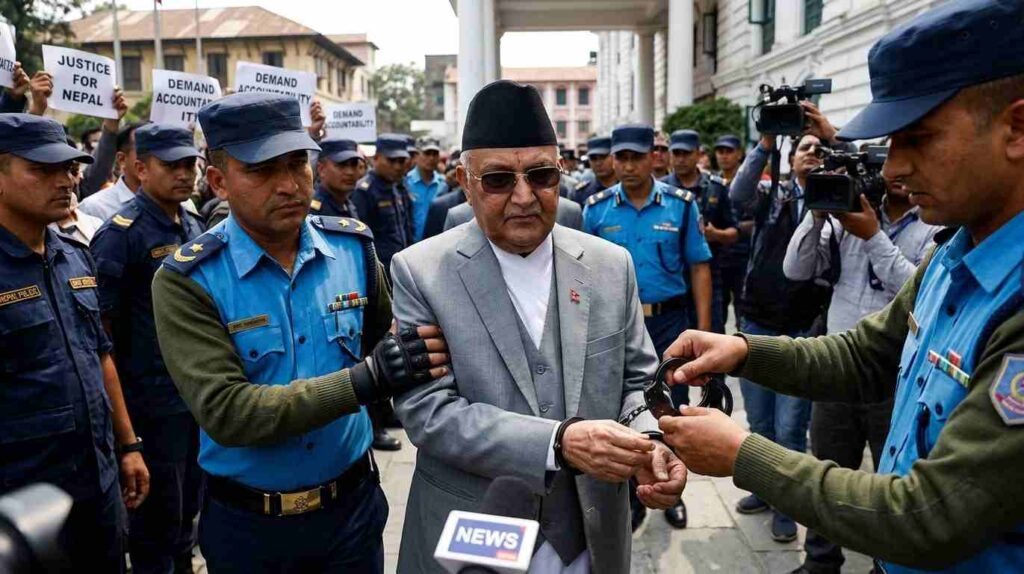
“I will fight this legal battle,” Oli told reporters briefly. His party, the CPN-UML, has called the arrest an act of “political vendetta” and convened an emergency meeting at their headquarters. Senior leader Pradeep Gyawali described the move as unjustifiable, warning that the party would not remain silent.
“The report is extremely negligent, amounts to character assassination, and reflects hate politics.” — KP Sharma Oli
A New Direction for Nepal?
The arrest of a four-time Prime Minister is unprecedented in Nepal’s fragile democracy. It places the young Prime Minister Balen Shah in a high-stakes position: delivering on the radical transparency promised to his Gen Z base while navigating the potential for further civil unrest from established political factions.
As the legal proceedings begin, the nation remains on edge. The Home Ministry has also recommended actions against former police chief Chandra Kuber Khapung and dozens of other officials, suggesting that this morning’s arrests are only the beginning of a much wider purge of the old guard.
For now, the streets of Kathmandu—once filled with the smoke of the September fires—are quiet, but the political atmosphere is more electric than ever.