
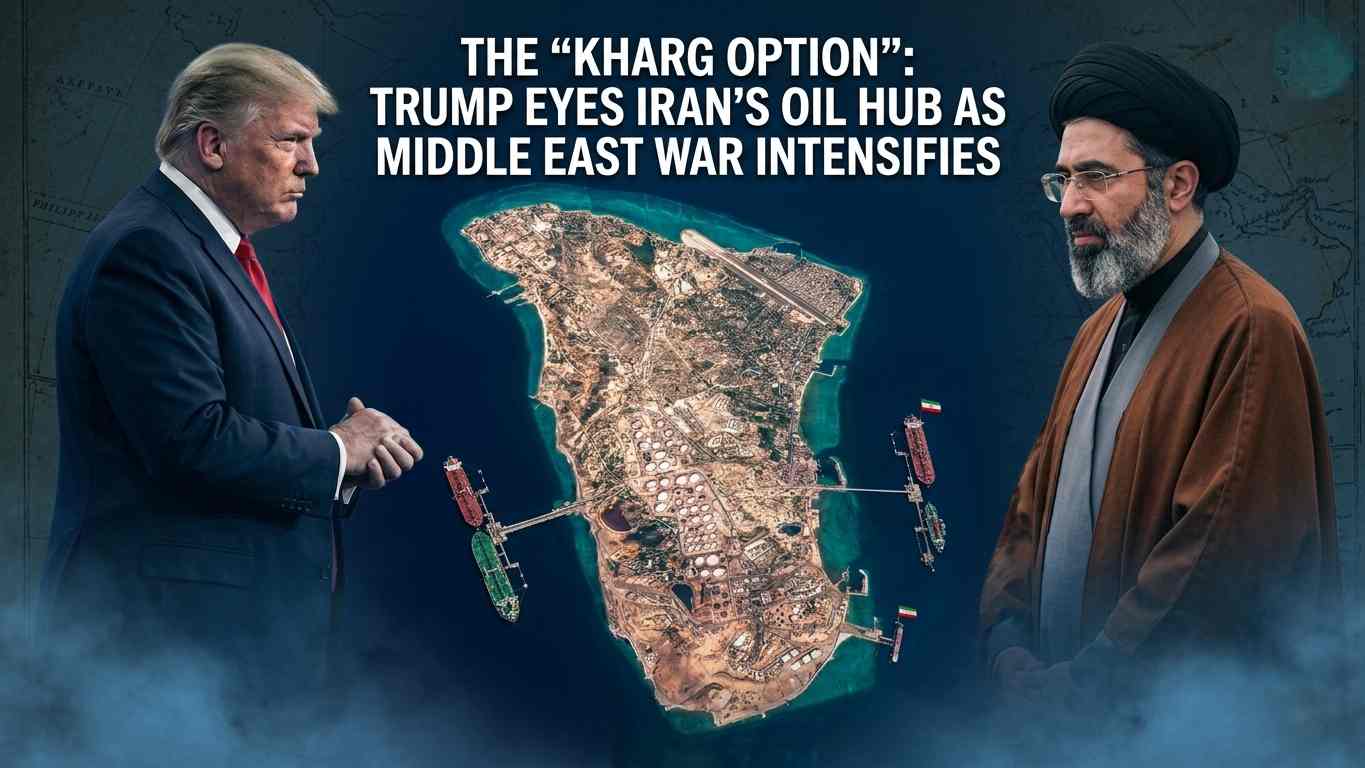
Trump Eyes Iran’s Oil Hub as Middle East War Intensifies: In a move that has sent shockwaves through global energy markets and shifted the landscape of the ongoing Middle East conflict, U.S. President Donald Trump has openly suggested that the United States could seize Kharg Island, Iran’s primary oil export terminal.
Speaking in a candid interview with the Financial Times on Sunday, the President did not mince words about his strategic preferences. “To be honest with you, my favourite thing is to take the oil in Iran,” Trump stated, dismissing critics within the U.S. as “stupid people” for questioning the morality or legality of such an operation.
As the U.S.-Israeli war against Iran enters its second month, the rhetoric from the White House signals a potential shift from a campaign of aerial bombardment to one of territorial occupation and resource control.
The Strategic Importance of Kharg Island
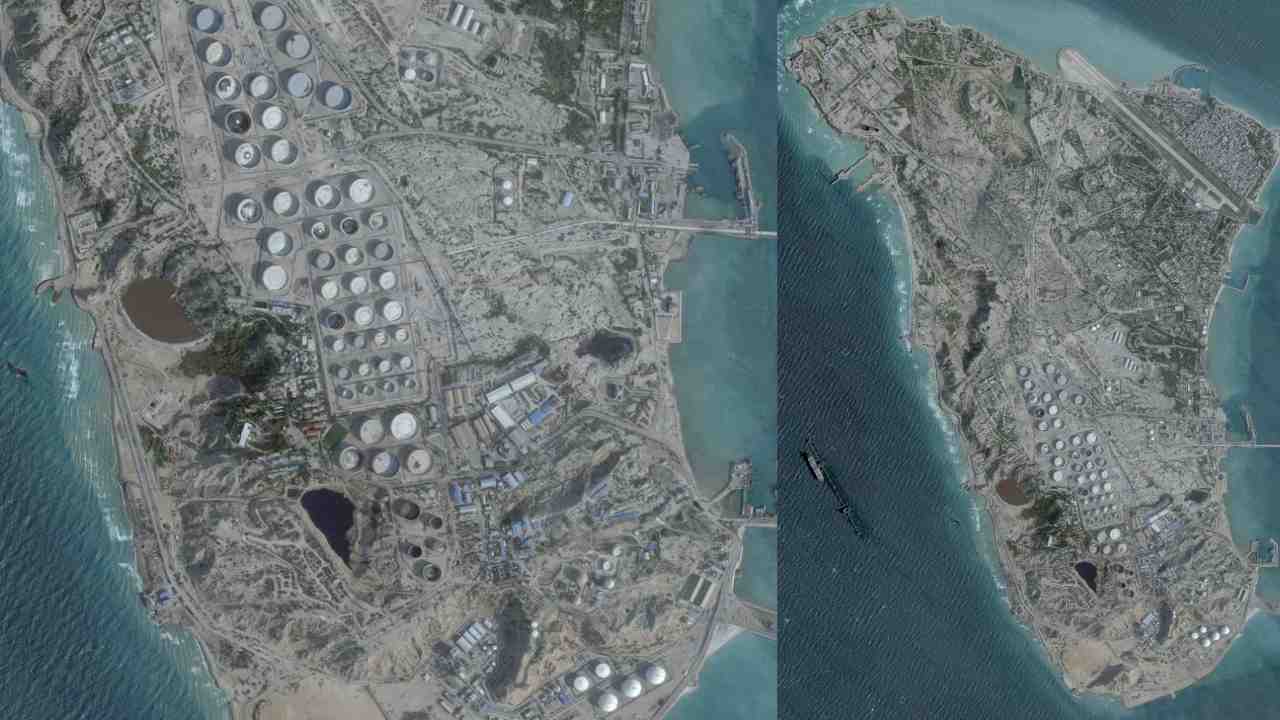
The “Kharg Option”: Trump Eyes Iran’s Oil Hub as Middle East War Intensifies, Kharg Island is the lifeblood of the Iranian economy. Located in the Persian Gulf, it handles over 90% of Iran’s crude oil exports. For decades, it has been considered a “red line” for Tehran. However, according to President Trump, that line is increasingly blurred.
Export Hub: Almost all of Iran’s seaborne oil passes through this facility.
Military Vulnerability: Despite its importance, Trump claimed the island is poorly defended. “I don’t think they have any defence. We could take it very easily,” he told the FT.
Economic Leverage: Seizing the island would effectively strip the Iranian leadership of its primary source of hard currency, potentially forcing an immediate collapse of the remaining state structures.
Massive Troop Build-up: The Pentagon’s Options
The President’s comments come on the heels of a massive surge in American military presence in the region. The Pentagon has reportedly ordered the deployment of 10,000 troops specifically trained for “land seizure and holding operations.”
Deployment Breakdown:
| Unit / Personnel | Status | Role |
| 2,200 Marines | Arrived Friday | Initial amphibious landing/Security |
| 2,200 Marines | En Route | Reinforcement |
| 82nd Airborne Division | Ordered to Deploy | Rapid response/Seizure |
| Total Surge Force | ~10,000 Personnel | Territorial Control |
Trump acknowledged that any such operation would not be a “hit-and-run” mission. “It would also mean we had to be there [in Kharg Island] for a while,” he noted, suggesting a long-term U.S. military footprint on Iranian soil.
Global Energy Crisis: Brent Crude Hits $116
The market reaction was instantaneous. In Asian trading on Monday, Brent crude oil surged above $116 a barrel, marking a 50% increase over the past month. The prospect of the world’s most vital oil artery—the Strait of Hormuz—becoming a permanent combat zone has left traders on edge.
Analysts warn that if the U.S. follows through with the seizure of Kharg Island, oil prices could easily breach the $150 mark, triggering a global recession. “We are looking at a scenario where energy is used as a weapon of war more directly than ever before,” said one market strategist.
Regime Change and the Mystery of Mojtaba Khamenei
Perhaps the most startling claim made by the President was that Iran has already undergone “regime change” in all but name. This follows the massive opening strikes of the war on February 28, which killed Supreme Leader Ayatollah Ali Khamenei and several top-tier officials.
Trump characterized the new Iranian leadership as a “totally different group of people” who are “very professional.” However, a cloud of uncertainty hangs over the new Supreme Leader, Mojtaba Khamenei.
“The son is either dead or in extremely bad shape,” Trump remarked. “We’ve not heard from him at all. He’s gone.” While Iranian state media has released written messages attributed to Mojtaba, there has been no video evidence or public appearance to confirm he survived the initial U.S.-Israeli strikes.
The “Pakistan-Flagged” Olive Branch
Despite the aggressive posturing, Trump hinted that a deal could be reached “fairly quickly.” He revealed that indirect negotiations through Pakistani intermediaries are advancing.
As a gesture of goodwill, Trump claimed that Iranian Parliamentary Speaker Mohammad Bagher Ghalibaf personally authorized the safe passage of oil tankers through the Strait of Hormuz.
“They gave us 10 [ships],” Trump said. “Now they’re giving 20… they’re going right up the middle of the Strait.”
The President has set a deadline of April 6 for Tehran to accept a comprehensive deal. If they refuse, he warned that the remaining 3,000 targets on the Pentagon’s list—largely energy and industrial infrastructure—will be engaged.
Conclusion: A High-Stakes Gamble
The “Kharg Option” represents one of the most significant escalations in modern military history. While Trump views it as a “favourite” move to secure oil and end the war on U.S. terms, military analysts are more cautious. An assault on the island would be “highly risky,” potentially resulting in significant U.S. casualties and a prolonged conflict that could draw in other regional powers.
As the April 6 deadline approaches, the world watches Kharg Island, waiting to see if it becomes the site of a historic seizure or the spark for a much larger global conflagration.