
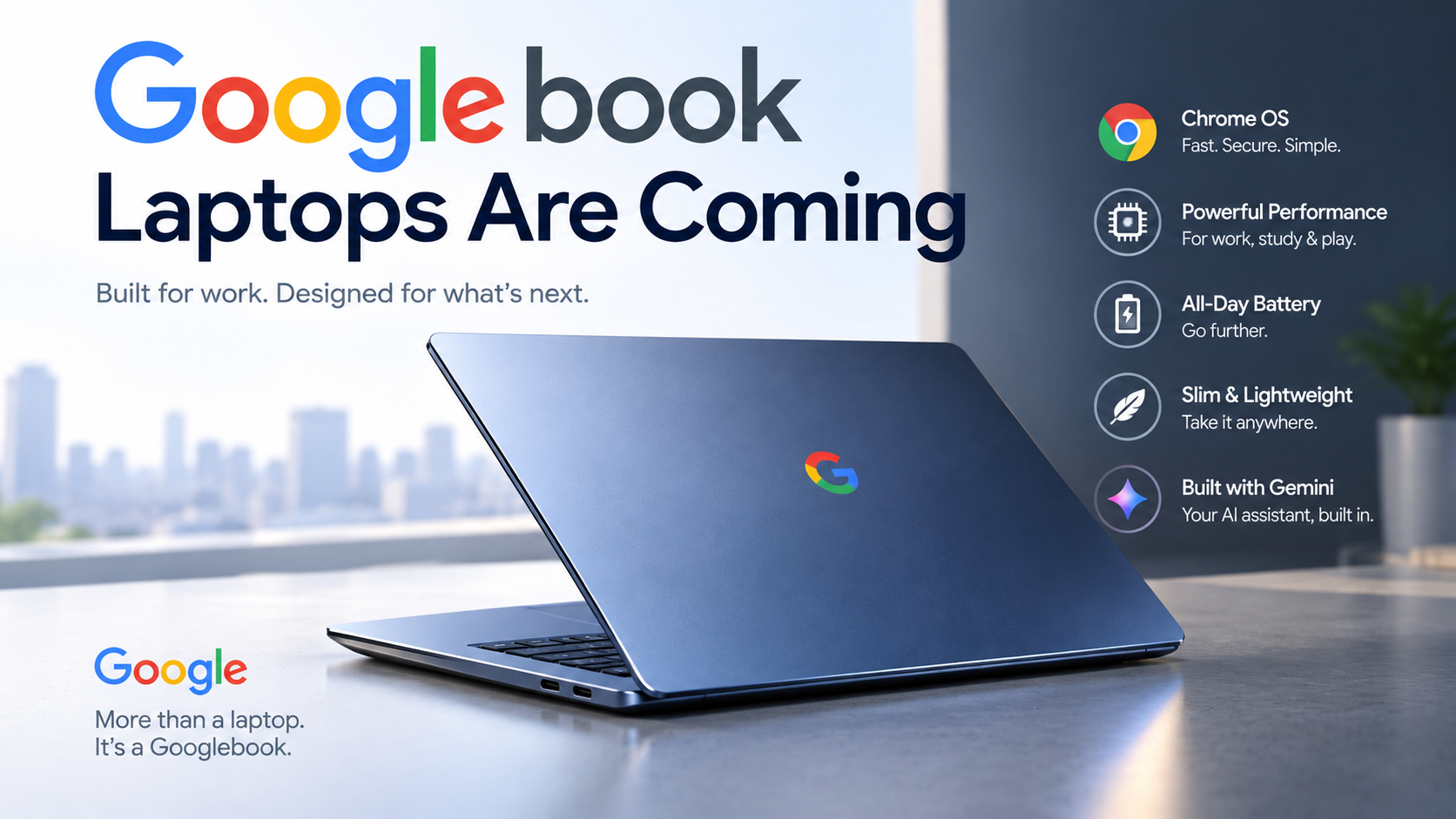
Googlebook is now in the spotlight as Google plans to change its laptop ecosystem. For years buyers who wanted a web‑first experience turned to Chromebooks. Those machines made a mark in schools and in budget‑friendly spaces but they often could not satisfy power users who needed strong performance and deep software integration. That old pattern is changing now.
Google confirmed that pre‑orders for its wave of Googlebook devices will open on September 21 at 9:00 AM ET. Of keeping tech enthusiasts in the dark Google is holding a dedicated press event, in New York City to show what makes this new category work.
Unlike the Pixel line of smartphones Google will not make all the hardware itself. Instead Google is teaming up with trusted hardware giants—Asus, Acer, Dell, HP and Lenovo—to launch the line of devices. When you press the pre‑order button on the Google Store you will buy third‑party hardware that meets Google’s new ecosystem standards.
What Is a Googlebook? (And How It Differs from Chromebooks)
At its core Googlebook is a high‑end laptop that is built to sit between desktop computers and convenient mobile devices. If you have felt limited by Chromebooks Googlebook is designed to solve those exact problems.
1. Aluminum OS Replaces ChromeOS
Chromebooks use ChromeOS, which used to run Android applications inside a layer or container. That arrangement produced performance, scaling problems and missing features.
Googlebook runs on a platform that was once called Aluminum OS. It is built on an Android foundation of the old ChromeOS. This platform lets laptops run apps directly while keeping the complete unchanged desktop version of the Google Chrome browser.
2. Built‑In AI Intelligence
Hardware is part of the picture. Google is adding Gemini Intelligence into the heart of the operating system. Important features are:
Key features include:
– Magic Pointer: A feature that changes the mouse cursor into a smart helper that can read text and pictures on the screen.
– Create My Widget: A system that lets people create custom desktop widgets instantly by giving simple prompts.
– Deep Phone Integration: Quick, sync with Android phones, for copy‑and‑paste of notifications file moves and smooth work flow.
Leaked Specs and Partner Models Revealed
Hardware leaks from top-tier computer makers paint a picture: Googlebooks are premium, flagship machines aimed directly at high-end laptops like Apple’s MacBook Air and top-spec Windows ultrabooks.
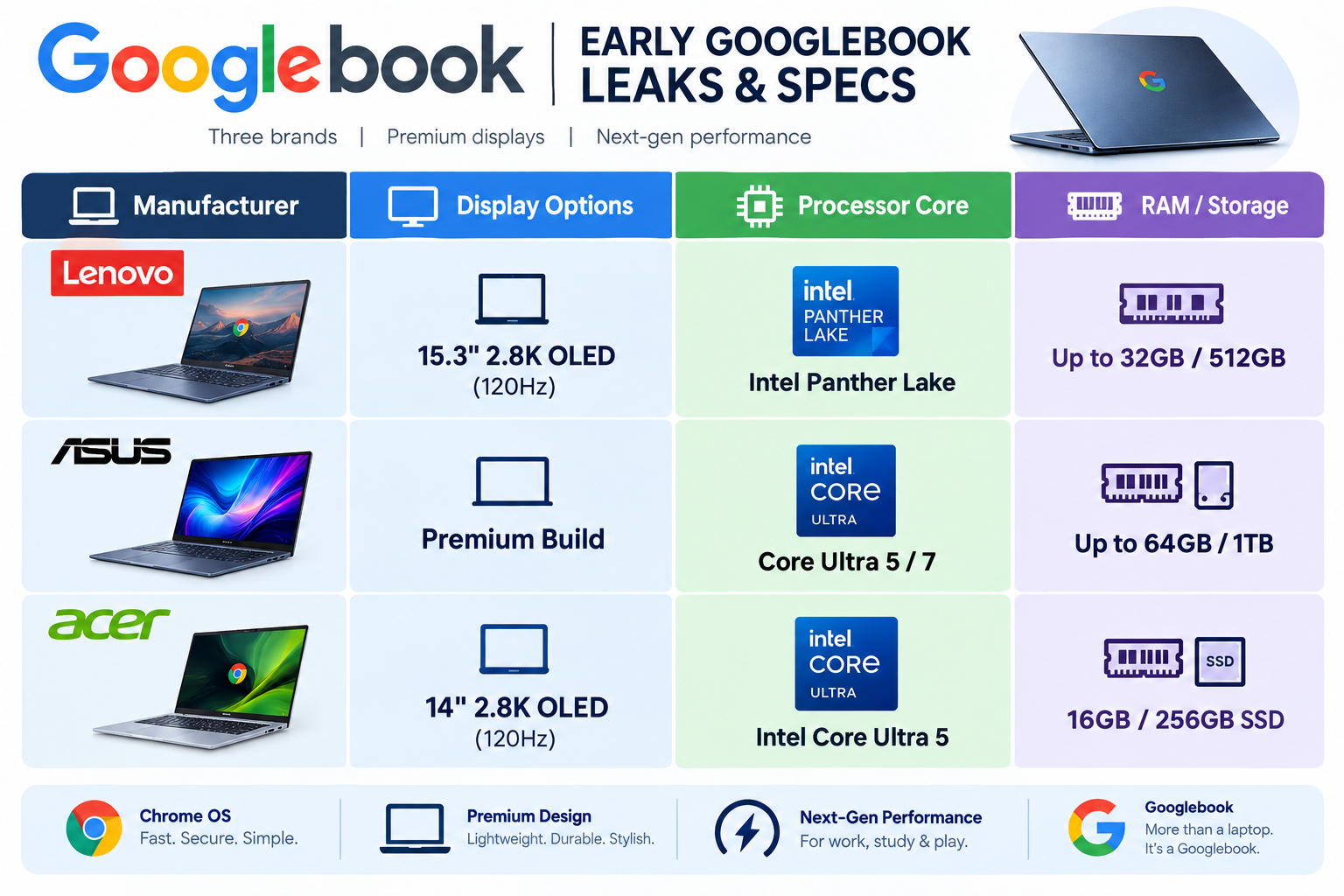
Lenovo Googlebook 15
Early inventory details reveal a 15.3-inch display with a 2880 x 1800 OLED touchscreen capable of running up to a smooth 120Hz refresh rate. Inside it runs on Intel’s Core Ultra 5 325 “Panther Lake” chip, backed by up to 32 GB of high-speed LPDDR5X RAM and up to 512 GB of internal storage.
Additional hardware features include:
- A 70 Wh battery designed for multi-day productivity.
- Thunderbolt 4 connectivity for -fast data transfer and multi-monitor setups.
- A haptic glass trackpad for feedback.
- Dedicated facial-authentication hardware for security.
- Google’s signature multi-colored exterior “glowbar” light strip.
Asus Googlebook Series
Listings from retailers reveal configuration options scaling up to Intel Core Ultra 7 processors. Early retail models feature 16 GB to 64 GB of memory paired with 512 GB SSDs starting around $1,365 USD (CA$1,900). Asus is clearly positioning its hardware toward creators and heavy multitaskers who require high memory bandwidth.
Acer Googlebook 14
Acer’s entry has surfaced through retail databases with a 14-inch 2.8K OLED display running at 120Hz. Powered by the Intel Core Ultra 5 325 chipset this variant packs 16 GB of RAM and a 256 GB solid-state drive. Listed pricing sits around €1,022 ( $1,178 USD) making it one of the most accessible entry points, into the flagship ecosystem.
Next-Gen Processors: Intel Panther Lake vs. Snapdragon X Elite
In sharp contrast to traditional Chromebooks—which typically use entry-level silicon to keep costs down—Googlebooks deploy heavyweight processors right out of the gate.
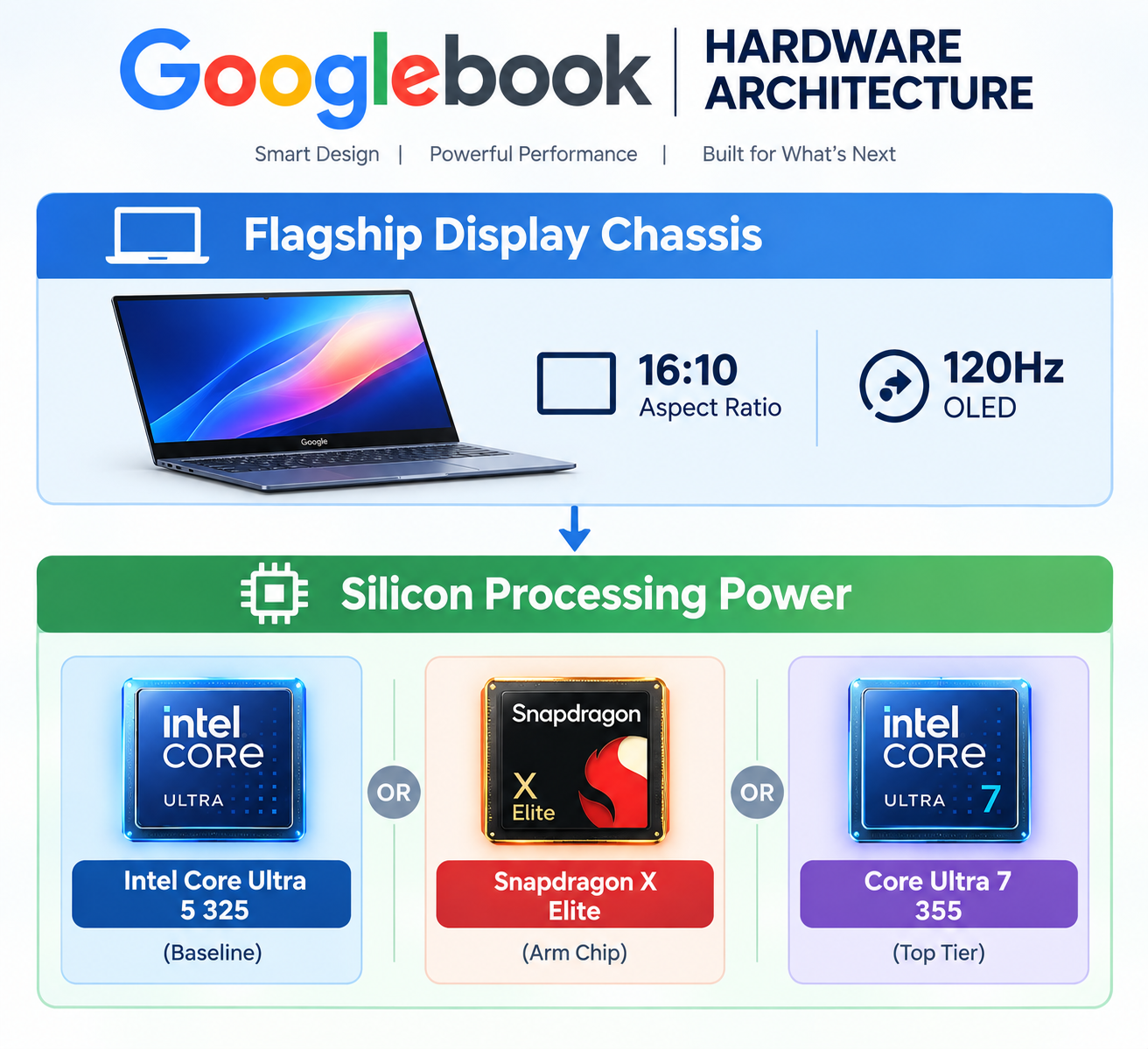
Intel Core Ultra 5 325 Panther Lake: Acts as the unified baseline standard across manufacturers, delivering strong single-thread speed and improved power efficiency.
Snapdragon X Elite: Offers Arm-based efficiency with extended battery life and dedicated neural processing power for local AI execution.
Intel Core Ultra 7 355: Designed for heavy computing tasks, handling raw rendering power and complex multitasking workloads effortlessly.
Hardware Features: The Glowbar Returns
Google’s teaser footage highlights a multi-colored exterior light strip across the chassis lid. Dubbed the “glowbar,” this signature element builds on concepts previously seen in earlier Pixel products.
| GLOWBAR UTILITY LIST |
| Color Bar Status –> Visual Battery Level While Closed Pulsing Blue –> Active Gemini Voice Interaction Color Indicator –> Silent Notifications & App Alerts |
Rather than serving purely as decorative lighting, the glowbar handles quick-glance status updates:
Real-time battery charging progress when the laptop lid is closed.
Notification alerts without opening the screen.
Visual feedback during active interactions with Gemini AI.
Expected Pricing and Availability
While Google has not officially posted final pricing across every vendor configuration, leak data provides clear estimates:
Entry-Level Models (14-inch OLED / 16GB RAM): Estimated around $1,150 – $1,200 USD.
Mid-Tier Models (15-inch OLED / 32GB RAM): Estimated around $1,350 – $1,500 USD.
Top-Spec Configurations (Core Ultra 7 / 64GB RAM): Expected to push past $1,800 USD.
Pre-orders officially start on September 21 at 9 AM ET. Early retailer entries suggest physical devices will begin shipping to buyers in early November.
Frequently Asked Questions
Can Googlebook run regular desktop programs?
Googlebook uses Aluminum OS, which runs the full desktop version of Google Chrome alongside native Android applications. It does not run legacy Windows (.exe) files directly, though cloud services and browser-based enterprise tools work natively.
When will Googlebooks start shipping to customers?
While pre-orders launch on September 21, leaked retailer databases suggest retail shipments will begin in early November.
Do Googlebooks have touchscreens?
Yes. Leaked configurations from Acer, Asus, and Lenovo show high-resolution 120Hz OLED touchscreens across multiple display sizes.