
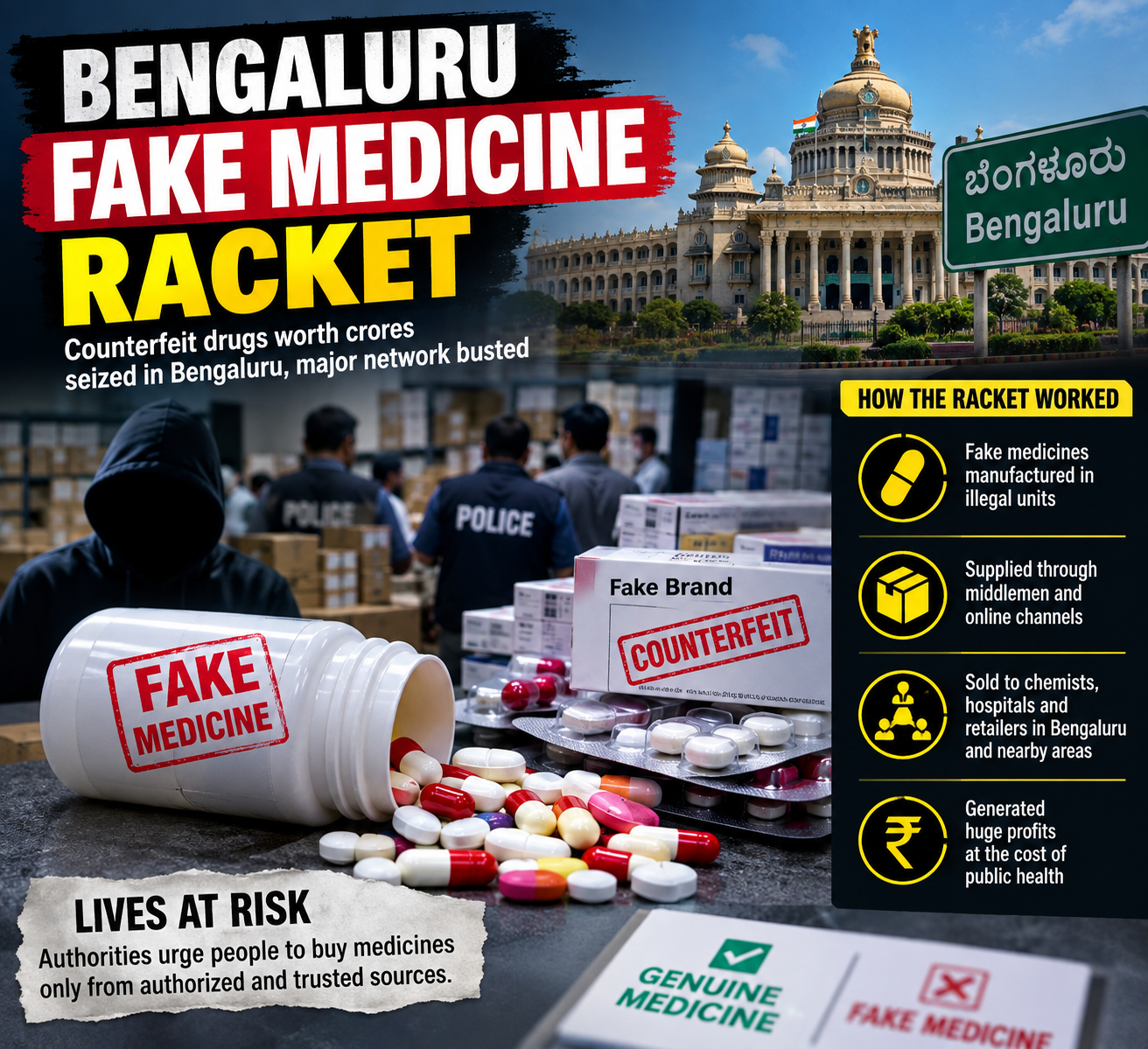
The Bengaluru fake medicine racket has sent massive shockwaves across India’s healthcare sector after law enforcement authorities exposed a deep-rooted counterfeit drug syndicate operating right out of Karnataka. State Health and Family Welfare Minister UT Khader confirmed that multi-agency teams have confiscated fake, relabeled, and expired critical care drugs worth approximately ₹5 crore.
What makes this discovery deeply alarming is that these spurious pharmaceuticals—ranging from life-saving ICU injections to high-value chemotherapy drugs—were reportedly channeled into more than 90 hospitals, nursing homes, and clinical establishments across Bengaluru.
As law enforcement agencies, drug inspectors, and inter-state police units dig deeper into the network, here is a detailed breakdown of how the syndicate operated, the state government’s enforcement response, and what patients must know to stay safe.
How the Multi-Crore Bengaluru Fake Medicine Racket Operated
The operation relied on an organized, multi-state supply chain designed to exploit gaps in traditional drug distribution networks. According to preliminary investigation details released by the state health ministry and the police, the syndicate followed a step-by-step process to pass off low-quality or discarded products as genuine, high-value life-saving pharmaceuticals.
1. Procurement from Sourcing Hubs
The operators procured cheap bulk formulations, unbranded generic drugs, and near-expiry stock from pharmaceutical manufacturing zones in Telangana and Himachal Pradesh.
2. The Illegal Packaging Plant
The core illegal operation was set up in a remote farmhouse facility situated near the Bidadi Toll Gate in Bengaluru South. Inside this facility, workers used specialized refilling equipment to transfer cheap liquids into clean, empty vials. Expired medicines were also cleaned up and placed into brand-new secondary packaging.
3. Counterfeit Labeling and Rebranding
Using counterfeit printed labels, packaging boxes, and fake invoices, the syndicate passed off cheap generics as expensive imported brands manufactured by top multinational companies, including Pfizer.
4. Supply Chain Penetration
To push these products into the market quickly, the network offered steep discounts—often up to 50% below the official market price—to hospital procurement teams, intermediaries, and retail outlets. More than 15 medical representatives are currently suspected of acting as sales channels to move these products into medical facilities.
Key Raid Milestones and Timeline
The investigation unfolded rapidly after an initial lead prompted state agencies to launch targeted enforcement raids.
[August 18]
Farmhouse Raid at Bidadi Toll Gate

Joint enforcement teams raid a hidden facility near Bidadi, seizing ₹4.91+ crore worth of fake/expired drugs, machinery, and fake labels.
[August 19]

Six-Member SIT Formed & Central Appeal

State Government forms an IPS-led SIT. Health Minister UT Khader writes to Union Health Minister J.P. Nadda seeking CDSCO involvement.
[Late August - Early September]

Krupa Healthcare Raid & First Key Arrest

SIT raids Krupa Healthcare near Minerva Circle, arresting owner Veeresh Kumar Jain for using the shop as a central storage facility.
[Mid-September]

Multi-State Enforcement Operations

SIT expands searches to over 10 locations across Karnataka, Tamil Nadu, Maharashtra, Telangana, Himachal Pradesh, and Haryana.
The Scale of Seizures: Critical ICU and Oncology Drugs
The physical evidence confiscated during the raids highlights the grave safety risks posed by the syndicate. The total market value of the seized inventory stands at nearly ₹5 crore.
| Category | Details of Seized Inventory | Primary Hazard |
| Oncology Formulations | Fake cancer chemotherapy injections and specialized anti-cancer drugs. | Sub-therapeutic dosage leading to treatment failure in critical patients. |
| ICU Critical Care | Emergency life-support injections, specialized fluids, and cardiac support formulations. | High risk of bacterial contamination, sepsis, or organ collapse due to lack of sterility. |
| Relabeled Generics | Low-cost generic antibiotics repackaged under global pharmaceutical labels. | Antibiotic failure and unintended drug interactions. |
| Expired Stocks | Outdated medications cleared of old batch numbers and stamped with fresh dates. | Chemical degradation rendering the drug completely inactive or toxic. |
Government Action: SIT Formation and Central Agencies
Addressing the media and issuing statements on social platform X, Health Minister UT Khader emphasized that the government acted immediately once the raid was executed.
“We did not wait a single day. The Karnataka Government proactively exposed and dismantled this spurious drug network. We will track down every link in their network, dismantle it brick by brick, and ensure every person responsible faces the harshest punishment under the law. There will be no mercy for anyone who profits from a patient’s desperation.”
— UT Khader, Karnataka Health & Family Welfare Minister
The Special Investigation Team (SIT)
Headway in the case is being driven by a specialized six-member team under Joint Commissioner of Police (West) C Vamshikrishna. The SIT combines enforcement authority from multiple state bodies:
Karnataka State Police (Lead criminal investigation & inter-state tracking)
Food Safety & Drug Administration (Chemical testing, batch sampling, regulatory enforcement)
Commercial Taxes Department (Financial auditing, tracking paper trails, fake invoice verification)
Request for CDSCO and Interstate Coordination
Recognizing that the syndicate’s distribution footprint spreads beyond Karnataka, UT Khader contacted Union Health Minister J.P. Nadda. The state has formally requested the Central Drugs Standard Control Organisation (CDSCO) to help map out supply lines in manufacturing hubs across Himachal Pradesh, Telangana, Haryana, Maharashtra, and Tamil Nadu.
Key Suspects Under the Scanner
Veeresh Kumar Jain (Arrested): Owner of Krupa Healthcare, located near Minerva Circle in Bengaluru. Investigators allege his pharmacy served as the primary storage depot and local distribution clearinghouse for nearly five years.
Prashant (Absconding): Identified by police as the main mastermind behind the illicit manufacturing plant at Bidadi. Manhunts are underway across multiple states to locate him.
Medical Representatives (Under Probe): Over 15 pharma marketing representatives are being questioned regarding how they brokered deals between the illegal warehouse and private hospital procurement managers.
Are Hospitals Blameworthy or Duped?
A major point of concern for the public is the involvement of over 90 hospitals and nursing homes. Investigative agencies have clarified that having a hospital name on distribution vouchers does not automatically prove deliberate criminal wrongdoing by the medical facility.
In many instances, hospital procurement departments were enticed by heavy commercial discounts offered by distributors claiming to supply legitimate batch clearance stock. However, police are scrutinizing purchase vouchers, GST returns, and vendor verification records to determine whether any hospital administrators knowingly bypassed safety regulations to boost profit margins.
Patient Safety Advisory: How to Spot Spurious Drugs
While regulatory agencies complete batch recalls, medical experts recommend that patients and caregivers follow strict safety checks when buying critical care or specialty medicines:
Inspect QR Codes and Barcodes: Authentic high-value medicines in India carry track-and-trace QR codes on their primary packaging. Scan them using a smartphone to verify batch authenticity.
Examine Packaging Integrity: Look closely at print quality, font alignment, alignment of expiry dates, and tamper-evident seals. Counterfeit labels often show slight print blurs or misaligned text.
Be Cautious of Unrealistic Discounts: High-end specialty drugs, cancer treatments, and imported ICU injections rarely sell at discounts exceeding 30–50% unless part of an authorized patient assistance program.
Demand Itemized GST Invoices: Never purchase prescription drugs without a formal invoice mentioning the batch number, manufacturing date, expiry date, and the seller’s valid Drug License (DL) number.
Buy Only from Authorized Pharmacies: Stick to hospital-attached pharmacies or recognized corporate chemist chains when procuring critical care medications.
The SIT investigation continues to gather momentum, with laboratory analysis reports expected shortly to confirm the exact chemical composition of all seized items. source: ANI News