
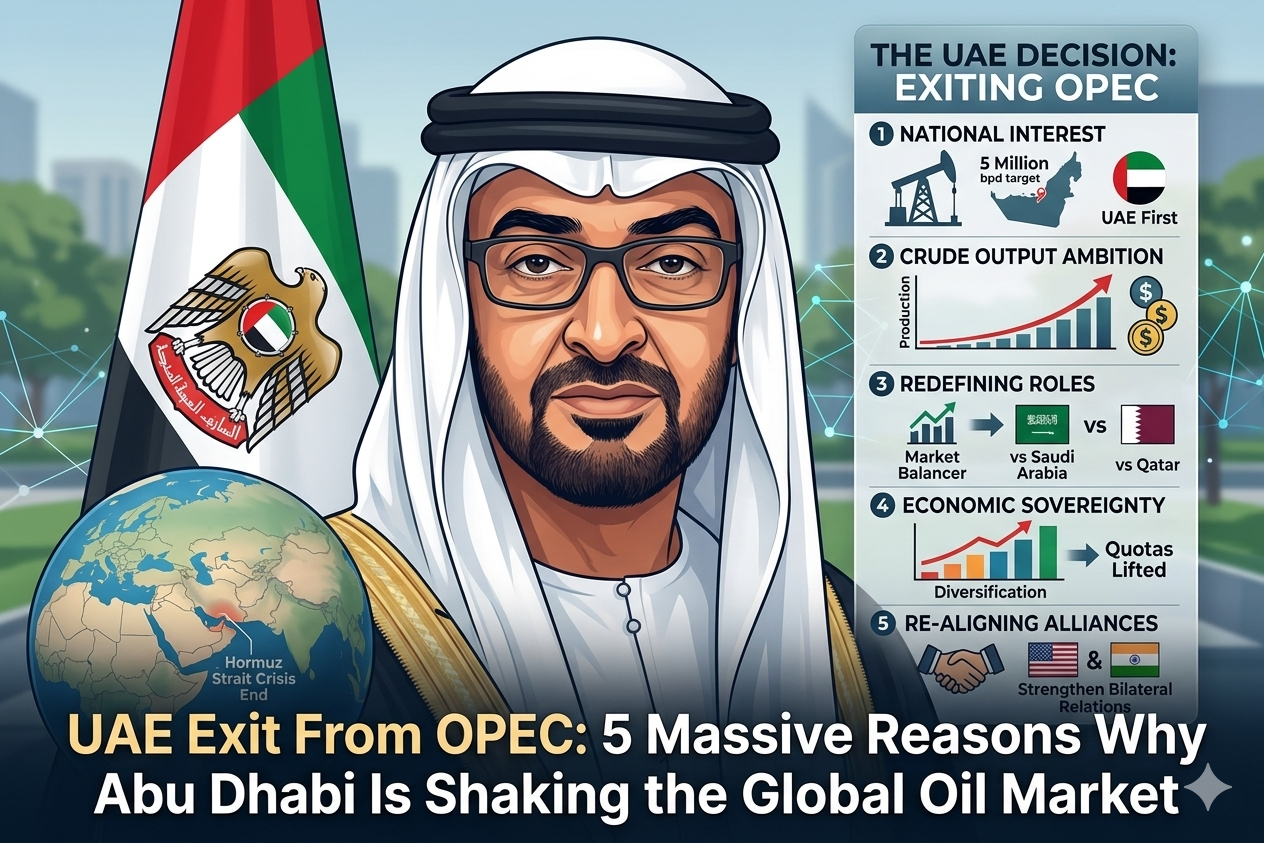
The UAE exit from OPEC has sent shockwaves through the global energy corridors, marking a historic departure for a nation that has been a cornerstone of the oil cartel for nearly six decades. In a stunning announcement that caught the world by surprise, the United Arab Emirates (UAE) confirmed its withdrawal from the Organisation of the Petroleum Exporting Countries and the wider OPEC+ alliance, effective May 1, 2026. This isn’t just a business move; it is a seismic geopolitical shift that could redefine the “black gold” economy and reshape alliances from Washington to Islamabad.
1. The Strategic Pivot: National Interests Over Cartel Quotas
The UAE exit from OPEC is primarily driven by a desire to decouple its economic destiny from the restrictive production quotas dictated by the group’s de facto leader, Saudi Arabia. For years, Abu Dhabi has been investing billions of dollars into its energy infrastructure.
The 5 Million Barrel Ambition
Under the leadership of the state-run firm Adnoc, the UAE has set a massive target: reaching a production capacity of 5 million barrels per day (bpd) by 2027.
The Conflict: While the UAE was building the capacity to pump more, OPEC+ was frequently forcing it to pump less to keep global prices high.
The Breaking Point: The Emirates grew tired of maintaining expensive “spare capacity” that they weren’t allowed to use. By leaving the group, the UAE can now monetize its natural resources at its own pace.
“The Emirates were not happy to have to constrain themselves, particularly when they wanted to pump more and the Saudis wanted to pump less,” says Firas Maksad, Director of Middle East at Eurasia Group.
2. The Geopolitical Friction: The Saudi-Pakistan Nexus
Beyond the oil wells, the UAE exit from OPEC is a manifestation of a deepening rift between Abu Dhabi and its neighbors. A significant, yet often overlooked, factor in this decision is the role of Pakistan and its tightening relationship with Saudi Arabia.
The Pakistan Problem
The UAE has reportedly been frustrated with Islamabad’s “meek” role during the recent conflict with Iran. While the UAE faced over 2,200 drone and missile attacks due to its proximity to the conflict zone, it perceived Pakistan’s attempt to play “mediator” as a lack of solidarity.
Financial Retaliation: Just weeks before the exit, Abu Dhabi recalled $3.5 billion in deposits from Pakistan, a move that crippled Islamabad’s foreign exchange reserves.
The Rivalry: The UAE sees a growing alliance between Saudi Arabia, Pakistan, and Turkey as a threat to its own regional influence. By breaking away from the Saudi-led oil bloc, the UAE is effectively dismantling the “economic solidarity” that once bound these nations.
3. The Trump Factor and US Relations
The timing of the UAE exit from OPEC aligns perfectly with the current political climate in the United States. Donald Trump, a long-term and vocal critic of OPEC, has often labeled the cartel as a “monopoly” that keeps prices artificially high.
By quitting, the UAE positions itself as a “market-friendly” producer, likely becoming Trump’s diplomatic favorite in the region. This “balancing producer” status could lead to significant investment benefits and a stronger defense partnership with the US, independent of the broader Gulf consensus.
4. Impact on Global Markets: What Happens to Oil Prices?
According to analysts at Barclays, the UAE exit from OPEC will accelerate oil supply growth once the current Hormuz crisis is resolved.
Short-term vs. Long-term
Short-term: Supply disruptions due to the war mean the market might not feel the impact immediately.
Medium to Long-term: More supply is coming. Analysts from ING suggest that as the UAE ramps up production to 5 million bpd, the global market will see increased flexibility, which could lead to a “backwardation” in the Brent forward curve.
5. A Huge Win for India’s Economy
One of the biggest beneficiaries of the UAE exit from OPEC is undoubtedly India. As the world’s third-largest oil consumer, India has long suffered from the price volatility caused by OPEC’s production cuts.
Benefits for India:
Lower Import Bill: Increased supply from a low-cost producer like the UAE will naturally put a ceiling on global oil prices.
Inflation Control: Cheaper crude means lower transportation costs, helping the Indian government manage domestic inflation.
Strengthened Ties: The UAE is already heavily invested in India’s infrastructure and energy sectors. This move allows for more direct, quota-free bilateral trade.
| Metric | Before Exit (Current) | Post-Exit (2027 Target) |
| UAE Production Capacity | 3.4 Million bpd | 5 Million bpd |
| OPEC Influence | High (Coordinated) | Diminishing (Fragmented) |
| Price Outlook | Volatile | Softening/Stabilizing |
The Road Ahead: Is This the End of OPEC?
The UAE exit from OPEC is a “big blow” to the group’s prestige. While market experts like Amrita Sen of Energy Aspects believe the remaining members will keep the group together, the loss of its third-largest producer makes the cartel look increasingly fragile.
For the UAE, the path is clear: prioritize national sovereignty, maximize production, and align with global powers that value market stability over price manipulation. As the dust settles on this historic decision, the world watches to see if other members will follow Abu Dhabi’s lead or if Riyadh can hold the remaining pieces of the cartel together.