
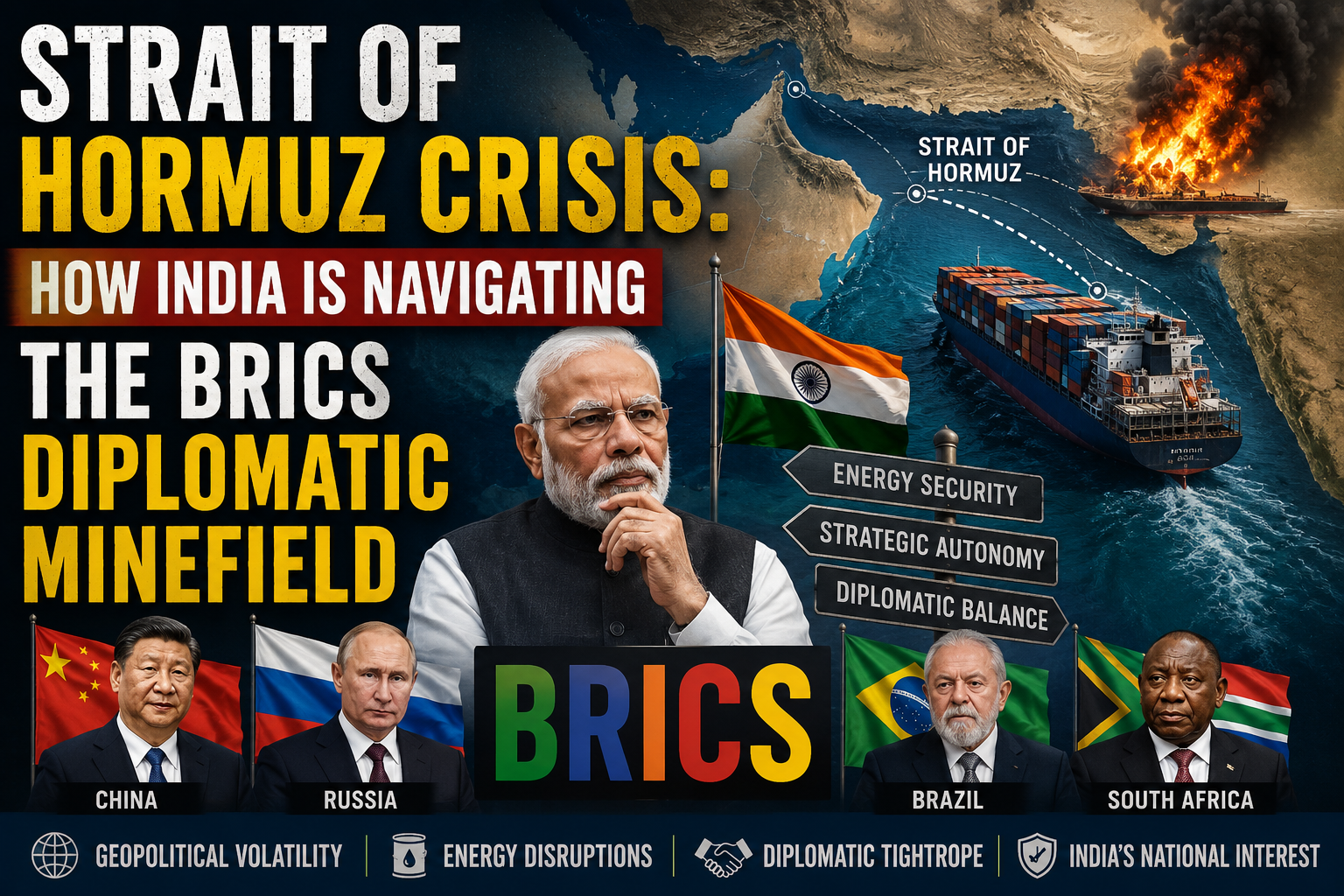
The Strait of Hormuz has once again become the focal point of global geopolitical anxiety. As tensions in the Middle East escalate to a fever pitch, India is finding itself in a high-stakes balancing act, attempting to safeguard its economic interests while managing the volatile internal dynamics of the newly expanded BRICS bloc.
In a recent high-level gathering in New Delhi, External Affairs Minister S. Jaishankar sent a clear and firm message to BRICS nations, including regional rivals Iran and the United Arab Emirates (UAE). His message was simple yet profound: maritime stability is not a luxury—it is a global necessity.
The Critical Importance of the Strait of Hormuz
To understand the gravity of the current situation, one must first understand the geography of global energy. The Strait of Hormuz is arguably the most important oil transit chokepoint in the world. Located between Oman and Iran, it connects the Persian Gulf with the Gulf of Oman and the Arabian Sea.
Energy Lifeline: Approximately one-fifth of the world’s total oil consumption passes through this narrow waterway daily.
India’s Stake: For India, any disruption in the Strait of Hormuz translates directly to higher fuel prices at the pump, inflationary pressure on the economy, and potential energy shortages.
The Red Sea Connection: Coupled with the Red Sea and the Suez Canal, these waterways form the primary artery for India’s trade with Europe and the Americas.
Minister Jaishankar’s insistence that “safe and unimpeded maritime flows… remain vital for global economic well-being” is not just diplomatic rhetoric; it is a survival directive for a nation striving to maintain a 7% plus growth rate amidst global chaos.
A Divided BRICS: The Iran-UAE Friction
The BRICS 2026 summitry has highlighted a significant challenge: the “Big Tent” is getting crowded, and the guests don’t always get along. The expansion of the bloc to include Iran, the UAE, Egypt, and Ethiopia was intended to give the Global South a stronger voice. However, it has also imported regional conflicts into the heart of the organization.
Heated Exchanges in New Delhi
Reports from the foreign ministers’ conclave suggest that the atmosphere was anything but cordial. The UAE Minister of State for Foreign Affairs, Khalifa Shaheen Al Marar, and Iranian Foreign Minister Seyed Abbas Araghchi reportedly engaged in “heated exchanges.”
The source of the friction? Allegations from Abu Dhabi regarding Iranian-backed attacks on energy infrastructure within the UAE. The disagreement was so intense that Russian Foreign Minister Sergey Lavrov reportedly had to intervene to prevent a total breakdown in communication.
The Consensus Crisis
Because BRICS operates on a consensus mechanism, these bilateral feuds have a paralyzing effect. The group failed to issue a unified statement on the West Asia crisis specifically because the UAE and Iran could not agree on the phrasing. Jaishankar’s subtle reminder that new members must “fully appreciate” the consensus mechanism was a polite way of telling the new entrants to leave their baggage at the door for the sake of the collective.
India’s ‘Duck Diplomacy’ Explained
Foreign affairs experts have described India’s current strategy as “duck diplomacy.” On the surface, India appears calm, neutral, and stable. Below the waterline, however, it is paddling furiously to keep the platform afloat.
1. The Balanced Approach India is one of the few global powers that maintains a “strategic partnership” with both Tehran and Abu Dhabi.
With Iran: India is a key partner in the Chabahar Port project and relies on Iran for regional connectivity to Central Asia.
With the UAE: The UAE is home to millions of Indian expatriates and remains one of India’s most reliable energy and investment partners.
2. Addressing the ‘Fog of War’ Recent incidents involving Indian-flagged vessels in the Strait of Hormuz have raised eyebrows. While some analysts feared these were deliberate strikes, experts like Robinder Sachdev suggest these are likely results of the “fog of war”—unintentional collateral damage in a region bristling with missiles and drones. India’s goal is to ensure this “confusion” doesn’t lead to a permanent blockade.
Prime Minister Modi’s Strategic Tour
As the foreign ministers wrapped up their talks, Prime Minister Narendra Modi embarked on a pivotal five-nation diplomatic tour, starting with the UAE.
Securing the Energy Future
The timing of the PM’s visit to meet President Sheikh Mohamed bin Zayed Al Nahyan is no coincidence. While the Strait of Hormuz remains a flashpoint, India is doubling down on its long-term energy agreements with the UAE. This visit aims to:
Solidify “uninterrupted” supply chains.
Invite further UAE investment into India’s Strategic Petroleum Reserves (SPR).
Strengthen the bilateral security architecture to protect shipping lanes.
The “Next Gen” Leadership
It is worth noting that Sheikh Mohamed’s visit to India in early 2026, accompanied by the next generation of UAE leaders, signaled that this relationship is being built for the long haul. India views the UAE not just as a petrol station, but as a gateway to the future of the Middle East.
The Global Power Shift: BRICS by the Numbers
Despite the internal bickering, the importance of the BRICS platform cannot be ignored. The grouping now represents:
49.5% of the global population.
40% of global GDP.
26% of global trade.
When India speaks at a BRICS forum about the Strait of Hormuz, it isn’t just speaking for New Delhi; it is speaking for nearly half the world’s population that cannot afford a total shutdown of global energy markets.
Iran’s Perspective: Resisting Hegemony
In his address, Iranian Foreign Minister Araghchi made it clear that Tehran views itself as a victim of “illegal expansionism.” He called on BRICS to resist what he termed “Western hegemony” and the “sense of impunity” displayed by the United States.
Tehran is actively seeking India’s diplomatic backing at the United Nations. By engaging with Jaishankar face-to-face, Iran hopes to soften potential UN resolutions and find a sympathetic ear in a nation that has historically resisted “unilateral coercive sanctions.”
Looking Ahead: The Path to De-escalationIndia has reiterated that “dialogue and diplomacy” are the only sustainable paths. However, as the situation in the Strait of Hormuz evolves, India’s role as a mediator will be tested.
Key Challenges for 2026:
Escalating Fuel Prices: If the crisis continues, India may face significant domestic economic hurdles.
Maritime Security: India may need to increase its naval presence (Operation Sankalp) to provide confidence to Indian merchant vessels.
The Gaza Factor: The humanitarian implications in Gaza continue to fuel the fire in the Strait of Hormuz. India’s stance on protecting civilians and public infrastructure remains central to its moral authority in the region.
Conclusion
The Strait of Hormuz is more than just a waterway; it is a barometer for the health of the global economy. India’s message to its BRICS partners is clear: regional grievances cannot be allowed to jeopardize global stability. As PM Modi continues his diplomatic tour and Minister Jaishankar manages the “duck diplomacy” in New Delhi, India’s goal remains steadfast—peace, stability, and the uninterrupted flow of energy.
In an era of “unprecedented uncertainty,” India is proving that being a “Vishwa Mitra” (Friend to the World) means making the tough calls, balancing the impossible, and ensuring that the lights stay on, not just in India, but across the globe.