
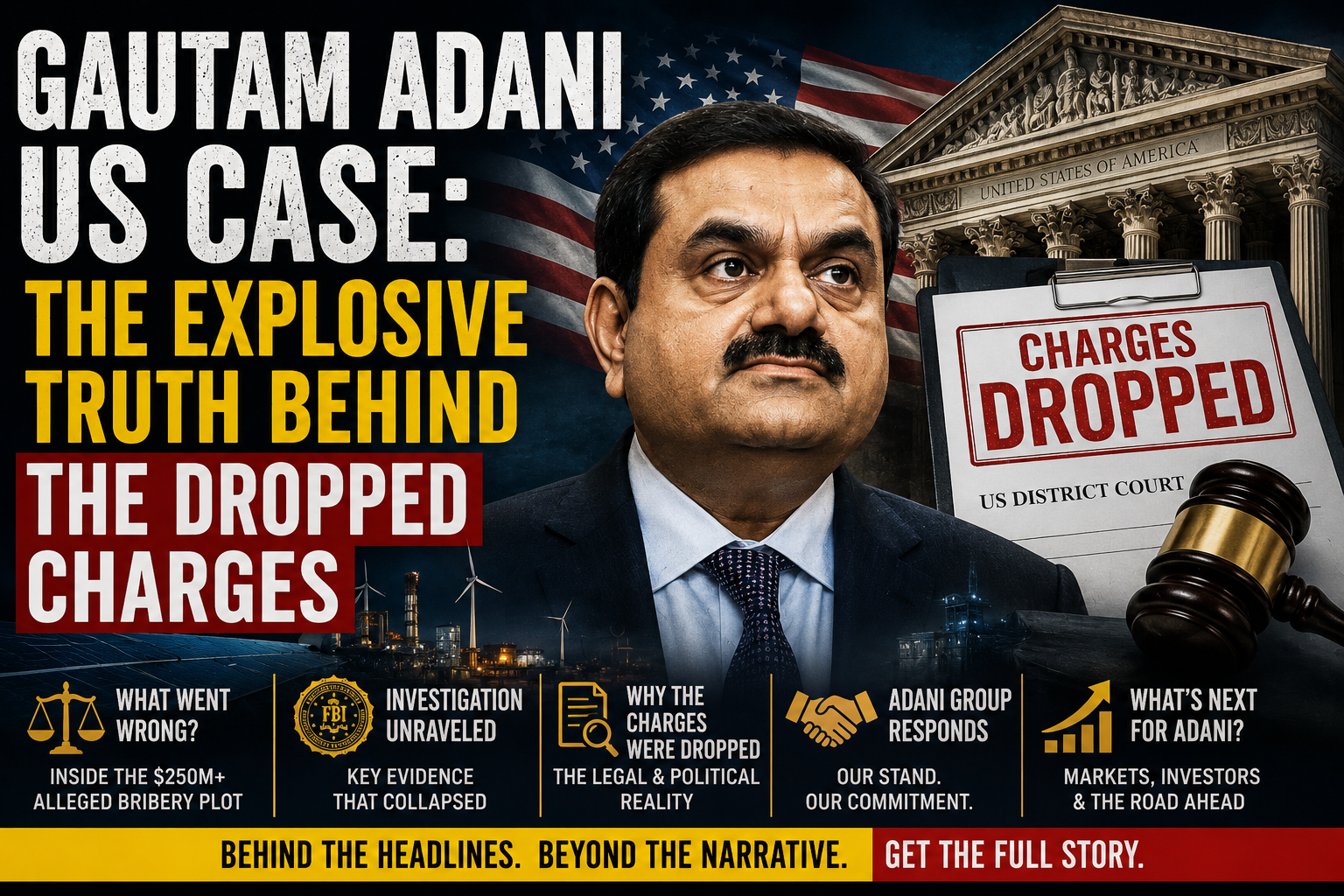
The Gautam Adani US Case has taken a turn that few could have predicted just months ago. In a move that is currently sending shockwaves through the global financial and political landscapes, the United States Justice Department is reportedly moving to drop criminal charges against the Indian billionaire. This development marks a stunning reversal of a case that once threatened to derail the Adani Group’s international ambitions and significantly strain U.S.-India diplomatic ties.
At the heart of the Gautam Adani US Case were allegations of a massive $265 million bribery scheme. Federal prosecutors in Brooklyn had originally claimed that Adani, his nephew, and several associates orchestrated a plan to bribe Indian government officials to secure lucrative solar energy contracts. The indictment, unsealed in the final weeks of the Biden administration, accused the defendants of “corruption and fraud at the expense of U.S. investors.” Today, however, the narrative has shifted from an “elaborate bribery scheme” to a calculated legal and economic settlement.
The Legal Masterstroke: Sullivan & Cromwell Steps In
The turning point for the Gautam Adani US Case appears to be a strategic change in legal counsel. Adani hired a powerhouse legal team led by Robert J. Giuffra Jr., the co-chairman of Sullivan & Cromwell. Giuffra is not just any lawyer; he is a prominent figure in the American legal system, famously known for representing high-profile clients, including President Trump.
According to insiders, Giuffra’s team presented a massive 100-slide presentation to the Justice Department. The goal was to systematically dismantle the prosecution’s case. The arguments were two-pronged:
Lack of Evidence: The defense argued that the basic evidence required to prove a bribery conspiracy was missing.
Jurisdictional Overreach: They contended that the U.S. had no business prosecuting a case where the alleged actions took place in India, involved Indian officials, and centered on Indian solar projects.
The “$10 Billion Offer” and Transactional Justice
Perhaps the most controversial aspect of the Gautam Adani US Case is a specific slide in that legal presentation—one that mentioned a $10 billion investment in the American economy.
Shortly after Donald Trump’s election, Adani had publicly pledged on social media to invest $10 billion in U.S. energy and infrastructure, potentially creating 15,000 jobs. During the private meetings with the DOJ, this pledge was reiterated. While prosecutors officially state that the investment played no role in the legal resolution, the optics have fueled intense debate.
Critics argue that this represents a “transactional approach to justice.” In this view, legal freedom is essentially being traded for economic promises. However, supporters of the decision suggest that the Trump administration is simply moving away from the “global corporate police” role that characterized previous administrations, particularly regarding the Foreign Corrupt Practices Act (FCPA).
Financial Penalties and Regulatory SettlementsWhile the criminal charges in the Gautam Adani US Case are being dropped, it is not a total “get out of jail free” card. The billionaire and his companies are still facing significant financial hits:
| Entity | Investigation Type | Estimated/Agreed Penalty |
| SEC (Securities & Exchange Commission) | Civil Fraud / Investor Misleading | $18 Million (Settled) |
| Treasury Department | Iranian Gas / Sanctions Violations | ~$275 Million (Pending) |
The SEC settlement, announced on May 14, 2026, involved a fine of $18 million, with Adani personally responsible for $6 million. Furthermore, the Treasury Department’s probe into alleged violations of U.S. sanctions regarding shipping Iranian gas remains a heavy financial cloud over the group.
Political Firestorms: New Delhi and Washington
The resolution of the Gautam Adani US Case has ignited a political war of words in India. Congress leader Rahul Gandhi has been vocal in his criticism, accusing Prime Minister Narendra Modi of using trade deals as a “bargain” to secure Adani’s release.
Gandhi’s post on X (formerly Twitter) alleged that the Prime Minister’s diplomatic efforts were compromised, suggesting that the recent U.S.-India trade agreements were inextricably linked to the dismissal of the Adani indictment. This sentiment reflects a broader perception in India that the billionaire’s close ties to the ruling government provide him with a unique shield against international legal scrutiny.
In Washington, the situation is equally tense. The deal has reportedly caused friction within the Justice Department. Some career prosecutors who built the case were allegedly so disillusioned by the top-down decision to drop the charges that they considered resigning. This mirrors the recent controversy surrounding former New York Mayor Eric Adams, where charges were reportedly dropped in exchange for political cooperation on immigration.
The Global Impact of the Adani Reversal
The Gautam Adani US Case is about much more than one man’s legal troubles. It signals a major shift in how the United States handles foreign bribery:
Weakening of the FCPA: The Foreign Corrupt Practices Act has long been the gold standard for fighting global corruption. By backing off from the Adani case, the U.S. may be signaling to global conglomerates that “routine business practices” in other countries will no longer be criminalized by American courts.
Economic Competitiveness: The Trump administration’s executive orders have argued that aggressive FCPA enforcement hurts American business interests. Dropping the Adani charges aligns with a “Business First” foreign policy.
Infrastructure and Ports: Adani is a titan of infrastructure. The dismissal of these charges restores his ability to travel freely and access U.S. capital markets, which is essential for his ambitious projects in ports, airports, and green energy across the globe.
Expert Analysis: Why Now?
Why did the U.S. choose to drop the Gautam Adani US Case at this specific moment? Foreign affairs analysts point to a combination of factors. The need for India as a strategic counterweight to China in the Indo-Pacific region cannot be overstated. A high-profile criminal trial against India’s most influential businessman would have created a diplomatic nightmare that the current administration was seemingly unwilling to endure.
Furthermore, the “Duck Diplomacy”—the act of keeping things calm on the surface while working furiously underneath—seems to have worked. By settling the civil and treasury matters with fines while dismissing the “conspiracy” charges, the U.S. maintains a semblance of regulatory oversight without completely alienating a key strategic partner.
Conclusion: A New Chapter for the Adani Group
The conclusion of the Gautam Adani US Case marks the end of a dark chapter for the Adani Group, but the reputational scars remain. While the stock markets are likely to react positively to the removal of the criminal threat, the questions surrounding the “transactional” nature of the deal will persist.
For Gautam Adani, the focus now shifts back to his $10 billion investment pledge in the U.S. and the massive infrastructure projects he is leading in India. For the rest of the world, the case serves as a landmark example of how law, politics, and massive economic stakes intersect in the modern era of global diplomacy.
As the Treasury Department prepares to unveil its final deal, all eyes will be on the Adani Group to see if they can navigate the remaining regulatory hurdles and emerge as a trusted player on the world stage once again.
Disclaimer: This information is based on various inputs from news agency.