
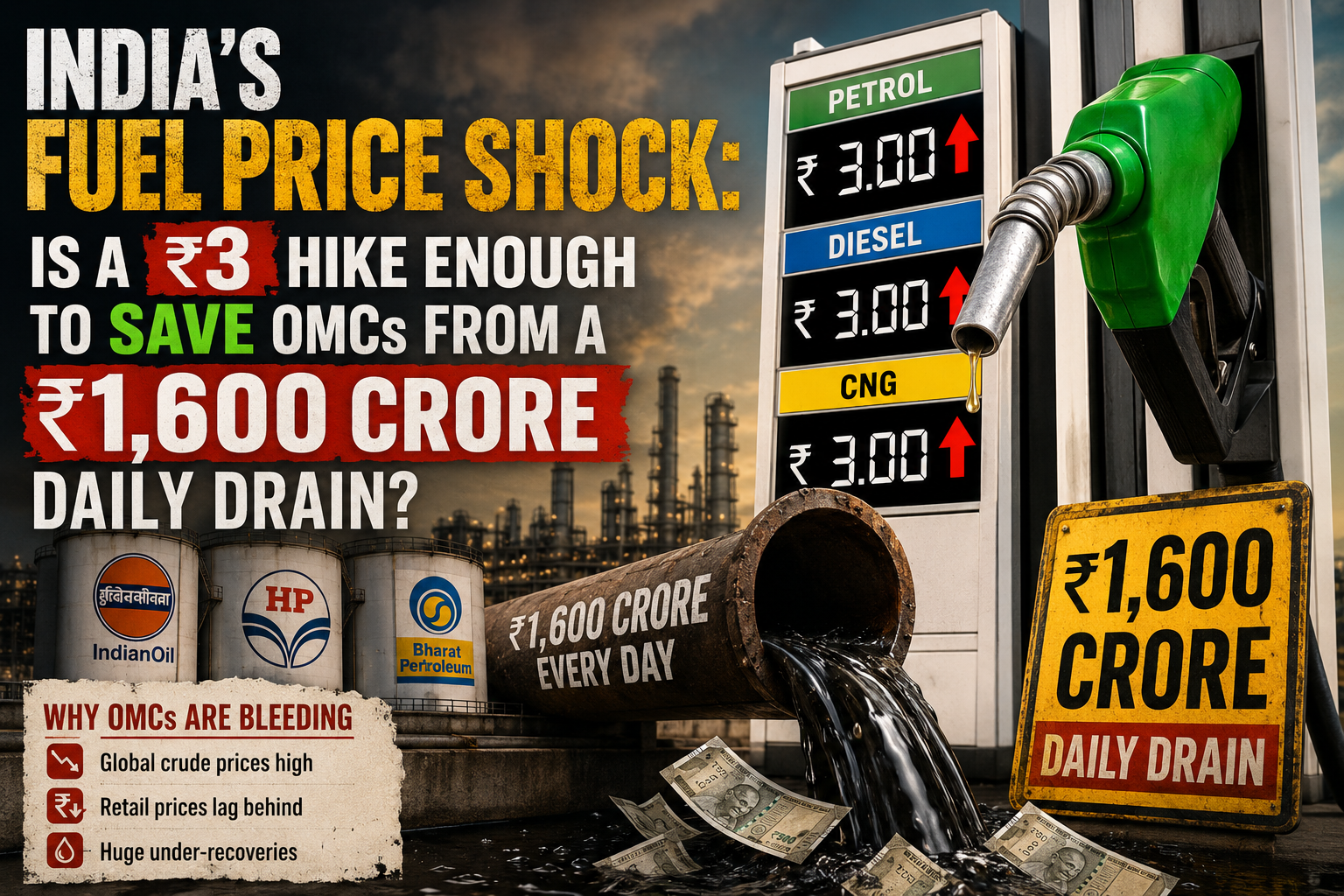
India’s Fuel Price Hike is the phrase on every Indian’s lips today as they pull into petrol pumps. On Friday, May 15, 2026, the long-standing “calm” in Indian fuel markets finally shattered. After nearly four years of price stability, oil marketing companies (OMCs) have been forced to raise the retail prices of petrol and diesel by ₹3 per litre.
While a ₹3 jump feels heavy for a middle-class family or a gig worker, the math behind the scenes tells a much more terrifying story. With under-recoveries hitting nearly ₹1,600 crore daily, a simple question arises: Is this ₹3 hike a genuine solution, or just a tiny bandage on a gaping wound?
India’s Fuel Price Hike:The Geopolitical Trigge-Why Now??
To understand the India’s Fuel Price Hike, one must look beyond Indian borders. The crisis isn’t domestic; it’s a direct fallout of the escalating US-Israel military action against Iran that began on February 28.
The Strait of Hormuz, a narrow waterway through which 40% of India’s oil needs pass, has become a maritime graveyard and a geopolitical chokepoint. With missile strikes hitting oilfields and tankers, the risk premiums and charter rates have skyrocketed. Shipping costs through Hormuz have reportedly surged to a staggering $2 million per voyage.
For 76 days, India stood as a global outlier. While 82 other nations imposed fuel rationing or massive price surges of up to 90%, India held its breath. OMCs absorbed the shock, but the pressure has finally become unsustainable.
The Brutal Math: Why ₹3 Is Not Enough
According to Petroleum Minister Hardeep Singh Puri, production costs have “gone through the roof.” Before the war, India’s crude basket averaged $69 a barrel. Today, it is hovering between $100 and $110.
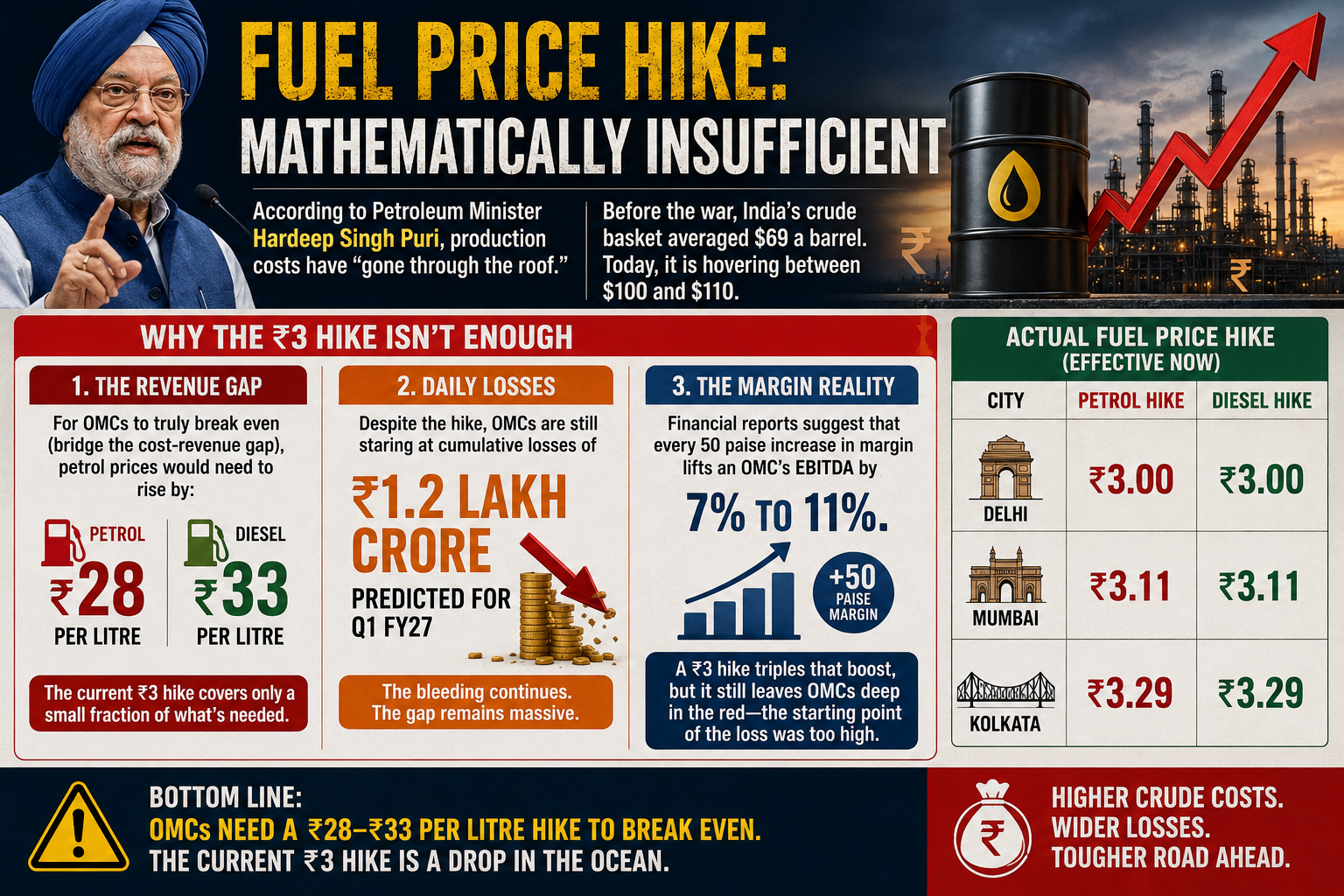
Here is the breakdown of why the current Fuel Price Hike is mathematically insufficient:
The Revenue Gap: For OMCs to truly break even (bridge the cost-revenue gap), petrol prices would need to rise by ₹28 per litre and diesel by a massive ₹33 per litre.
Daily Losses: Despite the hike, OMCs are still staring at cumulative losses of ₹1.2 lakh crore predicted for Q1 FY27.
The Margin Reality: Financial reports suggest that every 50 paise increase in margin lifts an OMC’s EBITDA by 7% to 11%. While a ₹3 hike triples that boost, it still leaves the companies deep in the red because the starting point of the loss was too high.
| City | Petrol Hike | Diesel Hike |
| Delhi | ₹3.00 | ₹3.00 |
| Mumbai | ₹3.11 | ₹3.11 |
| Kolkata | ₹3.29 | ₹3.29 |
A “Conscious Choice” to Protect the Poor
If the gap is ₹28, why only hike ₹3? The government calls this a “conscious choice.”
Fuel demand in India is “price inelastic”—meaning people can’t just stop using it. Farmers need diesel for irrigation pumps, and the entire logistics network of India runs on trucks. A full “pass-through” of global prices (a 200-300% hike) would have caused a total economic collapse and hit the bottom 20% of the population the hardest.
By absorbing the shock for over two months, the government and OMCs acted as a buffer. Even the current hike of 3-3.5% is the lowest among major economies compared to the UAE (52% hike) or the US (44% hike).
The “Twin Drain” and the Path Forward
The Indian economy is currently battling a “massive twin drain” on its foreign exchange reserves: Oil and Gold.
Oil: Every $10 rise in crude adds $13-14 billion to the import bill.
Gold: India’s second-largest import at $72 billion.
Instead of mandatory rationing, the Prime Minister has made a rare appeal for voluntary restraint. The strategy is simple: reduce the volume of imports to save the dollar.
What Citizens are Being Asked to Do:Reduce Fuel Consumption: Opt for carpooling or public transport to lower the collective demand.
Avoid Gold Purchases: Refraining from buying gold for just one year could significantly stabilize the Current Account Deficit.
Cut Non-Essential Travel: Outbound tourism costs the country nearly $30 billion annually.
Conclusion: A Tenuous Balance
The India’s Fuel Price Hike of May 15 is a signal, not a solution. It informs the public that the era of “absorbed costs” is reaching its limit. India has chosen a path of “persuasion over panic,” refusing to be extorted by a geopolitical crisis.
However, if the fighting in the Middle East is prolonged and the Strait of Hormuz remains a graveyard for tankers, the government may find itself with no choice but to implement further rounds of hikes. For now, the ₹3 increase is a calculated gamble—a hope that diplomacy will prevail before the OMCs run completely dry.