
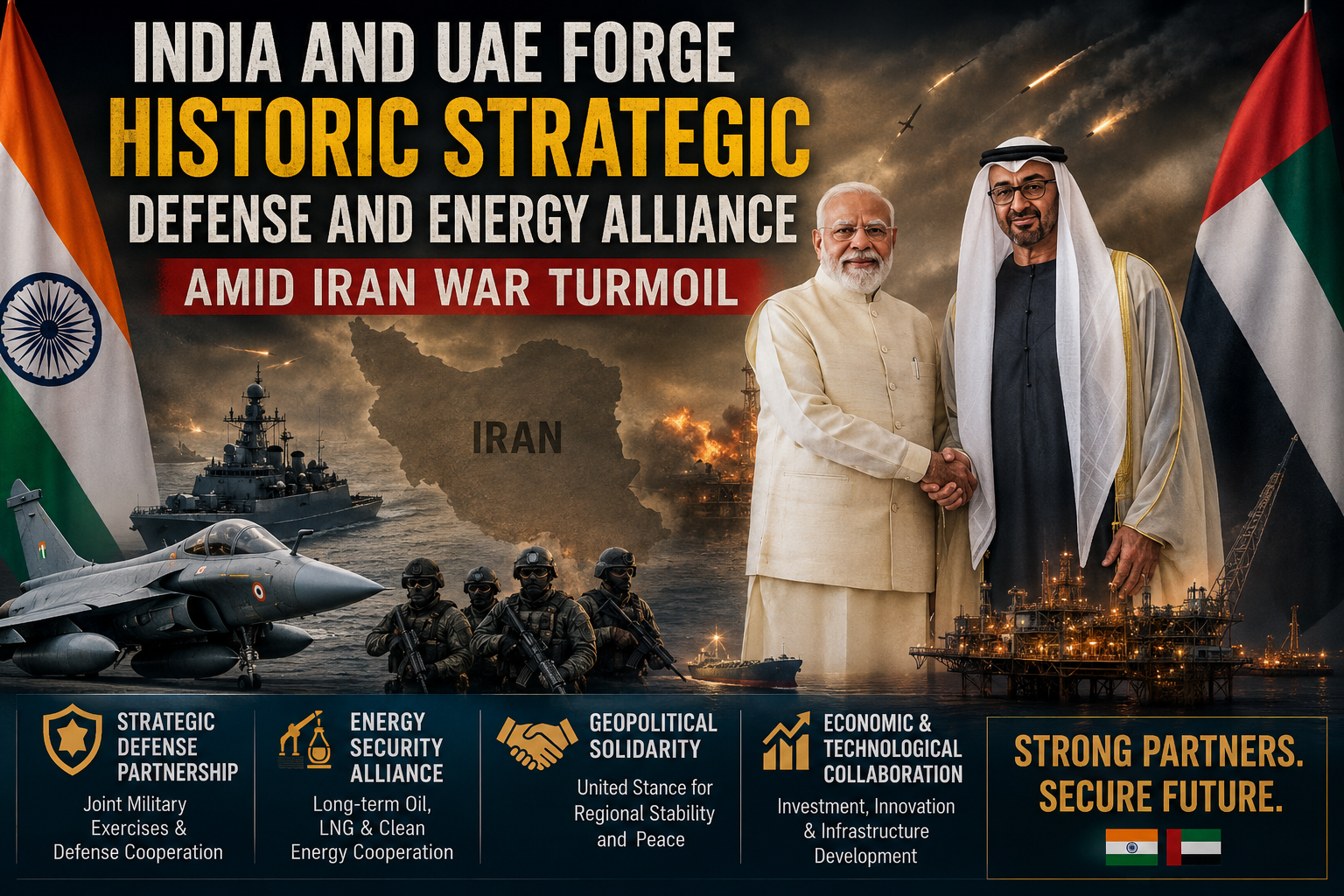
The geopolitical landscape of the Middle East and South Asia is undergoing a tectonic shift. On Friday, May 15, 2026, Prime Minister Narendra Modi’s high-stakes visit to Abu Dhabi culminated in a series of landmark agreements that redefine the India-UAE Strategic Partnership. As the shadow of the Iran war looms over global energy markets and maritime corridors, New Delhi and Abu Dhabi have signaled a decisive move to insulate their economies and national security through unprecedented cooperation.
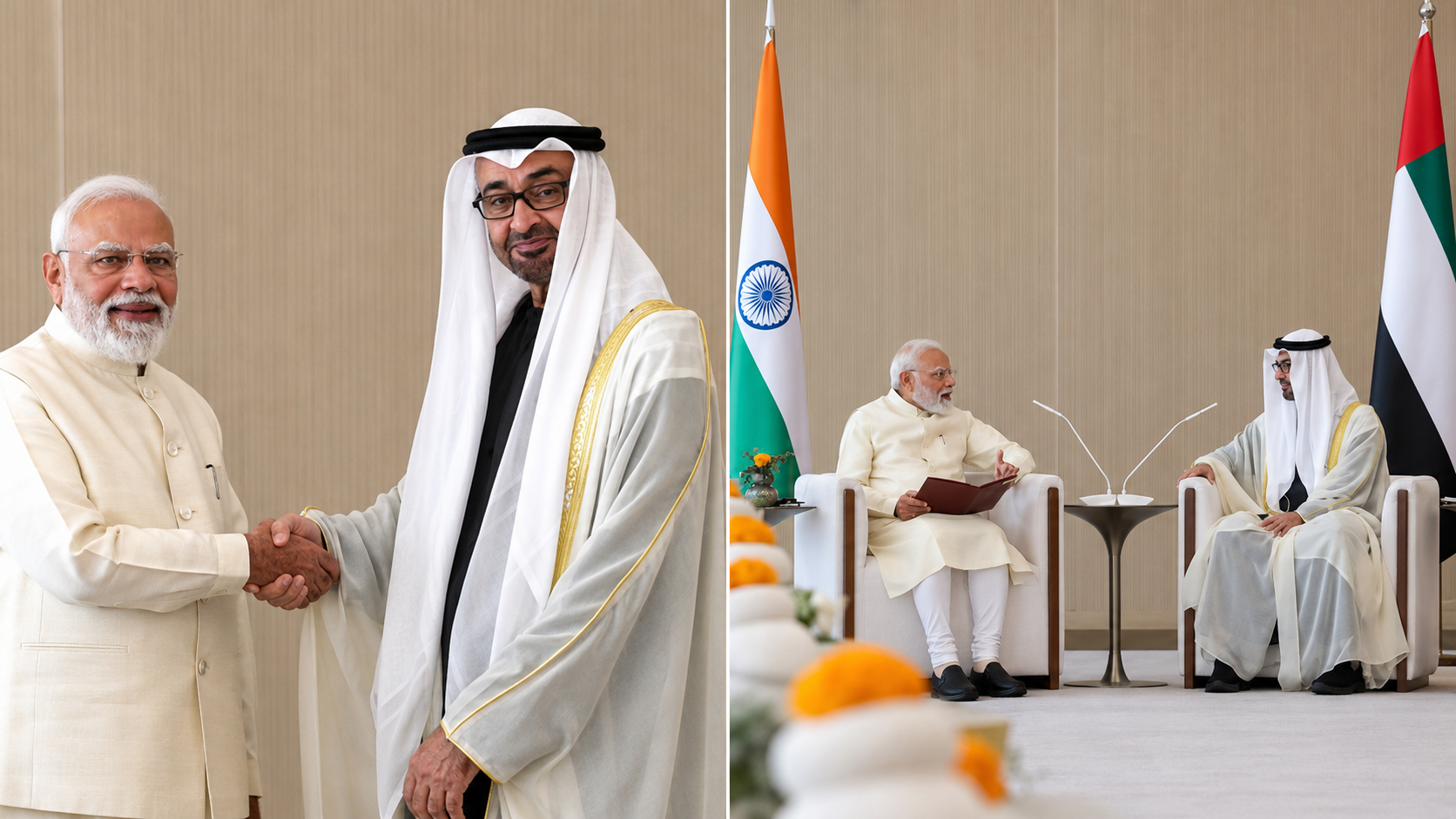
The visit, part of PM Modi’s broader five-nation tour, comes at a time when the world is grappling with the aftershocks of the conflict between Iran and the U.S.-Israeli alliance. With the Strait of Hormuz effectively a “no-go zone” for much of the world’s shipping, the India-UAE Strategic Partnership has evolved from a buyer-seller relationship into a comprehensive security and energy umbrella.
1. A New Era of Defense Industrial Collaboration
The cornerstone of this visit was the formalization of a framework for a strategic defense partnership. This isn’t just about purchasing hardware; it is a deep-rooted commitment to co-development and intelligence sharing.
Key Pillars of the Defense Pact:
Defense Industrial Collaboration: Joint ventures in manufacturing military hardware, reducing reliance on Western or Russian supply chains.
Maritime Security: Given the recent drone and missile strikes on the UAE’s eastern coast, protecting the Sea of Oman and the Indian Ocean has become a mutual priority.
Cyber Defense and Secure Communications: In an era of hybrid warfare, both nations have agreed to exchange real-time information to thwart state-sponsored cyber-attacks.
Innovation and Advanced Technology: Focus on AI-driven defense systems and drone-countermeasure technologies.
This move is seen as a strategic counter-balance to the strengthening ties between Saudi Arabia and Pakistan. While Islamabad has played a mediator role in the Iran conflict, India has firmly aligned its security interests with the UAE, which recently suffered Iranian strikes on its Fujairah refinery—an attack that injured three Indian workers and drew sharp condemnation from PM Modi.
2. Energy Security: Beyond the Strait of Hormuz
With India importing nearly 90% of its crude requirements, the closure of the Strait of Hormuz posed an existential threat to its economic growth. The India-UAE Strategic Partnership addressed this vulnerability through revolutionary oil and gas pacts.
Strategic Petroleum Reserves (SPR)
The UAE’s ADNOC (Abu Dhabi National Oil Company) has agreed to explore a massive expansion of its crude oil storage in India. The deal proposes increasing storage by up to 30 million barrels. Most significantly, for the first time, India is exploring the potential to store its own strategic reserves within the UAE’s Fujairah terminals. This provides a “buffer” located outside the volatile Persian Gulf, ensuring that even if the Strait remains blocked, Indian tankers can bypass the chokepoint.
The LNG and LPG Factor
India and the UAE inked a $3 billion LNG deal earlier this year, but this visit added another layer:
LPG Expansion: ADNOC and Indian Oil Corp (IOC) will expand trading opportunities to ensure cooking gas remains affordable for India’s massive population.
OPEC Exit Impact: The UAE’s recent exit from OPEC allows it more flexibility in production. This “freedom” is expected to result in higher output, with India positioned as a preferred buyer at a time when global fuel prices are skyrocketing.
3. Economic Integration and Direct Investment
Beyond guns and oil, the India-UAE Strategic Partnership is being cemented by massive capital flows. The Indian foreign ministry announced fresh UAE investments worth $5 billion on Friday.
| Investor | Transaction Type | Value |
| Emirates NBD | 60% stake acquisition in RBL Bank | $3 Billion |
| Abu Dhabi IHC | Sammaan Investment | $1 Billion |
| Direct Investment | New Infrastructure Projects | $1 Billion |
These investments serve a dual purpose: they provide the UAE with a high-growth destination for its sovereign wealth, and they provide India with the liquidity needed to modernize its infrastructure amidst the global energy crisis.
4. Navigating the “Great Game” of 2026
The geopolitical subtext of this visit cannot be ignored. While Pakistan has moved closer to Saudi Arabia through mutual defense accords and acted as a bridge between Washington and Tehran, India has focused on building a “Minilateral” alliance with the UAE.
The India-UAE Strategic Partnership is a pragmatic response to the “Iran war” which began with strikes on February 28. As the fragile ceasefire holds, New Delhi is wasting no time. By securing long-term energy deals and establishing a “Maritime Security Corridor,” PM Modi is ensuring that India’s growth trajectory remains unhampered by the regional turmoil.
Conclusion: A Resilient Future
The agreements signed in Abu Dhabi represent a “de-risking” strategy for the 21st century. By integrating their defense sectors and creating a cross-border energy reserve, India and the UAE are not just surviving the current crisis—they are building a fortress of stability.
As Sultan Ahmed Al Jaber, CEO of ADNOC, rightly noted: “The strength of the UAE-India energy partnership becomes ever more critical as demand accelerates.” For the 4.3 million Indians living in the Emirates and the 1.4 billion back home, this strategic shift is the ultimate insurance policy against a volatile world.