The integrity of India’s medical entrance system has been shaken to its core. The NEET 2026 paper leak has not just exposed a flaw in the examination process; it has unveiled a sophisticated, multi-layered criminal enterprise operating from the coaching heartlands of Rajasthan to the academic circles of Maharashtra. As the Central Bureau of Investigation (CBI) digs deeper, the narrative shifts from simple “guess papers” to a systemic betrayal of over 23 lakh students whose futures now hang in the balance.
In this deep dive, we explore the rise of “Rakesh Sir” and “Bhai Sir,” the involvement of the Biwal family, and how a Pune-based lecturer allegedly turned the National Testing Agency’s (NTA) own protocols against itself.
The Sikar Connection: A Hub of Dreams and Deception
Sikar, Rajasthan, is known as a burgeoning hub for competitive exam preparation. Thousands of students flock here annually, fueled by the hope of wearing a white coat. However, beneath the competitive fervor lies a “shadowy network” of consultants and teachers who promised a shortcut to success for the right price.
The Rise of Rakesh Kumar Mandawariya
At the center of the Rajasthan leg of the NEET 2026 paper leak is Rakesh Kumar Mandawariya, better known to locals as “Rakesh Sir.” An alumnus of the prestigious Navodaya Vidyalaya, Mandawariya operated out of a modest office on Piprali Road called RK Consultancy.
While the office was physically small, its influence was massive. Mandawariya didn’t just offer career guidance; he was a “paper solver” and a middleman who bridged the gap between the source of the leak and the desperate aspirants. When the CBI and local police began their crackdown, Mandawariya vanished, leaving his office air conditioning running—a chilling testament to the haste of his escape. He was eventually apprehended in the hills of Uttarakhand.
The Mystery of ‘Bhai Sir’ and the Front Institutes
The investigation further led to Satyanarayan Chaudhary, or “Bhai Sir.” A chemistry teacher by profession, Chaudhary allegedly ran the Deep Career Institute. Interestingly, the institute appeared to be more of a facade than a functioning school.
Evidence suggests that Chaudhary used this “institute” to market his “Master Stroke” guess papers. These weren’t mere academic predictions; they were suspiciously accurate mirrors of the actual exam. Posters for his institute featured members of the Biwal family—the very family now at the heart of the CBI’s arrest list.
The Biwal Family: The Middlemen of the Scam
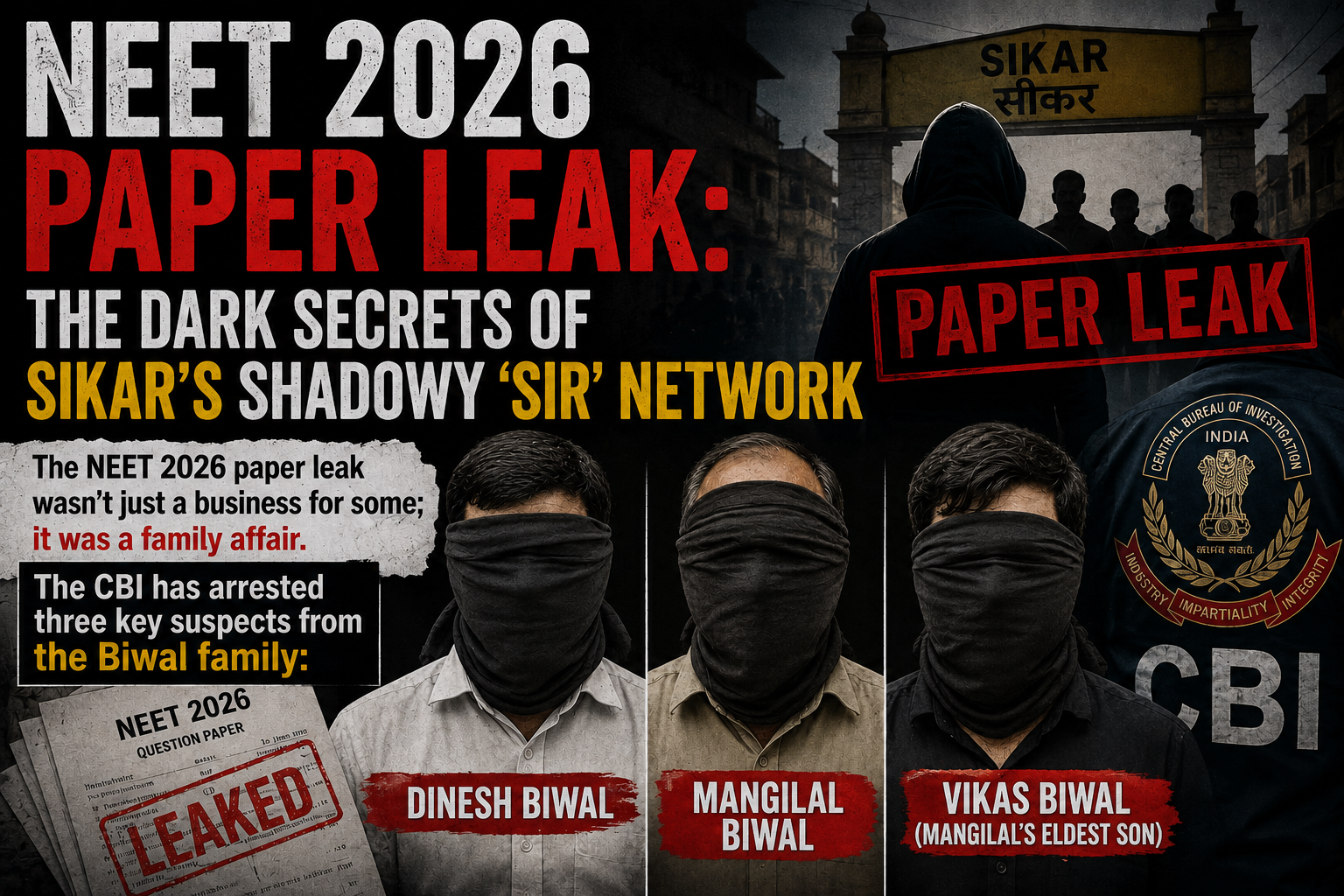
The NEET 2026 paper leak wasn’t just a business for some; it was a family affair. The CBI has arrested three key suspects from the Biwal family:
Dinesh Biwal
Mangilal Biwal
Vikas Biwal (Mangilal’s eldest son)
According to investigators, the Biwal brothers purchased the leaked “guess” paper and funneled it into the coaching ecosystem of Sikar. The financial trail is staggering. Mandawariya allegedly bought the paper from the Biwals for ₹15 lakh and subsequently sold it to individual students and smaller coaching centers for ₹3 lakh to ₹5 lakh per head.
The irony of the situation is poignant: a poster for ‘Bhai Sir’s’ institute congratulated three girls from the Biwal family for clearing previous NEET exams. One of them, Gunjan Biwal, is currently a medical student in Varanasi. Authorities are now looking into whether these past successes were also built on the foundation of leaked papers.
How the Leak Spread: From ₹15 Lakh to Free
The mechanics of the NEET 2026 paper leak follow a classic viral pattern. What started as a high-value commodity quickly depreciated as it reached the hands of students.
The Premium Phase: Initially sold for lakhs by Mandawariya.
The Panic Phase: On the night of May 2nd, just hours before the exam, the paper was being traded for as little as ₹15,000.
The Viral Phase: In some instances, students shared the paper for free via WhatsApp, hoping to help friends.
The “lid” was finally blown off the scam by a hostel owner in Sikar. His son, an MBBS student in Kerala, had received the paper from a friend and passed it to his father. Recognizing the gravity of the document, the hostel owner alerted authorities, setting off a chain reaction that led to the current CBI probe.
The Mastermind: P.V. Kulkarni and the NTA BreachWhile the Sikar network handled distribution, the CBI believes they found the source in Pune. The arrest of P.V. Kulkarni, a chemistry lecturer, marks a turning point in the NEET 2026 paper leak investigation.
Unlike the local consultants in Sikar, Kulkarni had legitimate access. Reports indicate he was involved in the examination process on behalf of the National Testing Agency (NTA) itself. This “insider threat” is what allowed the paper to be compromised as early as the last week of April. Kulkarni allegedly worked with Manisha Waghmare, a beauty salon owner, to mobilize students and collect payments.
| Key Figure | Role in Network | Status |
| P.V. Kulkarni | Alleged Kingpin / NTA Insider | Arrested |
| Dinesh Biwal | Primary Distributor | Arrested |
| Rakesh Mandawariya | Sikar Broker | Detained/Under Probe |
| Manisha Waghmare | Student Recruiter | Arrested |
The Impact on 23 Lakh Aspirants
The scale of the NEET 2026 paper leak is unprecedented. For the 2.3 million students who appeared for the exam on May 3rd, the news is a devastating blow. The Ministry of Education, under Dharmendra Pradhan, has already announced major reforms and the possibility of free re-exams for those affected.
However, the psychological toll is harder to rectify. Students who spent years in 14-hour study sessions now find their merit eclipsed by those who could afford a ₹5 lakh “shortcut.”
“The mandate was to establish the scale of the leak,” a Rajasthan Police official stated. “Now that the CBI has taken over, we are seeing that these ‘Sirs’ in Sikar were just cogs in a much larger, more dangerous machine.”
Breakdown & Analysis
To understand why the NEET 2026 paper leak has dominated the headlines, one must look at the “WhatsApp Guarantee” mentioned in seized devices. Accused persons were promising scores of “500 to 600 marks” to students who bought the leaked content.
The investigation is currently focusing on:
Digital Forensics: Seized laptops from RK Consultancy and Deep Career Institute.
Financial Trails: Moving beyond cash to track UPI and hawala transactions.
NTA Protocols: Identifying how a lecturer like Kulkarni bypassed security measures designed to keep the paper confidential.
Conclusion: A System in Need of Surgery
The NEET 2026 paper leak is a symptom of a deeper malady in India’s high-stakes examination culture. When “Career Guidance” becomes a front for crime, and “Sirs” become scammers, the sanctity of the medical profession is at risk.
As the CBI continues its arrests—now totaling eight and counting—the focus remains on cleaning up the “shadowy network” of Sikar and ensuring that the 2026 academic year doesn’t become a lost chapter for India’s future doctors.
The shutters may be down on Piprali Road, but the heat is just beginning for those who traded the dreams of millions for a few crore rupees.
Frequently Asked Questions (FAQ)1. Who is the main accused in the NEET 2026 paper leak?
While the Biwal brothers were the primary distributors in Rajasthan, P.V. Kulkarni, a Pune-based lecturer with NTA ties, is considered the kingpin.
2. How many students are affected by the leak?
Approximately 23 lakh (2.3 million) students who registered for the NEET UG 2026 exam are impacted by the ongoing investigation.
3. Will there be a re-exam for NEET 2026?
The government has indicated that reforms and localized re-exams are being considered, but a nationwide re-test depends on the final CBI report regarding the extent of the spread.
4. What was the role of ‘Rakesh Sir’ in Sikar?
Rakesh Mandawariya acted as a broker, purchasing the paper from the Biwals and selling it to students through his consultancy firm.