
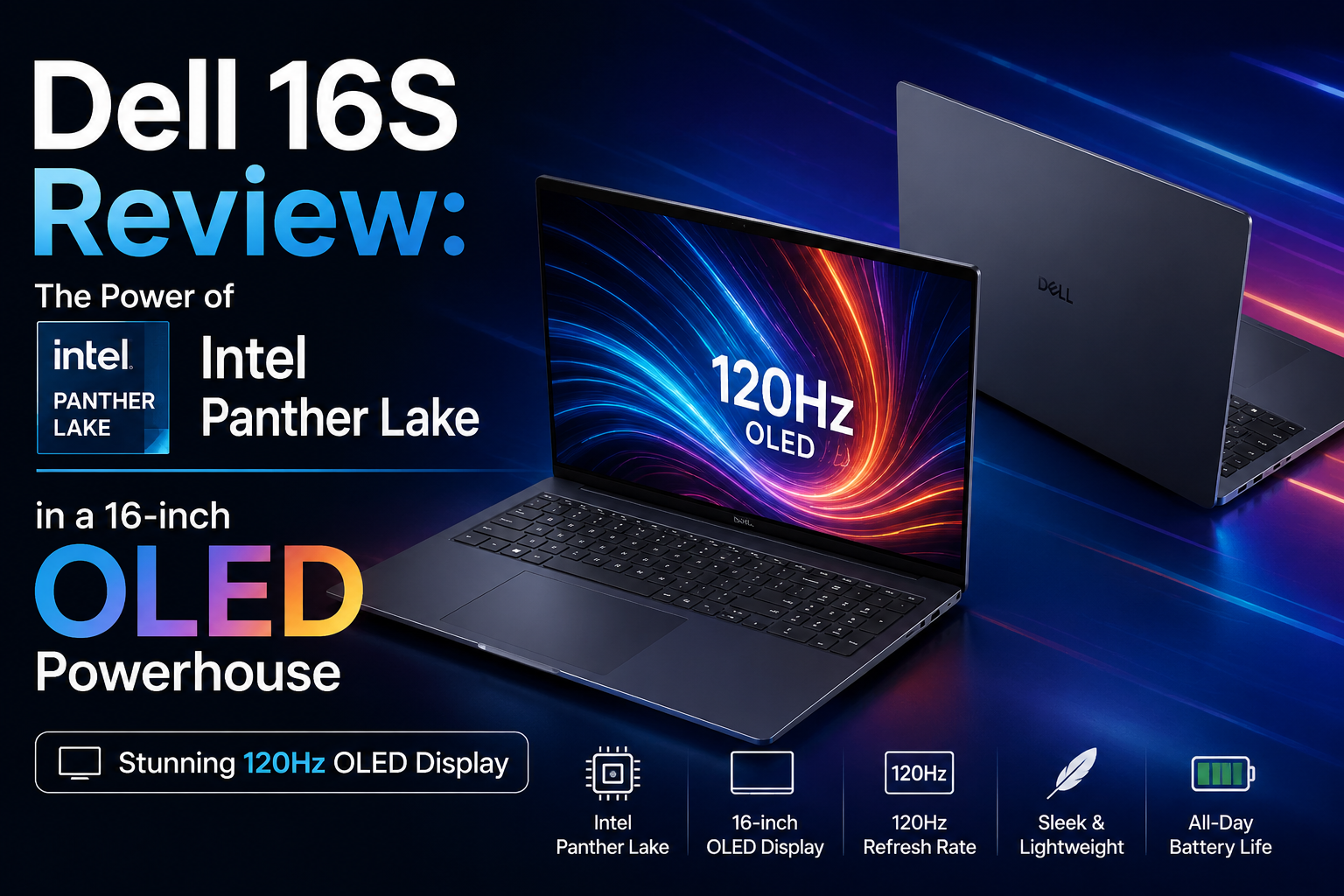
Dell 16S Review : The world of consumer laptops is currently undergoing a massive shift. As we move deeper into 2025 and look toward 2026, the battle for efficiency versus raw performance has never been more intense. This week, Dell made a significant move by officially launching the Dell 16S, a machine that aims to redefine the 16-inch category. Replacing the well-regarded Dell 16 Plus, the new 16S isn’t just a minor refresh; it is a fundamental leap forward, primarily due to the inclusion of Intel’s highly anticipated Panther Lake architecture.
In this deep dive, we will explore everything the Dell 16S has to offer, from its global availability and pricing to its sophisticated display options and the sheer processing power of the Core Ultra 9 386H.
The Evolution of the Dell 16-Inch Lineup
For years, Dell has balanced its portfolio between the ultra-premium XPS line and the more accessible “Plus” or “S” series. The Dell 16S is the successor to the Dell 16 Plus (reviewed in June 2025). While the previous model utilized the Lunar Lake platform—noted for its impressive battery life and efficiency—the Dell 16S shifts gears toward Panther Lake.

This transition is crucial. Panther Lake represents Intel’s next frontier, utilizing advanced process nodes to deliver a significant boost in Instructions Per Clock (IPC) and AI compute capabilities. For users who felt Lunar Lake was a bit too focused on low-power tasks, the 16S provides the “muscle” that creative professionals and heavy multitaskers have been craving.
Key Specifications at a Glance:
Processor Options: Intel Core Ultra 5 322 up to Core Ultra 9 386H.
RAM: Up to 32 GB LPDDR5x.
Storage: Up to 2 TB PCIe Gen4 SSD.
Battery: 70 Wh (a 9% increase over the previous generation).
Display: 16-inch 1200p IPS, 1600p IPS, or 1800p (2.8K) OLED.
Graphics: Intel Integrated / Intel Arc B390 (on specific variants).
Intel Panther Lake: The Heart of the Dell 16S
The primary talking point of the Dell 16S is undoubtedly the silicon. Intel’s Panther Lake chips are designed to compete directly with the best from Apple’s M-series and Qualcomm’s Snapdragon X Elite.
Core Ultra 9 386H: The Flagship Experience
In North America, the top-tier configuration features the Core Ultra 9 386H. This processor is built for those who don’t want to compromise. Whether you are rendering 4K video, running local Large Language Models (LLMs), or managing massive datasets in Excel, the 386H provides the headroom necessary to avoid thermal throttling and lag.
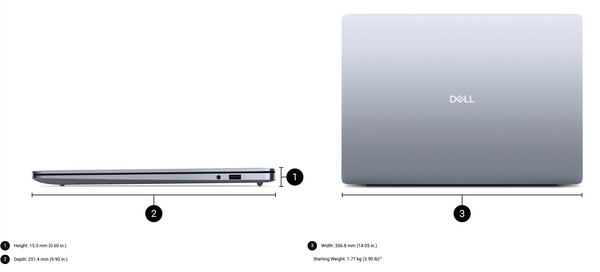
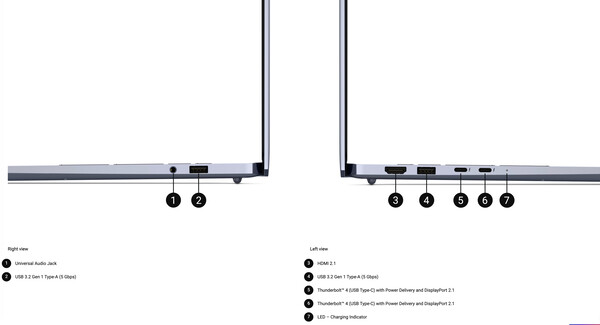
Regional Variations in Processing Power
Interestingly, Dell has opted for a staggered release regarding CPU options:
North America: Consumers have immediate access to the Core Ultra 5 322, Core Ultra 7 355, and the flagship Core Ultra 9 386H.
Europe: Currently, the market is limited to the Core Ultra 5 and Core Ultra 7 355 models.
Coming Soon: Dell has teased the arrival of the Core Ultra 5 336H, Core Ultra 7 356H, and the Core Ultra X7 358H.
The Core Ultra X7 358H is particularly noteworthy because it is the only variant confirmed to feature Intel Arc B390 graphics. This “Battlemage” based integrated graphics solution promises a substantial leap in gaming and creative performance, potentially making the 16S a viable light-gaming machine without the need for a bulky dedicated GPU.
Visual Excellence: 1800p OLED vs. IPS Panels

Dell understands that a 16-inch laptop is often a primary workstation. Consequently, the screen is the most important interface. The Dell 16S offers a “good, better, best” approach to displays, but there are significant regional differences that buyers should be aware of.
The OLED Dream
The “Best” option is the 1800p (2.8K) OLED display. This panel is the crown jewel of the Dell 16S. With a 120 Hz refresh rate, scrolling through web pages and editing video feels incredibly fluid.
Color Accuracy: It covers 100% of the DCI-P3 color space, making it an ideal choice for photographers and digital artists.
Contrast: Being OLED, it offers true blacks and an infinite contrast ratio.
Brightness: It peaks at 400 nits. While not the brightest in the industry, the per-pixel lighting of OLED makes it appear much more vibrant than a traditional LCD.
The IPS Alternatives
For those looking to save money or prioritize battery life, Dell offers IPS panels:
1600p IPS (The European Standard): This panel features 500 nits of brightness and a variable refresh rate of 48-120 Hz. It covers 100% sRGB, making it a reliable “prosumer” choice.
1200p IPS (The Budget Entry): Available in North America, this is the base model screen. It peaks at 400 nits and only covers 45% of the NTSC color space with a 60 Hz limit. This is strictly for office work and student use.
Visual Excellence: 1800p OLED vs. IPS Panels
One of the criticisms of the previous 16 Plus was that its 64 Wh battery was “just enough” but not industry-leading. Dell has addressed this in the Dell 16S by bumping the capacity to 70 Wh.
While a 9% increase might seem modest on paper, when paired with the architectural efficiencies of Intel Panther Lake, the real-world impact is expected to be significant. Users can expect to get through a full work day of light-to-medium tasks without reaching for the charger. Furthermore, Dell’s power management software allows for aggressive “Battery Saver” modes that don’t completely tank the performance of the Core Ultra chips.
Global Pricing and Availability
The Dell 16S is a premium machine, and its pricing reflects its position in the market.
United States: Pricing starts at $1,319 for the base configuration (Core Ultra 5, 16GB RAM, 512GB SSD, 1200p IPS). For the fully-loaded “dream machine” with the Core Ultra 9 and OLED panel, the price climbs to $2,119.
United Kingdom: The entry price is £1,199, though this often includes the 1600p IPS display as standard.
Eurozone: Prices start at €1,349.
It is important to note that the high-end Core Ultra X7 358H variants (with Arc B390 graphics) do not yet have official pricing. Tech enthusiasts are keeping a close eye on this, as it could be the “sweet spot” for value and performance.
Comparison:Dell 16S vs. Alienware 15 vs. The CompetitionThis week was busy for Dell, as they also launched the Alienware 15. While both are 15-16 inch machines, they target very different audiences.
The Alienware 15 is for the hardcore gamer, featuring beefy cooling and NVIDIA RTX 50-series (or 40-series) dedicated GPUs.
The Dell 16S is the “Sophisticated Powerhouse.” It is thinner, lighter, and more suited for a boardroom or a coffee shop. It relies on the Intel Panther Lake NPU (Neural Processing Unit) for AI tasks, making it a “Copilot+ PC” capable of handling the next generation of Windows features.
Other gadgets launched this week include the Sony Bravia 3II and new projectors from Epson, but in the world of computing, the 16S stands alone as a testament to Intel’s comeback.
Why You Should Care About the Dell 16S
If you are currently using a laptop from 2021 or 2022, the Dell 16S represents the perfect upgrade path. You aren’t just getting a faster processor; you are getting:
AI Readiness: The Panther Lake NPU is designed to handle background tasks like eye contact correction, noise cancellation, and local image generation without taxing the CPU.
Display Longevity: A 120Hz OLED screen is a “once you see it, you can’t go back” upgrade. It makes the entire OS feel faster.
Refined Design: Dell has moved away from the “clunky” 16-inch designs of the past, opting for a sleek, CNC-machined chassis that feels premium.
Final Verdict: Is the Dell 16S Worth It?The Dell 16S is a bold statement. By being one of the first global manufacturers to fully embrace Intel Panther Lake, Dell is positioning itself as a leader in the next era of PC hardware.
For the creative professional in North America, the $2,119 OLED model is a compelling alternative to the MacBook Pro 16, offering a more flexible OS and a display that is arguably more vibrant for media consumption. For the European office worker, the €1,349 base model offers a sturdy, high-resolution workstation that will remain relevant for years to come.
As we continue to monitor the performance of the Core Ultra 9 386H in real-world benchmarks, one thing is certain: the Dell 16S is the laptop to beat this season.