
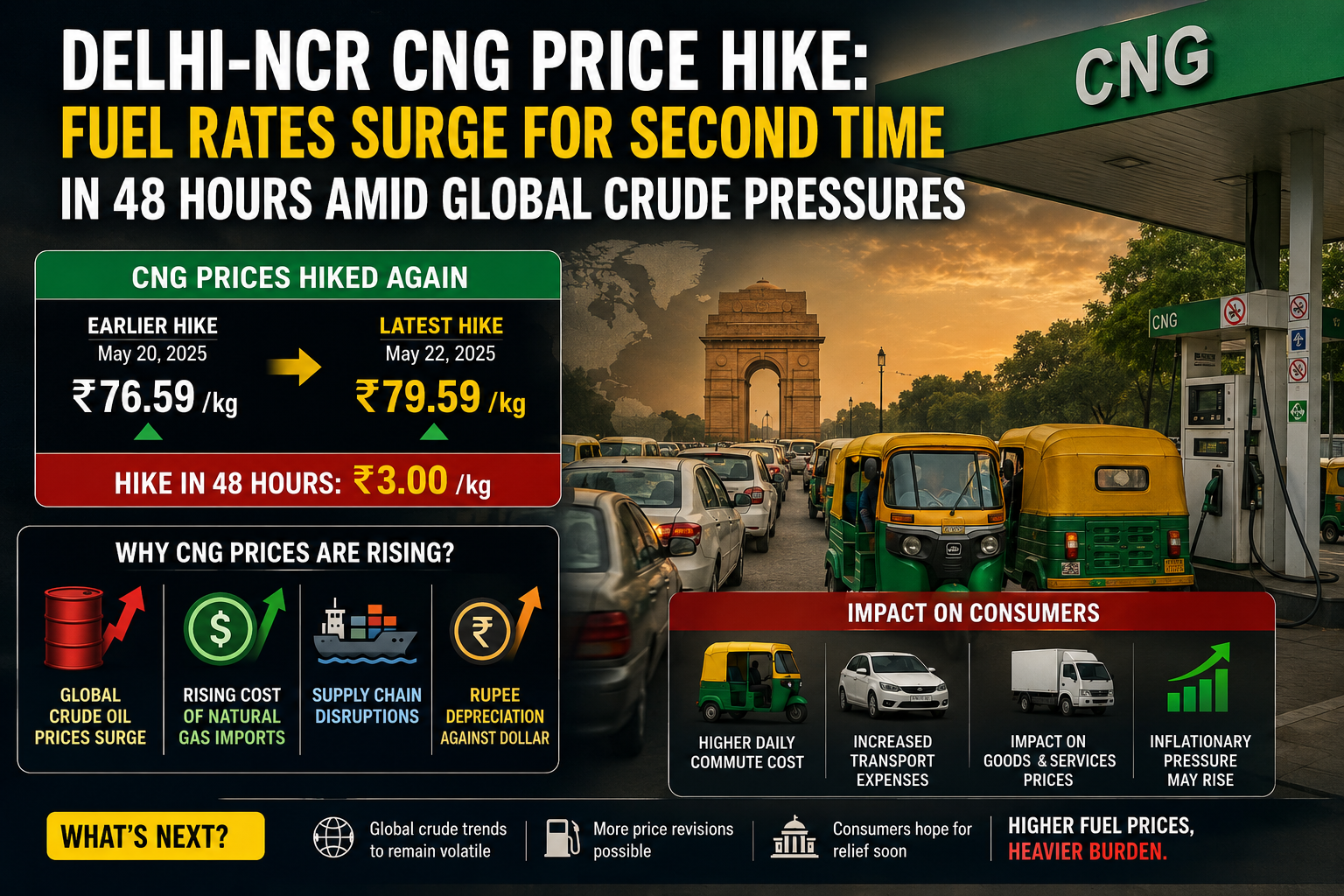
Delhi – CNG prices faced another financial shock on Sunday morning, May 17, 2026, as Compressed Natural Gas (CNG) prices went up for the second time in just two days. The latest update adds an extra ₹1 per kg to the fuel’s retail price. This comes immediately after a bigger ₹2 per kg hike on May 15.
Rising global energy costs have forced domestic oil companies to pass the financial burden onto public consumers. These back-to-back price hikes have hit the local transport sector hard, leaving private car owners, cab drivers, auto-rickshaw operators, and delivery companies struggling with high running costs. Experts warn that as daily travel becomes more expensive, it could soon drive up the prices of daily groceries and essential goods across Northern India.
Breakdown of the New Retail Tariff Structure
The cascading revisions have altered the retail landscape for automotive fuel across Delhi and its neighboring satellite cities. To understand the immediate financial impact, it is essential to examine how these changes reflect at the fuel stations.
Current Retail Prices Across Key Zones
Following the ₹1 hike on Sunday, the final retail prices for CNG across major sectors of the National Capital Region and other metropolitan hubs have been structured as follows:
| Region / City | Previous Price (Post-May 15 Hike) | New Retail Price (Effective May 17) | Net Increase in 48 Hours |
| NCT of Delhi | ₹79.09 per kg | ₹80.09 per kg | ₹3.00 per kg |
| Noida & Ghaziabad | ₹87.70 per kg | ₹88.70 per kg | ₹3.00 per kg |
| Mumbai Metro Region | ₹84.00 per kg | ₹84.00 per kg (As of May 15) | ₹2.00 per kg |
The retail price in Delhi has officially breached the psychological threshold of ₹80 per kilogram, marking a historic high for the city’s green transport infrastructure. Meanwhile, consumers in the Uttar Pradesh cluster of the NCR, including Noida, Greater Noida, and Ghaziabad, continue to pay a significant premium, with prices hovering near the ₹89 mark due to varying local state taxes and pipeline distribution tariffs.
The 48-Hour Timeline of Revisions
The rapid progression of these price adjustments underscores the urgency faced by supply utilities:
May 14, 2026: Delhi CNG prices stood at a baseline of ₹77.09 per kg.
May 15, 2026: An abrupt upward revision of ₹2.00 per kg was enforced, pushing the rate to ₹79.09 per kg.
May 17, 2026: A secondary calibration of ₹1.00 per kg was implemented, establishing the current rate of ₹80.09 per kg.
Core Catalysts: Global Crude Surge and Geopolitical Crises
The domestic escalation in CNG rates cannot be viewed in isolation. It is the direct consequence of severe structural disruptions in international energy markets. India relies heavily on imports to satisfy its domestic natural gas and crude oil requirements, making its domestic pricing framework highly sensitive to geopolitical shifts.
The Strait of Hormuz Standoff and Iran Conflict
The primary driver behind the current energy crunch is the intensifying conflict involving Iran, which has severely jeopardized shipping safety along the Strait of Hormuz. The strait, a narrow maritime passageway sandwiched between the Gulf of Oman and the Persian Gulf, serves as the world’s most critical oil transit chokepoint.
[Persian Gulf] ---> [Strait of Hormuz (Disrupted Zone)] ---> [Gulf of Oman] ---> [Global Markets / India]
With the Islamic Revolutionary Guard Corps (IRGC) engaging in persistent standoffs and encountering maritime friction, international shipping liners have faced unprecedented operational risks. Insurers have exponentially raised premium rates for vessels traversing these waters, forcing many conglomerates to reroute energy tankers or delay shipments. This logistical bottleneck has restricted the global supply equilibrium, creating an artificial deficit that has triggered aggressive speculative buying on international energy exchanges.
Explosive Growth in Global Crude Indices
Because domestic natural gas formulas in India are partially linked to international oil benchmarks and global energy baskets, the sharp appreciation of crude oil has placed immense pressure on gas sourcing costs.
The Post-February Surge: International crude oil indices have skyrocketed by more than 50 percent since late February 2026.
The Break from Price Freezes: For several months, domestic retail fuel prices across India had remained artificially frozen. The Union government actively intervened to absorb global price volatility, seeking to protect the domestic consumer base from inflationary headwinds.
Margin Depletion: However, as the geopolitical crisis prolonged, the financial losses sustained by state-run oil marketing companies (OMCs) became structurally unsustainable. The current round of calibrated increases reflects the mandatory alignment of domestic retail prices with international realities.
Parallel Upward Shocks in Petrol and Diesel Markets
The stress within the alternative fuel segment mirrors a broader realignment of liquid transport fuels. Just prior to the second CNG adjustment, the Ministry of Petroleum and Natural Gas permitted a significant policy shift regarding conventional liquid fuels.
On Friday, May 15, 2026, state-backed oil marketing firms announced a uniform increase of ₹3.00 per litre for both petrol and diesel. This particular revision represented a critical milestone, as it marked the very first time in more than four years that retail liquid fuel prices had been revised upward on such a scale.
Current Liquid Fuel Matrix in the National Capital
The current baseline pricing for liquid fuels in the capital city highlights the synchronized nature of the energy inflation:
Petrol: Advanced to ₹97.77 per litre in Delhi.
Diesel: Escalated to ₹90.67 per litre across local retail outlets.
According to financial analysts and industry briefs compiled by the Press Trust of India (PTI), even these robust hikes do not fully insulate public sector oil companies from their underlying under-recoveries. Refining margins have shrunk due to high acquisition costs for spot deliveries of Liquefied Natural Gas (LNG) and crude parameters, implying that further structural price corrections could be on the horizon if international maritime corridors remain unstable.
Heavy Losses for Auto and Cab Drivers
The double price hike has made local transport workers very angry. Many of them had switched to CNG because of government rules to reduce pollution, but now they feel trapped.
Complaints from Drivers
Drivers at a CNG station near Delhi’s Lok Kalyan Marg shared how hard it has become to survive. One driver explained the problem clearly:
“Fuel prices went up twice in two days, but our passenger fares are still the same. Everything else is getting more expensive, so how can we save any money? Even vehicle repairs cost more now. We need the government to increase official auto and taxi fares immediately so we don’t lose money.”
Delivery and Cab Services in Trouble
For thousands of online cab and delivery drivers, CNG used to be a cheap option compared to diesel. Now, a ₹3 per kg jump in just 48 hours cuts directly into their daily earnings. At the same time, companies moving goods across the city are raising their delivery fees, which will likely make online shopping and market goods more expensive for everyone.
Macroeconomic Outlook: Amplified Retail Inflation Risks
Beyond the immediate complaints of commuters and transport syndicates, monetary experts and structural economists are warning of the broader macroeconomic consequences of this synchronized energy spike.
The Logistics Velocity Multiplier
Transport fuel costs act as a foundational input across modern supply chains. When the price of diesel and CNG climbs, the cost per ton-kilometer of moving goods escalates in tandem.
Perishable Deliveries: Fresh produce, dairy products, and essential grains are transported daily into Delhi-NCR from agrarian hubs in Haryana, Punjab, and western Uttar Pradesh via fleets of light and medium commercial vehicles that run on CNG.
Secondary Price Influx: Increased refueling costs will inevitably be passed down to wholesale traders, who in turn adjust retail prices. This shift means consumers will likely feel the impact of the fuel hike not just at the pump, but also at local grocery stores and vegetable markets.
The Challenge for Monetary Policy
The timing of these energy price hikes poses a clear challenge for fiscal and monetary authorities. With core inflation already facing pressure from global supply chain reconfigurations, sudden shocks in basic inputs like petrol, diesel, and natural gas can anchor inflationary expectations permanently upward. Economists suggest that if the localized energy crisis extends through the next quarter, the Reserve Bank of India’s monetary policy committee may have to maintain a hawkish stance to prevent secondary inflationary pressures from disrupting broader economic stability.
The Direction of the Future: What Consumers Should Expect Next
As long as the maritime impasse near the Iranian coastline persists, the pressure on global energy contracts is unlikely to ease. Consumers navigating the Delhi-NCR market should brace for a period of sustained volatility.
Public Transport Tariff Pressure: Trade unions representing auto-rickshaws, traditional taxis, and private stage-carriage buses are preparing formal petitions for the Delhi Government and neighboring state departments, demanding an immediate 15 to 20 percent hike in flag-down rates.
Corporate Fleet Adjustments: Private corporate commuter networks and school bus operators are expected to introduce fuel surcharge clauses into their seasonal service agreements.
Accelerated Shift toward Electric Mobility: This acute pricing pressure on both conventional fuels and clean gas alternatives may inadvertently accelerate consumer interest in electric vehicles (EVs). As the operational cost advantage of CNG narrows relative to electricity tariffs, battery-operated two-wheelers and commercial three-wheelers become a much more attractive proposition for long-term urban utility.
Ultimately, the developments of mid-May 15 and May 17 show how closely local commuter expenses are tied to global energy dynamics. For the millions operating within the Delhi-NCR economic zone, managing daily transportation budgets will require careful planning as the market adapts to this high-cost energy landscape